

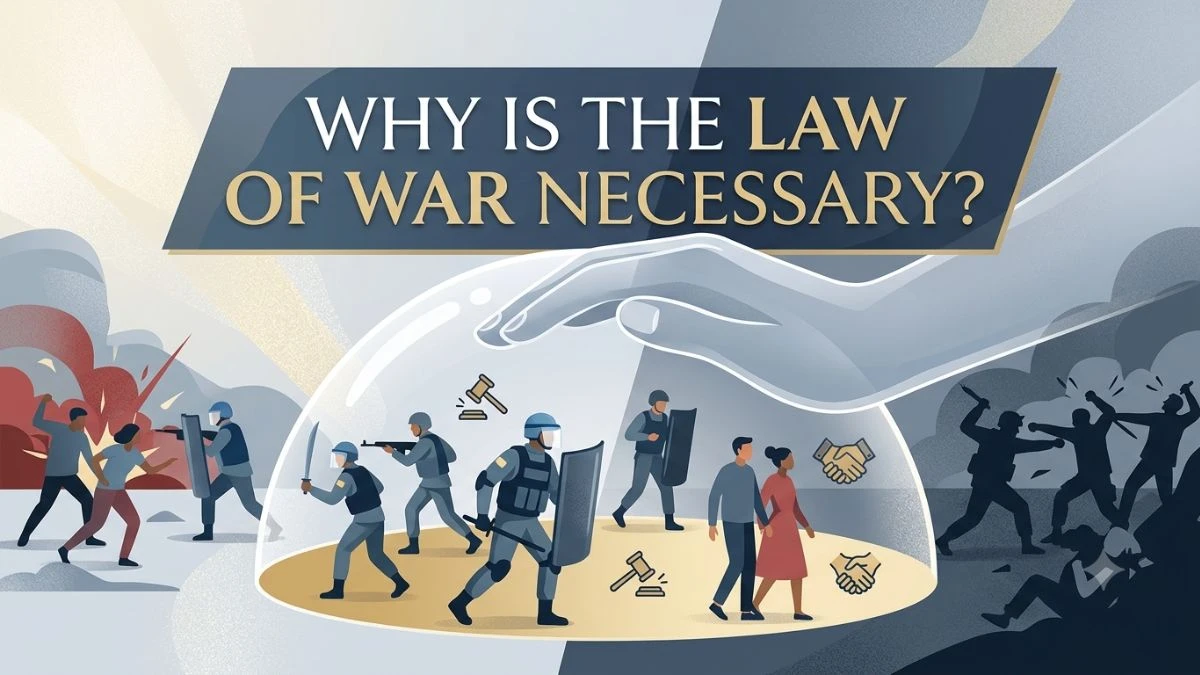
The law of war is necessary because armed conflict can cause enormous human suffering, destruction, and displacement. It establishes legal limits on how war is conducted, protects civilians and other people who are not taking part in fighting, regulates the treatment of wounded and captured persons, and restricts certain weapons and methods of warfare. Its purpose is not to make war acceptable, but to reduce unnecessary suffering and preserve basic human dignity during armed conflict.
The law of war is also known as international humanitarian law (IHL) or the law of armed conflict (LOAC). These terms generally refer to the body of international and domestic rules governing conduct during armed conflict.
What Is the Law of War?
The war law is a set of legal rules that applies when an armed conflict occurs. It regulates how military operations may be conducted and establishes protections for people who are not, or are no longer, participating in hostilities.
It covers matters such as:
- Protection of civilians
- Treatment of prisoners of war and detainees
- Care for wounded, sick, and shipwrecked persons
- Protection of medical personnel and certain humanitarian activities
- Selection of lawful military targets
- Restrictions on weapons and methods of warfare
- Precautions intended to reduce civilian harm
- Accountability for serious violations
The law of war does not make every act committed during a conflict lawful. Instead, it establishes minimum legal standards that parties to an armed conflict must follow.
Why Do We Need Laws During War?
War creates situations in which ordinary life, infrastructure, and civilian safety can be severely disrupted. Without legal restrictions, military operations could expose civilians, prisoners, wounded soldiers, and other protected persons to even greater risks.
The law of war therefore places limits on the conduct of hostilities. One of its central ideas is that military objectives must be distinguished from civilians and civilian objects. Customary international humanitarian law recognizes the principle that attacks must not be directed against civilians or civilian objects.
These rules are important because military necessity does not mean that anything is permitted during an armed conflict.
What Are the Main Reasons the Law of War Is Necessary?
1. It Protects Civilians
Civilians are among the people most vulnerable to the effects of armed conflict. International humanitarian law requires parties to distinguish between civilians and military objectives.
Civilian homes, schools, hospitals, places of worship, and other civilian objects are not automatically lawful military targets. An object can lose its civilian protection when it meets the applicable legal requirements for being a military objective, but attacks must still comply with other applicable rules.
This principle of distinction is one of the fundamental rules of IHL.
2. It Limits Harm Caused by Military Operations
The law of war does not simply ask whether a military objective exists. It also imposes restrictions concerning how an attack is planned and carried out.
The principles of proportionality and precautions are particularly important. Parties must take feasible precautions to protect civilians and civilian objects from the effects of attacks.
This means military decision-makers must consider foreseeable civilian harm when planning and conducting operations.
3. It Requires Humane Treatment of Captured and Detained Persons
People who are captured, detained, wounded, sick, or otherwise no longer taking part in hostilities are protected by important humanitarian rules.
Customary IHL recognizes the requirement that civilians and persons who are hors de combat be treated humanely.
Torture, cruel treatment, and humiliating or degrading treatment are prohibited under important rules of humanitarian law.
The protections can vary depending on the person’s status and the type of armed conflict, so the legal classification of a person matters.
4. It Protects the Wounded and Sick
A person does not lose all legal protection simply because they were previously participating in combat.
Wounded, sick, and shipwrecked persons must receive appropriate medical care to the fullest extent practicable and without adverse distinctions based on grounds other than medical need.
This principle reflects one of the central humanitarian purposes of the Geneva Conventions: protecting people who are especially vulnerable because of armed conflict.
5. It Restricts Certain Weapons and Methods
The law of war does not permit every weapon or tactic simply because it may provide a military advantage.
International humanitarian law contains restrictions on weapons and methods that cause unnecessary suffering or superfluous injury.
Separate treaties also regulate or prohibit particular weapons and methods. Therefore, determining whether a weapon is lawful may require examining the relevant treaty obligations, customary international law, and the circumstances in which the weapon is used.
6. It Reduces Unnecessary Suffering
The purpose of IHL is not to eliminate every consequence of war. Armed conflict can still result in death, injury, destruction, and displacement.
Instead, the law attempts to establish a legal balance between legitimate military operations and humanitarian protection.
Rules concerning distinction, proportionality, precautions, humane treatment, and unnecessary suffering work together to place limits on the conduct of hostilities.
7. It Creates Rules That Apply Even in Internal Conflicts
The law of war is not limited to traditional wars between two countries.
International humanitarian law also contains rules applicable to non-international armed conflicts, although the precise legal framework depends on the circumstances and classification of the conflict.
For example, Common Article 3 of the Geneva Conventions provides important minimum protections for persons taking no active part in hostilities, including members of armed forces who have laid down their arms or are otherwise hors de combat.
Therefore, the absence of a formal declaration of war does not by itself mean that humanitarian protections disappear.
What Is the Difference Between Military Necessity and Humanitarian Protection?
Military forces may have legitimate operational objectives, but military necessity does not provide unlimited permission to use force.
The law of war requires military operations to comply with applicable legal restrictions. For example, the existence of a military objective does not remove the requirements of distinction, proportionality, and precautions.
This is one reason the law of war is important: it recognizes that military operations may be necessary while still imposing humanitarian limits on how those operations are conducted.
Does the Law of War Apply Only to Declared Wars?
No.
The application of international humanitarian law generally depends on the existence and classification of an armed conflict, not simply on whether a government has formally declared war.
Different rules may apply to international armed conflicts and non-international armed conflicts. The legal classification of a particular situation can therefore be important when determining which treaty and customary rules apply.
This distinction is particularly important because modern armed conflicts do not always resemble traditional wars between states.
What Are the Geneva Conventions?
The Geneva Conventions of 1949 are among the most important treaties forming the foundation of modern international humanitarian law.
The four conventions address different categories of protection, including:
- Wounded and sick members of armed forces on land
- Wounded, sick, and shipwrecked members of armed forces at sea
- Prisoners of war
- Civilians during wartime
The conventions were developed to strengthen legal protection for victims of armed conflict. The U.S. Department of State describes the four 1949 Geneva Conventions as foundational rules for protecting victims of armed conflict.
Additional treaties and customary international law also contribute to the modern law of armed conflict.
How Does the Law of War Apply in the United States?
The United States implements and applies the law of war through a combination of international obligations, federal statutes, military regulations, and other applicable domestic and customary international law.
The U.S. government’s law-of-war framework includes obligations arising from treaties such as the 1949 Geneva Conventions as well as applicable customary international law.
U.S. military personnel are also subject to military law and regulations governing conduct during armed conflict.
The War Crimes Act, 18 U.S.C. § 2441, is an important federal statute concerning certain war crimes. The statute is part of U.S. federal law and provides criminal penalties for specified conduct covered by the Act. The U.S. Code identifies the War Crimes Act of 1996 as 18 U.S.C. § 2441 et seq.
The Uniform Code of Military Justice (UCMJ) is another important part of the U.S. military legal system. Depending on the circumstances, unlawful conduct by service members may also result in proceedings under military law or other applicable statutes.
What Happens When the Law of War Is Violated?
Serious violations of the law of war may constitute war crimes.
Depending on the offense, the person involved, the jurisdiction, and the circumstances, violations may be investigated or prosecuted under domestic law or through other applicable legal mechanisms.
Accountability serves several purposes. It can provide a basis for prosecuting serious wrongdoing, discourage future violations, and reinforce the principle that armed conflict does not place individuals completely outside the law.
However, not every harmful act occurring during a war automatically constitutes a war crime. The legal classification depends on the applicable rules and the specific facts.
What Principles Guide the Conduct of War?
Several principles are especially important in understanding why the law of war exists.
Distinction
Military forces must distinguish between civilians and military objectives. Attacks may be directed only against lawful military objectives.
Proportionality
Even when attacking a lawful military objective, the expected incidental civilian harm must be assessed under the applicable proportionality rule.
Precautions
Parties must take feasible precautions to protect civilians and civilian objects against the effects of attacks.
Humane Treatment
Civilians and persons who are no longer participating in hostilities must be treated humanely.
Prohibition of Unnecessary Suffering
The law restricts means and methods of warfare that are of a nature to cause superfluous injury or unnecessary suffering.
Together, these principles establish a legal framework for conducting military operations while limiting avoidable humanitarian harm.
Why Is the Law of War Important for Modern Conflicts?
Modern warfare can involve air operations, cyber capabilities, long-range weapons, autonomous technologies, urban combat, and non-state armed groups. These developments can create difficult legal questions.
The basic humanitarian principles remain important because technological change does not remove the obligation to comply with applicable law.
For example, when a new military technology is developed, the relevant legal questions can include whether its use can distinguish lawful targets from protected persons or objects, whether foreseeable harm is excessive in relation to the anticipated military advantage, and what precautions can reasonably be taken.
The law therefore provides a framework that can continue to guide military conduct even as the nature of warfare changes.
Why Is the Law of War Necessary? — Simple Answer
The law of war is necessary because war does not remove legal and humanitarian obligations. It establishes limits on military operations, protects civilians and other protected persons, regulates the treatment of wounded and captured individuals, restricts certain weapons and methods, and provides rules for accountability when serious violations occur.
Its central purpose is to reduce the suffering caused by armed conflict while recognizing that military operations may still take place.
Key Takeaways
- The law of war is also called international humanitarian law or the law of armed conflict.
- It regulates conduct during armed conflicts.
- It protects civilians and other persons who are not participating in hostilities.
- It requires humane treatment of protected persons and persons hors de combat.
- Wounded and sick persons are entitled to appropriate care.
- Military operations are subject to rules concerning distinction, proportionality, and precautions.
- Certain weapons and methods of warfare are restricted or prohibited.
- The Geneva Conventions of 1949 are a central part of the modern humanitarian framework.
- U.S. law also provides mechanisms for addressing certain war crimes.
- Serious violations may result in criminal prosecution or other forms of accountability.
- The rules can apply to both international and non-international armed conflicts, depending on the circumstances.
Legal Authorities Related to the Law of War
Geneva Conventions of 1949
The four Geneva Conventions establish important protections for wounded and sick members of armed forces, shipwrecked personnel, prisoners of war, and civilians.
Common Article 3
Common Article 3 provides fundamental humanitarian protections in non-international armed conflicts for persons who are not taking an active part in hostilities, including persons who are hors de combat.
War Crimes Act — 18 U.S.C. § 2441
The War Crimes Act is a U.S. federal statute addressing specified war crimes and providing criminal penalties under federal law.
Uniform Code of Military Justice
The UCMJ establishes the military justice system applicable to members of the U.S. armed forces and can provide a basis for addressing unlawful conduct by service members.
Frequently Asked Questions
Does the law of war prohibit all military force?
No. The law of war regulates the conduct of armed conflict rather than prohibiting every use of military force. Whether force is lawful can involve separate legal questions, including rules concerning the resort to force.
Is international humanitarian law the same as the law of war?
The terms are commonly used to describe substantially the same body of rules governing conduct during armed conflict. “International humanitarian law” emphasizes the humanitarian purpose of the rules, while “law of war” and “law of armed conflict” are also widely used.
Are hospitals always protected during armed conflict?
Hospitals and medical units receive special protection under applicable humanitarian law. However, the precise rules and exceptions depend on the circumstances and applicable legal provisions.
Can a soldier be held personally responsible for a war crime?
Yes. Individuals can potentially face criminal responsibility for conduct that qualifies as a war crime under applicable law. Responsibility depends on the offense, evidence, jurisdiction, and the person’s role and circumstances.
What does “hors de combat” mean?
The term generally refers to a person who is out of the fight, such as someone who has been captured or is incapacitated by wounds or sickness, subject to the applicable legal requirements.
Does international humanitarian law protect the environment?
Yes. The conduct-of-hostilities rules can apply to the natural environment. Customary IHL recognizes protections involving distinction, military necessity, proportionality, and environmental harm.
Can civilians ever lose protection from attack?
Civilian status and protection must be assessed under the applicable rules. For example, civilians lose protection from direct attack for such time as they take a direct part in hostilities, subject to the applicable legal framework.
Why are precautions important before an attack?
Precautions are intended to reduce civilian casualties and damage to civilian objects. The applicable rules require feasible measures to be taken in light of the circumstances at the time.
Are prisoners of war entitled to medical treatment?
Yes. The applicable Geneva Convention rules provide important protections concerning the treatment and care of prisoners of war, including medical needs.
What is the main goal of international humanitarian law?
Its central humanitarian goal is to limit the effects of armed conflict, protect people who are not participating in hostilities or are no longer doing so, and restrict unnecessary suffering while allowing lawful military operations to continue.
Sources & References
- International Committee of the Red Cross (ICRC) – Geneva Conventions: https://www.icrc.org/en/war-and-law/treaties-customary-law/geneva-conventions
Explore Question Categories

Founder & Publisher, Law Act
Prabh Kalsi is the founder and publisher of Law Act. He manages the website’s content research, organization, editing, and publishing. Law Act’s legal content is developed using publicly available legislation, government resources, official publications, and other authoritative sources. The website provides general legal information for educational and informational purposes and does not provide personalized legal advice.