

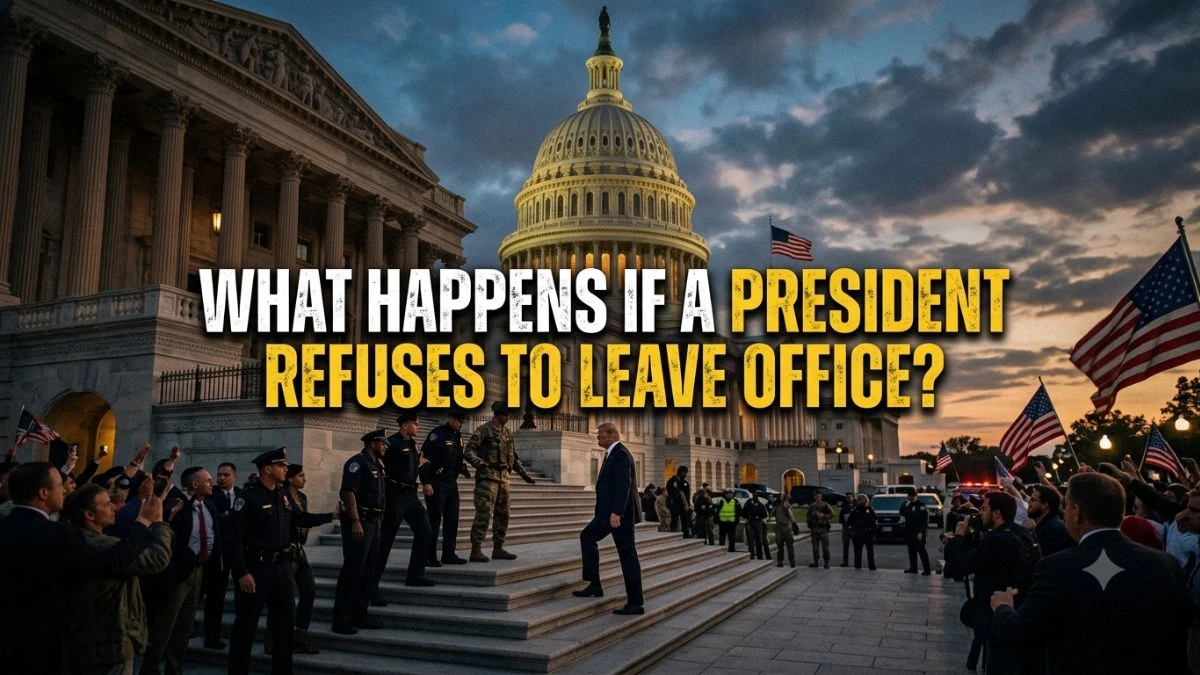
If a U.S. president refuses to leave office after the presidential term legally ends, the refusal does not extend the president’s term or preserve presidential powers. Under the Constitution, the presidential term ends at noon on January 20, and the successor’s term begins at that time. If the former president refuses to leave a government building or otherwise obstructs the transfer of power, the situation becomes a legal and law-enforcement matter rather than a continuation of presidential authority.
What Happens When a President’s Term Ends?
The U.S. Constitution does not allow a president to remain in office simply because the president refuses to recognize the end of the term.
The 20th Amendment establishes that the terms of the President and Vice President end at noon on January 20. Federal law also provides that the four-year presidential term begins on January 20 following the election.
At that point, the outgoing president’s authority as President ends and the incoming president’s constitutional term begins, assuming the successor is legally qualified to take office.
This means that an outgoing president cannot create an additional term by refusing to leave, delaying a ceremony, disputing the election personally, or remaining physically inside the White House.
Does a President Lose Power at Noon on January 20?
Yes.
The important point is that presidential authority comes from holding the constitutional office. It does not continue merely because the former president claims to still be President.
Once the presidential term ends, the former president no longer has the powers of the presidency. The new President becomes the person entitled to exercise those constitutional powers.
The transfer therefore does not depend on the outgoing president voluntarily agreeing that the term has ended.
What If the President Refuses to Recognize the Election Result?
A president can challenge an election through the legal processes available under federal and state law. However, personally refusing to accept the result does not create a new legal term of office.
The presidential election process includes the appointment of electors, the casting and certification of electoral votes, and the congressional counting process. Current federal law provides for Congress to meet on January 6 to count electoral votes, subject to the procedures established by law.
Election disputes therefore have to be handled through the legal and constitutional process. A president cannot simply declare that the election was invalid and thereby extend the presidential term.
What Happens to Presidential Powers After the Term Ends?
After the term expires, the former president cannot continue exercising the powers attached to the presidency.
For example, a former president would no longer have presidential authority to:
- Issue presidential orders in an official presidential capacity
- Direct federal executive agencies as President
- Exercise the constitutional powers of the presidency
- Serve as Commander in Chief by virtue of the former office
- Make official presidential appointments or decisions
- Direct federal officials as the sitting President
The critical distinction is between being a former President and holding the office of President.
A person can retain the title “former President,” but that title does not give the person the legal powers of the presidency.
Would the Military Still Follow the Former President?
No.
The military’s authority comes through the lawful constitutional chain of command, not from the personal wishes of someone whose presidential term has expired.
Once another person is legally President, military personnel and other federal officials are expected to follow lawful orders from the person who holds the office.
This is one reason the constitutional transfer of presidential power is designed around a specific date and time rather than depending on the outgoing president’s cooperation.
What If the Former President Refuses to Leave the White House?
This is a different issue from presidential authority.
A person can no longer be President while still physically refusing to leave a government property. The legal question then becomes how authorities should lawfully enforce the former president’s removal from the premises.
The former president would not regain presidential authority merely by remaining inside the White House.
Law-enforcement authorities would have to act under the applicable federal laws, regulations, orders, and lawful procedures governing the property and the person’s conduct.
It is therefore more accurate to say that a former president who refuses to leave could be subject to lawful removal than to claim that the Secret Service or military would automatically remove the person in a particular manner.
Would the Secret Service Protect a Former President?
Former presidents may continue to receive federal protection under federal law, but protective duties do not mean that the former president retains presidential authority.
This distinction is important.
The Secret Service’s role is not to preserve an expired presidency. Its protective responsibilities operate under federal law and applicable official duties.
Therefore, protection of a former president and recognition of the lawful sitting president are separate issues.
Could a Former President Order the Military to Keep Them in Office?
No.
A former president cannot create legal authority simply by issuing an order after the presidential term has expired.
An order claiming to come from the presidency would have to come from someone who legally holds the office and has the authority to issue that order.
The military does not receive unlimited authority from a former president merely because that person previously served as Commander in Chief.
What If the President Refuses to Attend the Inauguration?
The outgoing president does not have to personally participate in the inauguration ceremony for the constitutional transition to occur.
The ceremony is important symbolically, but the legal transfer of presidential authority is governed by the Constitution and federal law.
The key moment is the beginning and end of the constitutional terms, not whether the outgoing president personally attends the ceremony.
Therefore, an outgoing president’s absence from the inauguration would not by itself prevent the successor from assuming office.
What If the President Refuses to Leave Before the New President Arrives?
The physical transition and the constitutional transition are separate matters.
The presidential term ends according to the Constitution. If the outgoing president remains physically present after that time, that does not give the person additional presidential powers.
Authorities would have to address any physical occupation, security issue, obstruction, or other unlawful conduct under the applicable law.
In other words:
The presidency can transfer even if the former president refuses to cooperate physically.
What Happens If the President-Elect Cannot Take Office?
This is where presidential succession law becomes important.
The law provides rules for situations in which there is no President or Vice President able to discharge the powers and duties of the office.
For example, 3 U.S.C. § 19 establishes a succession framework involving the Speaker of the House and other officials when there is neither a President nor Vice President able to serve under the circumstances specified by law.
However, this provision should not be confused with a rule allowing an outgoing president to stay in office simply by refusing to leave.
The ordinary situation is much simpler: when the presidential term ends and a qualified successor assumes office, the outgoing president becomes a former president.
Does the 20th Amendment End the President’s Term Automatically?
Yes.
The 20th Amendment is central to this issue because it establishes the timing of the end of the presidential and vice-presidential terms.
The constitutional rule prevents uncertainty about whether an outgoing president remains in office merely because a successor has not physically taken control of the White House.
Federal law also states that the four-year presidential term commences on January 20 following the election.
What If There Is a Dispute About Who Won the Election?
A disputed election does not give the incumbent president unlimited authority.
Election disputes must be handled through the legal and constitutional mechanisms governing presidential elections.
Federal law establishes procedures for electoral votes and their counting by Congress. The Electoral Count Reform Act also established detailed rules governing the congressional counting process and the role of the Vice President and Congress in that process.
The important distinction is this:
Disputing an election result is a legal process; refusing to leave office after a term has legally ended is not a way to extend that term.
Can Congress or the Courts Stop an Outgoing President?
Congress and the courts have important roles in the constitutional system, but the exact legal response depends on the circumstances.
Courts can resolve appropriate legal disputes within their jurisdiction, while Congress has constitutional and statutory responsibilities concerning presidential elections and the counting of electoral votes.
The constitutional system does not give an outgoing president a unilateral power to decide that their own term has been extended.
What Would Happen to Federal Agencies?
Federal executive agencies do not become extensions of a former president after the person’s term ends.
Once the lawful transfer of presidential authority occurs, federal officials are expected to operate under the authority of the person who legally holds the presidency.
This is essential for continuity of government. Government operations cannot depend on whether an outgoing president personally accepts the result of the constitutional process.
Can a President Simply Declare Themselves President for Another Term?
No.
A president cannot legally create an additional presidential term by making a declaration, refusing to leave the White House, issuing orders, or claiming that an election was invalid.
The presidency is a constitutional office with defined terms and procedures for choosing the person who holds it.
Personal possession of the White House or control over a particular building would not itself determine who legally holds the presidency.
Simple Example
Imagine that President A’s term ends at noon on January 20 and President B is the person legally entitled to begin the next presidential term.
If President A says, “I refuse to leave and I am still President,” that statement does not extend President A’s term.
At noon:
- President A’s presidential term ends.
- President B’s term begins, assuming President B is qualified to take office.
- President A becomes a former president.
- Presidential powers belong to President B.
- Any refusal by President A to vacate government property becomes a separate legal and law-enforcement issue.
The important point is that physical occupation and constitutional authority are not the same thing.
What Is the Main Legal Rule?
The simplest way to understand the situation is:
A president’s authority comes from the constitutional office, not from physical possession of the White House or personal acceptance of an election result.
Once the presidential term legally ends, the former president cannot extend the term by refusing to leave.
The constitutional system establishes when the term ends, when the successor’s term begins, and what happens if there is a genuine vacancy or inability to assume the office.
Key Legal Provisions
20th Amendment to the U.S. Constitution
The 20th Amendment establishes the timing of the end of the presidential and vice-presidential terms and the beginning of the new terms.
Article II of the U.S. Constitution
Article II establishes the executive branch and the constitutional office of the President, including the President’s powers and responsibilities.
3 U.S.C. § 101
Federal law provides that the four-year presidential term begins on January 20 following the election.
3 U.S.C. § 15
This provision establishes the congressional process for counting electoral votes and contains rules governing that process.
3 U.S.C. § 19
This statute establishes a line of succession for circumstances in which there is neither a President nor Vice President able to discharge the powers and duties of the office. It is not a general rule allowing an outgoing president to remain in office by refusing to leave.
Frequently Asked Questions
Can a U.S. president refuse to accept that their term has ended?
A president may personally refuse to accept the result, but that personal refusal does not legally extend the presidential term. The term is controlled by the Constitution and federal law.
Does the president have to agree before the new president can take power?
No. The constitutional transfer of presidential authority does not depend on the outgoing president’s personal agreement.
Can refusing to leave the White House make someone president?
No. Physical possession of the White House does not determine who holds the constitutional office of President.
Can a former president still issue presidential executive orders?
No. A former president cannot issue executive orders using the authority of the presidency after the presidential term has ended.
What happens if both the President and Vice President cannot serve?
Federal succession law provides a framework for determining which eligible official may act as President when neither the President nor Vice President can discharge the powers and duties of the office.
Is the inauguration ceremony what legally makes someone President?
The oath of office is constitutionally significant, but the beginning and end of presidential terms are governed by the Constitution and federal law. The transfer of authority is not dependent solely on the outgoing president’s attendance at an inauguration ceremony.
Can a former president challenge the transfer of power?
Legal challenges can be brought through the appropriate judicial and constitutional processes. However, filing a challenge does not automatically give a former president authority to continue serving after the term has ended.
Can the military decide who should be President?
The military does not independently choose the President. Its authority operates within the constitutional government and lawful chain of command.
Conclusion
If a U.S. president refuses to leave office after the presidential term has ended, the refusal does not legally extend the person’s presidency.
The 20th Amendment establishes when the presidential term ends, and federal law establishes when the next four-year term begins. Once the outgoing president’s term has expired, presidential authority belongs to the person legally entitled to hold the office.
If the former president refuses to cooperate physically, that creates a separate legal and law-enforcement problem. It does not restore presidential powers or create an additional term.
The U.S. constitutional system is specifically structured so that presidential power is tied to the lawful office and its defined term—not to an individual’s willingness to surrender power.
Sources & References
- U.S. Constitution (20th Amendment): https://www.archives.gov/founding-docs/amendments-11-27
- Presidential Transition Act: https://www.gsa.gov/presidential-transition-directory
Explore Question Categories

Founder & Publisher, Law Act
Prabh Kalsi is the founder and publisher of Law Act. He manages the website’s content research, organization, editing, and publishing. Law Act’s legal content is developed using publicly available legislation, government resources, official publications, and other authoritative sources. The website provides general legal information for educational and informational purposes and does not provide personalized legal advice.