

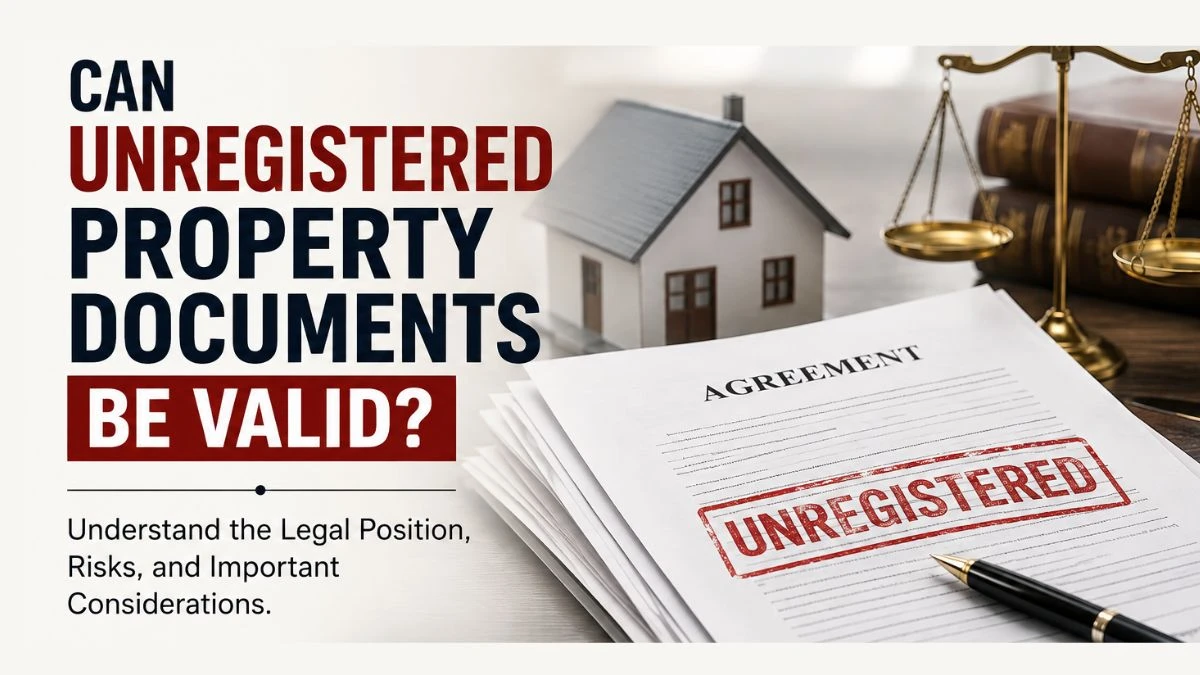
Yes, an unregistered property document can have legal value in India, but it may not transfer ownership or create the intended property rights when the law requires registration.
The legal effect of an unregistered property document depends on the type of document, the transaction involved, the applicable law, stamp duty requirements, and the purpose for which the document is being relied upon.
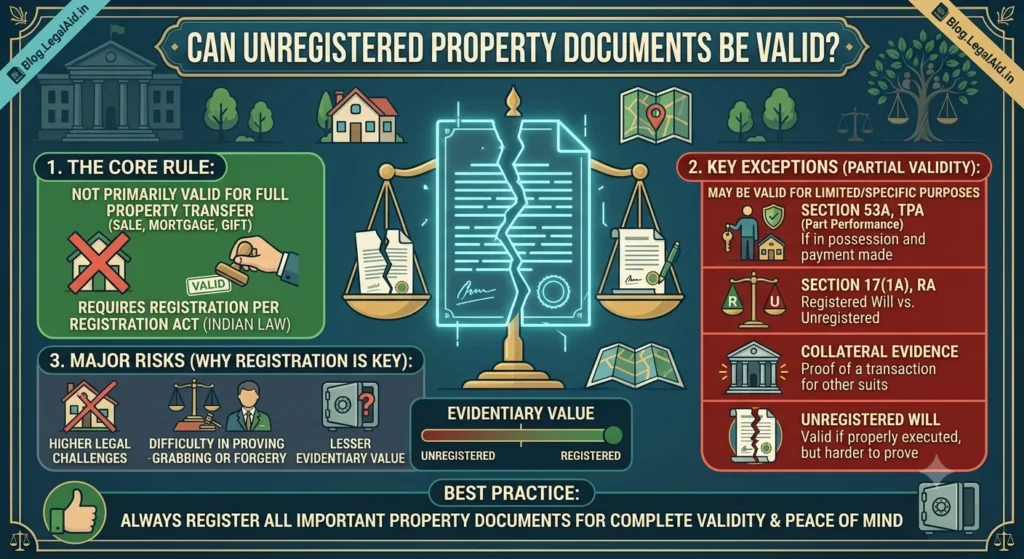
For example, an unregistered sale deed that is required to be registered generally cannot transfer ownership of immovable property. However, an unregistered document may sometimes be considered by a court for a limited or collateral purpose, subject to the requirements of law.
The main provisions dealing with this issue are found in the Registration Act, 1908, particularly Sections 17 and 49, along with relevant provisions of the Transfer of Property Act, 1882. Section 17 identifies documents for which registration is compulsory, while Section 49 explains the consequences of non-registration.
Is an Unregistered Property Document Valid?
There is no single answer for every property document.
An unregistered document may have legal value in some circumstances, but if the law requires that particular document to be registered, non-registration can prevent it from:
- Transferring ownership of immovable property;
- Creating or declaring certain rights in the property;
- Being used as evidence of the transaction for the purpose prohibited by Section 49;
- Having the full legal effect intended by the parties.
At the same time, Section 49 contains an important exception. In appropriate circumstances, an unregistered document may be used for purposes permitted by the proviso to that section, such as evidence of a contract in a suit for specific performance or evidence of a qualifying collateral transaction.
Therefore, “unregistered” does not always mean “completely useless.”
Can an Unregistered Sale Deed Transfer Ownership?
Generally, no.
A sale of immovable property must comply with the applicable requirements of the Transfer of Property Act and the Registration Act.
An unregistered sale deed that is required to be registered generally cannot transfer legal ownership of the property.
The Supreme Court has explained that a sale of immovable property is completed through the legally required conveyance and that an agreement to sell by itself does not create ownership in favour of the buyer.
Example
Suppose A agrees to sell a house to B for ₹50 lakh.
A and B sign a document and B pays the agreed amount, but the document that is legally required to transfer the property is not registered.
B may have evidence of the transaction and may have certain contractual remedies depending on the circumstances, but B does not automatically become the legal owner merely because the document was signed or payment was made.
Can an Unregistered Agreement to Sell Be Valid?
An agreement to sell can have legal significance even though it does not itself transfer ownership.
An agreement to sell generally creates a contractual obligation to complete the sale. It does not by itself make the buyer the owner of the property.
The Supreme Court has reiterated that an agreement for sale does not itself create an interest or title in immovable property.
However, the registration and stamp-duty treatment of particular agreements can depend on the circumstances and applicable state amendments.
Therefore, people should not assume that signing an agreement on stamp paper automatically gives them ownership of a property.
Can an Unregistered Property Document Be Used in Court?
Sometimes, yes.
Section 49 of the Registration Act generally restricts an unregistered document that was required to be registered from being used to affect the immovable property or prove the transaction for the prohibited purpose.
However, the proviso to Section 49 permits certain limited uses.
For example, an unregistered document may, where the legal requirements are satisfied, be used:
- As evidence of a contract in a suit for specific performance; or
- For a collateral transaction that does not itself require a registered instrument.
The Supreme Court has explained that a collateral purpose must be genuinely separate from the transaction for which registration was required. An unregistered document cannot simply be used indirectly to prove the very transaction that the law requires to be registered.
What Does Section 17 of the Registration Act Say?
Section 17 of the Registration Act, 1908 deals with documents for which registration is compulsory.
Among other things, Section 17 covers instruments of gift of immovable property and certain non-testamentary instruments that create, declare, assign, limit or extinguish rights, title or interests in immovable property.
This is why registration is extremely important for many transactions involving ownership or other rights in immovable property.
However, Section 17 also contains exceptions and state amendments. Therefore, the exact registration requirement should always be checked for the particular document and transaction.
What Does Section 49 of the Registration Act Say?
Section 49 explains the legal effect of non-registration.
Where a document is required to be registered under Section 17 or the applicable provisions of the Transfer of Property Act but remains unregistered, it generally cannot:
- Affect the immovable property covered by the document;
- Confer certain rights or powers covered by the section; or
- Be received as evidence of the transaction affecting the property for the prohibited purpose.
However, the proviso to Section 49 permits certain limited uses, including specific-performance proceedings and qualifying collateral transactions.
This distinction is extremely important when dealing with an old or unregistered property document.
Registered vs Unregistered Property Documents
| Basis | Registered Document | Unregistered Document |
|---|---|---|
| Registration | Registered with the appropriate authority | Not registered |
| Ownership transfer | Can transfer ownership where the law requires registration and other requirements are satisfied | Generally cannot transfer ownership where registration is mandatory |
| Legal effect | Usually gives the transaction its legally required effect | May have restricted legal effect |
| Use in court | Generally capable of being relied upon subject to other rules of evidence | May be restricted by Section 49 |
| Collateral use | Not usually an issue | May be possible where legally permitted |
| Risk of dispute | Generally lower regarding registration status | Greater risk of disputes over legal effect |
| Stamp duty | Applicable as required by law | Non-payment or insufficient payment can create additional issues |
What Property Documents Usually Require Registration?
The answer depends on the nature of the transaction and applicable law.
Common examples include:
Sale Deed
A sale deed used to transfer ownership of immovable property generally requires registration.
Gift Deed
An instrument of gift of immovable property is among the documents for which Section 17 requires registration.
Lease Deed
Certain leases require registration, depending on the term and applicable law.
Mortgage Documents
Certain mortgage transactions require registration depending on the type and circumstances of the mortgage.
Agreement to Sell
An agreement to sell does not itself transfer ownership. Its registration requirements can depend on the transaction, state amendments and other applicable laws.
Can a Notarised Property Document Transfer Ownership?
No, notarisation and registration are different legal processes.
A notary’s authentication of signatures or execution does not replace registration where the law requires registration.
Therefore, a document should not be treated as equivalent to a registered conveyance merely because it has been notarised.
For example, a notarised agreement or power of attorney does not by itself transfer ownership of a house or land.
The Supreme Court’s decision in Suraj Lamp & Industries Pvt. Ltd. v. State of Haryana is important in this context. The Court held that transactions structured merely through agreements to sell, powers of attorney and Wills do not by themselves convey title in immovable property in the manner of a registered conveyance.
Can a Power of Attorney Transfer Property Ownership?
A Power of Attorney by itself does not operate as a sale deed transferring ownership.
A power of attorney generally authorises another person to act on behalf of the person granting the authority.
It should not be confused with a registered conveyance transferring title.
The Supreme Court’s decision in Suraj Lamp is frequently cited for the principle that a GPA transaction cannot be treated as a substitute for a legally required conveyance.
Is an Unregistered Will Valid?
Yes, a Will is different from a sale deed or other conveyance document.
Registration of a Will is generally optional under the Registration Act, 1908.
Therefore, an unregistered Will can be valid if it has been properly executed and satisfies the applicable requirements of succession law.
This is an important distinction: not every document concerning property requires registration in order to be legally valid.
What Happens If a Required Property Document Is Not Registered?
If a document that is legally required to be registered is left unregistered, it may fail to produce the intended legal effect.
Depending on the circumstances, the affected party may have remedies such as:
- Seeking specific performance of a valid contract;
- Seeking recovery of money;
- Seeking an appropriate declaration;
- Relying on the document for a legally permitted collateral purpose;
- Taking other legal action available under the applicable law.
The appropriate remedy depends on the document, transaction, possession, payment, limitation and other facts.
Can Old Unregistered Property Documents Create Legal Rights?
It depends on the document and circumstances.
An old property paper should not automatically be treated as proof of ownership.
A court may need to examine:
- What type of document it is;
- When it was executed;
- Whether registration was compulsory at that time;
- Whether stamp duty requirements were satisfied;
- Whether possession was transferred;
- Whether consideration was paid;
- Whether other registered documents exist;
- Whether the document can be used for a limited purpose under Section 49;
- Whether limitation or other legal issues apply.
Therefore, old property documents should be examined individually rather than assuming that they are either completely valid or completely invalid.
Important Supreme Court Judgments
Suraj Lamp & Industries Pvt. Ltd. v. State of Haryana
The Supreme Court addressed transactions involving agreements to sell, powers of attorney and Wills and made clear that such arrangements cannot be treated as a substitute for the legally required conveyance of title.
K.B. Saha & Sons Pvt. Ltd. v. Development Consultant Ltd.
The Supreme Court explained the effect of Section 49 and recognized that an unregistered document may, in appropriate circumstances, be used for a collateral purpose permitted by law.
The Court emphasized that a collateral transaction must be independent from the transaction for which registration was required.
Frequently Asked Questions
Can an unregistered sale deed be valid in India?
An unregistered sale deed that is required to be registered generally cannot transfer ownership of immovable property. However, the document may have limited legal significance in circumstances permitted by law.
Can an unregistered agreement to sell transfer ownership?
No. An agreement to sell does not itself transfer ownership. A legally effective conveyance is required to transfer title where the law requires one.
Can an unregistered property document be used in court?
Yes, in some circumstances. Section 49 restricts the use of certain unregistered documents but permits limited uses, including qualifying collateral purposes and specific-performance proceedings.
Does notarisation make an unregistered property document valid?
No. Notarisation does not replace registration where registration is legally compulsory.
Can a notarised agreement make someone the owner of a property?
No. A notarised agreement does not by itself transfer ownership of immovable property.
Is an unregistered Will valid?
Yes, an unregistered Will can be valid because registration of a Will is generally optional, provided the Will satisfies the applicable legal requirements.
Can an unregistered document prove possession?
It may sometimes be relevant to possession or other collateral matters, depending on the facts and the purpose for which the document is being relied upon. The court must consider the applicable evidence and registration rules.
Can old unregistered property papers be used in court?
They may have limited evidentiary value depending on the type of document, date, purpose and applicable law. A court may examine the document together with other evidence.
What is the difference between notarisation and registration?
Notarisation and registration are different processes. Notarisation does not substitute for compulsory registration of a property document.
Key Takeaways
- An unregistered property document is not automatically completely invalid.
- A document requiring compulsory registration generally cannot transfer ownership without registration.
- An unregistered sale deed generally does not transfer title.
- An agreement to sell does not itself transfer ownership.
- Section 49 restricts the use of certain unregistered documents but allows specific limited uses.
- Notarisation does not replace registration.
- A Power of Attorney is not a substitute for a conveyance of ownership.
- A Will is treated differently because its registration is generally optional.
- State amendments and the exact nature of the transaction can affect registration requirements.
- Old property documents should be examined based on their individual facts.
Conclusion
Can unregistered property documents be valid? Yes, but their legal effect is limited when the law requires registration.
An unregistered document that was required to be registered generally cannot transfer ownership of immovable property or have the full legal effect intended by the parties.
At the same time, Section 49 of the Registration Act recognizes limited circumstances in which an unregistered document may still be considered, including certain specific-performance proceedings and collateral transactions.
Therefore, an unregistered property document should not simply be described as either “valid” or “invalid.” Its legal effect depends on what the document is, what transaction it records, whether registration was compulsory, and the purpose for which it is being relied upon.
If a property dispute involves an old sale deed, agreement to sell, power of attorney, gift deed, lease, or other unregistered document, the document should be reviewed in light of the applicable registration, stamp-duty, property and limitation laws.
Sources & References
- Transfer of Property Act, 1882 – India Code: https://www.indiacode.nic.in/
Explore Question Categories

Founder & Publisher, Law Act
Prabh Kalsi is the founder and publisher of Law Act. He manages the website’s content research, organization, editing, and publishing. Law Act’s legal content is developed using publicly available legislation, government resources, official publications, and other authoritative sources. The website provides general legal information for educational and informational purposes and does not provide personalized legal advice.