


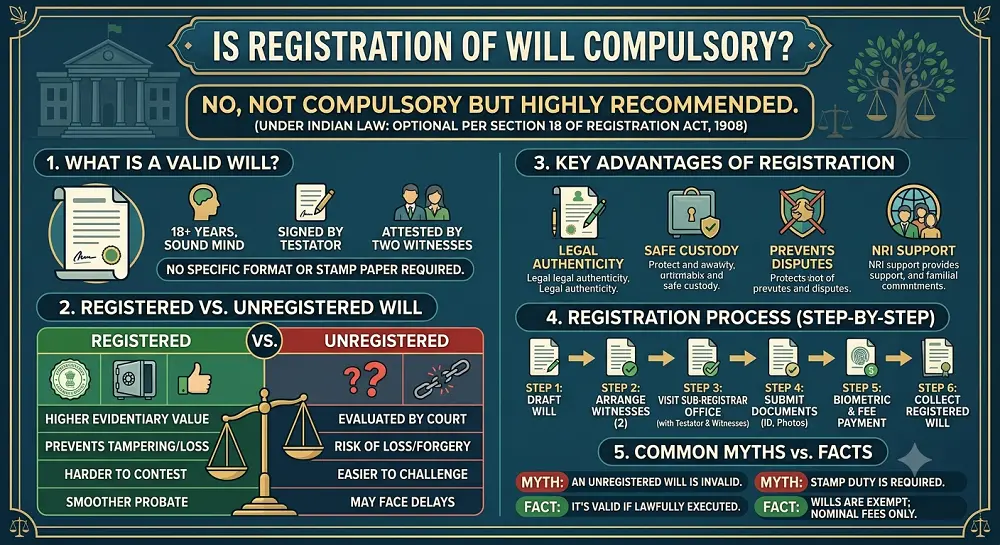
No, registration of a Will is not compulsory in India. A Will can be valid even if it is not registered, provided it is properly made, signed and attested according to the applicable law.
Under Section 18 of the Registration Act, 1908, registration of a Will is optional. Therefore, a person can make a Will without registering it with a Sub-Registrar. The law also contains specific provisions dealing with the presentation and registration of Wills.
However, registration may be useful in some circumstances because it creates an official registration record. It is important to remember that registration does not automatically make a Will valid or prevent it from being challenged in court.
Is Registration of Will Mandatory in India?
No. Registration of Will is not mandatory in India.
A person may execute a Will without registering it. For a Will governed by Section 63 of the Indian Succession Act, 1925, the requirements relating to execution and attestation must still be satisfied.
Generally, the testator should:
- Be capable of understanding the nature and effect of the Will.
- Make the Will voluntarily.
- Sign or affix their mark to the Will.
- Have the Will attested by at least two witnesses.
- Ensure that the witnesses attest the Will as required by law.
Therefore, registration and validity are two different issues.
A Will does not become valid merely because it is registered, and an unregistered Will does not become invalid merely because it is not registered.
Is an Unregistered Will Valid in India?
Yes, an unregistered Will can be legally valid in India.
Registration is not a mandatory condition for every Will. What is more important is whether the Will was properly executed and attested and whether the testator had the required testamentary capacity.
If the Will is later disputed, the person relying on the Will may have to prove that it was genuinely executed by the testator.
The Supreme Court has repeatedly emphasized that the person propounding a Will must establish its due execution and the testator’s sound and disposing state of mind. Where suspicious circumstances exist, those circumstances may also have to be satisfactorily explained.
Registered Will vs Unregistered Will
| Basis | Registered Will | Unregistered Will |
|---|---|---|
| Is registration mandatory? | No | No |
| Can it be legally valid? | Yes, if properly executed | Yes, if properly executed |
| Registration record | Available | No registration record |
| Witnesses | Generally required for execution | Generally required for execution |
| Can it be challenged? | Yes | Yes |
| Does registration guarantee validity? | No | Not applicable |
| Procedure | Requires registration before the appropriate registering authority | No registration procedure |
The important point is that a registered Will is not automatically stronger than an unregistered Will in every legal situation. If a Will is challenged, the court can examine its execution, testamentary capacity and surrounding circumstances.
What Are the Requirements for a Valid Will?
Registration is only one aspect of a Will. The Will must also satisfy the applicable legal requirements.
For a Will covered by Section 63 of the Indian Succession Act, 1925, the testator must execute the Will in the manner required by law and it must be attested by at least two witnesses.
The person making the Will should also have the mental capacity to understand what they are doing and should make the Will voluntarily.
1. The testator should have testamentary capacity
The person making the Will should understand the nature and effect of the Will and the property being dealt with.
2. The Will should be made voluntarily
A Will made because of coercion, fraud or undue influence may face serious legal challenges.
3. The Will should be signed or executed properly
The testator must execute the Will in accordance with the applicable legal requirements.
4. At least two witnesses should attest the Will
For a Will governed by Section 63 of the Indian Succession Act, 1925, attestation by two or more witnesses is required.
5. The contents should clearly express the testator’s wishes
The Will should clearly identify the beneficiaries and explain how the assets are intended to be distributed.
Does a Will Have to Be Registered With a Sub-Registrar?
No, a Will does not have to be registered with a Sub-Registrar to be valid.
However, a testator may choose to present the Will for registration.
The Registration Act, 1908 contains specific provisions concerning Wills. Section 18 includes Wills among documents for which registration is optional, while Sections 40 and 41 deal specifically with the presentation and registration of Wills.
The Act also provides that Wills may be presented or deposited according to the procedure provided under the Act.
Does Registration Make a Will More Valid?
No. Registration does not by itself make an otherwise invalid Will valid.
For example, if there are serious defects in execution or evidence shows that the testator did not have the required mental capacity, registration alone will not cure those defects.
The Supreme Court has held that the court must be satisfied about the genuine execution of a Will and must consider suspicious circumstances where they arise.
Therefore, it is better to think of registration as an additional formal record, rather than a guarantee that the Will cannot be challenged.
Can an Unregistered Will Be Challenged?
Yes. An unregistered Will can be challenged in court.
However, the same is true of a registered Will.
A Will may be questioned on grounds such as:
- Lack of testamentary capacity
- Undue influence
- Coercion
- Fraud
- Suspicious circumstances
- Improper execution
- Failure to satisfy the applicable attestation requirements
The Supreme Court has recognized that suspicious circumstances surrounding a Will can require closer examination by the court.
Therefore, registration does not make a Will immune from legal challenge.
Is a Will on Plain Paper Valid in India?
Yes, a Will can generally be made on plain paper.
There is no general requirement that an ordinary Will must be prepared on stamp paper merely to make it valid.
What matters is compliance with the applicable legal requirements relating to execution and attestation.
However, because succession laws can vary depending on the circumstances and the personal law applicable to the testator, professional legal advice may be appropriate for complicated estates.
Should You Register Your Will?
Although registration is not compulsory, some people may choose to register their Will, particularly where:
- The estate contains valuable property.
- There are several beneficiaries.
- Family disputes are possible.
- The Will distributes assets differently from what family members may expect.
- The testator wants an official registration record.
- The estate includes multiple properties or other substantial assets.
For example, if a person leaves most of their property to one child while giving little or nothing to another child, the Will may face greater scrutiny after the person’s death. Careful execution, proper attestation and clear documentation can therefore become particularly important.
What Is the Difference Between a Will and a Registered Will?
A Will is a testamentary document stating how a person’s assets should be dealt with after death.
A registered Will is a Will that has additionally been presented for registration under the Registration Act.
The fundamental difference is therefore the registration status. Registration does not replace the legal requirements for making a valid Will.
What Does the Registration Act, 1908 Say About Wills?
The Registration Act, 1908 contains provisions dealing specifically with Wills.
Section 18 – Registration is Optional
Section 18 lists Wills among the documents that may be registered. This is the key provision supporting the position that registration of a Will is optional.
Section 40 – Who Can Present a Will?
Section 40 provides that the testator, or after the testator’s death a person claiming as executor or otherwise under the Will, may present it to a Registrar or Sub-Registrar for registration.
Section 41 – Registration of Wills
The Act also contains a specific provision dealing with the registration of Wills and authorities to adopt.
What Does the Supreme Court Say About Wills?
The Supreme Court of India has repeatedly explained that proving a Will involves more than simply producing a document.
In H. Venkatachala Iyengar v. B.N. Thimmajamma, the Supreme Court explained important principles concerning proof of a Will, including the need to establish due execution and the testamentary capacity of the testator. Suspicious circumstances may require satisfactory explanation.
In Jaswant Kaur v. Amrit Kaur, the Supreme Court considered the burden of proving a Will and the effect of suspicious circumstances surrounding its execution.
The Supreme Court has continued to apply these principles in later decisions concerning proof and suspicious circumstances surrounding Wills.
Is Probate Required for Every Will?
No, probate is not automatically required for every Will in India.
Whether probate is required depends on the circumstances, including the applicable law, location and nature of the property and other relevant factors.
The requirement of probate should therefore not be confused with registration of a Will.
Registration concerns recording the Will with the registering authority.
Probate is a court process concerning the establishment of the Will and the authority of the executor in circumstances where probate is required.
If substantial property or a family dispute is involved, it is advisable to obtain legal advice on whether probate or another court process is necessary.
Frequently Asked Questions
Is registration of Will compulsory in India?
No. Registration of a Will is not compulsory. A Will can be valid without registration if it satisfies the applicable legal requirements.
Is an unregistered Will valid?
Yes. An unregistered Will can be valid if it has been properly executed and attested and the testator had the required testamentary capacity.
Is a registered Will better than an unregistered Will?
Registration can provide an official registration record, but it does not guarantee that the Will is valid or prevent it from being challenged.
Can an unregistered Will be challenged?
Yes. An unregistered Will can be challenged on grounds such as improper execution, lack of testamentary capacity, undue influence, fraud or suspicious circumstances.
Does a Will need stamp paper?
An ordinary Will does not generally have to be written on stamp paper merely to be valid. The applicable requirements concerning execution and attestation must still be followed.
How many witnesses are required for a Will?
For a Will governed by Section 63 of the Indian Succession Act, 1925, the Will must be attested by at least two witnesses.
Can a registered Will be cancelled?
A testator can generally revoke or alter their Will during their lifetime while legally capable of doing so. A later valid Will may also affect the operation of an earlier Will.
Does registration prevent disputes over a Will?
No. Registration may provide an official record, but it does not prevent beneficiaries or other interested persons from challenging the Will in appropriate circumstances.
Key Takeaways
- Registration of Will is not compulsory in India.
- An unregistered Will can be legally valid.
- Registration of a Will is optional under the Registration Act, 1908.
- A Will must still satisfy the applicable requirements for execution and attestation.
- Registration does not automatically prove that a Will is genuine.
- A registered Will can still be challenged.
- An unregistered Will can also be challenged.
- The Supreme Court considers execution, testamentary capacity and suspicious circumstances when a Will is disputed.
- For complicated estates or likely family disputes, professional legal advice can be useful.
Conclusion
Registration of Will is not compulsory in India. A person can make a valid Will without registering it, provided the Will satisfies the applicable legal requirements for execution and attestation.
Section 18 of the Registration Act, 1908 specifically includes Wills among documents for which registration is optional. The Act also contains separate provisions dealing with the presentation and registration of Wills.
However, registration should not be treated as a guarantee that a Will cannot be challenged. Courts can still examine whether the Will was properly executed, whether the testator had the required capacity and whether suspicious circumstances exist.
Therefore, whether to register a Will is ultimately a matter of individual circumstances. Where valuable assets, multiple properties, complicated inheritance arrangements or potential family disputes are involved, obtaining advice from a qualified legal professional may be appropriate.
Sources & References
- The Registration Act, 1908 – India Code: https://www.indiacode.nic.in/
Explore Question Categories

Founder & Publisher, Law Act
Prabh Kalsi is the founder and publisher of Law Act. He manages the website’s content research, organization, editing, and publishing. Law Act’s legal content is developed using publicly available legislation, government resources, official publications, and other authoritative sources. The website provides general legal information for educational and informational purposes and does not provide personalized legal advice.