

The registration fee for property in India is a government charge paid to officially register a property document with the appropriate registration authority. It is separate from stamp duty and usually depends on the state, property value, type of document and applicable registration rules.
There is no single registration fee applicable throughout India. Each state and Union Territory has its own fee structure, rates, limits and concessions.
For example, a property buyer may have to pay both stamp duty and registration charges when registering a sale deed. The exact amount should be checked under the rules applicable to the state where the property is located.
Quick Answer
Registration fee is the amount paid to the government for recording a property transaction in the official registration records.
It may apply when registering documents such as:
- Sale deeds
- Gift deeds
- Certain lease deeds
- Mortgage documents
- Partition deeds
- Settlement deeds
- Other documents affecting rights in immovable property
The Registration Act, 1908 provides the central legal framework for registration of documents, while applicable state laws and rules determine many of the charges and procedures. Section 17 of the Act specifies documents for which registration is compulsory.
How Much Is the Registration Fee for Property in India?
The registration fee is not the same in every state.
The amount can depend on:
- Property value
- Type of property
- Type of document
- State or Union Territory
- Whether a maximum fee limit applies
- Whether the buyer or transaction qualifies for a concession
- Other charges prescribed by the applicable authority
Therefore, it is better not to assume that a particular percentage applies to every property transaction in India.
Example of Registration Fee Calculation
Suppose the applicable registration fee is 1% and the value used for calculation is ₹50 lakh.
Registration fee = ₹50,00,000 × 1% = ₹50,000
This is only an example. The actual fee may be different because the applicable state rules determine the rate and calculation method.
Is Registration Fee the Same as Stamp Duty?
No. Registration fee and stamp duty are two different charges.
Stamp duty is a duty imposed on specified instruments under applicable stamp laws. Registration fee is charged for registration of documents with the registration authority.
| Basis | Stamp Duty | Registration Fee |
|---|---|---|
| Meaning | Government duty on a chargeable instrument | Fee for registering the document |
| Main purpose | Levy on the instrument/transaction as prescribed by law | Official registration of the document |
| Rate | Depends on applicable stamp law | Depends on applicable registration rules |
| Authority | Generally state/UT authority for relevant matters | Registration authority under applicable rules |
| Same throughout India? | No | No |
| Example | Stamp duty on a sale deed | Fee for registering the sale deed |
Because rates and valuation rules differ between jurisdictions, buyers should check the official rules applicable to the property’s location.
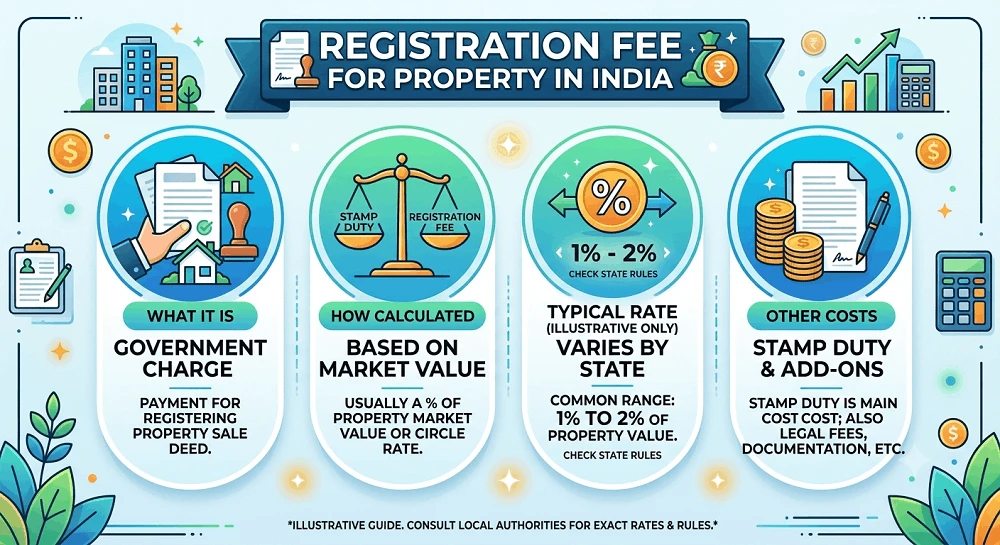
How Is Property Registration Fee Calculated?
The calculation depends on the applicable state or Union Territory rules.
In many transactions, the relevant value may be connected with the consideration stated in the document, market value, circle rate, guideline value or another prescribed valuation method.
The applicable authority may also have minimum values, maximum fee limits or special rules for particular documents.
For this reason, the following formula should be treated only as a basic example:
Registration Fee = Applicable Registration Rate × Applicable Property/Transaction Value
Example
If the applicable rate is 1% and the applicable value is ₹80 lakh:
₹80,00,000 × 1% = ₹80,000
The actual amount payable must be calculated using the rules applicable in the relevant state.
What Is Circle Rate or Guideline Value?
A circle rate, guideline value, ready reckoner rate or similar term may refer to a government-prescribed value used for property valuation, depending on the state.
These terms are not necessarily identical in every state.
The government-prescribed value can be important when calculating stamp duty and, depending on the applicable law, other property-related charges.
Therefore, a buyer should not calculate registration expenses only from the negotiated sale price without checking the applicable valuation rules.
Who Pays the Registration Fee: Buyer or Seller?
In a typical property sale, the buyer commonly pays the registration fee and other registration-related expenses.
However, the parties may agree between themselves to share certain expenses differently.
The actual legal liability and payment procedure can depend on the applicable state law, document and transaction.
Therefore, the sale agreement should clearly state how government charges and other transaction expenses will be handled.
When Is Property Registration Required?
The Registration Act, 1908 makes registration compulsory for specified documents.
Section 17 includes, among other documents, instruments of gift of immovable property and certain non-testamentary instruments that create, declare, assign, limit or extinguish rights in immovable property.
Whether a particular document must be registered depends on the document, transaction and applicable law.
How Long Do You Have to Register a Property Document?
Section 23 of the Registration Act, 1908 generally provides that a document other than a will must be presented for registration within four months from the date of execution, subject to the exceptions and provisions contained in the Act.
This means buyers and sellers should not unnecessarily delay registration after executing a document.
Special situations can have different rules, so the applicable provisions should be checked before relying on the four-month period.
Where Is Property Registration Done?
Property documents are generally presented before the appropriate Sub-Registrar or registration office having jurisdiction under the applicable registration law.
The exact process can vary between states.
Many states now provide online facilities for appointments, fee calculation, document preparation or other parts of the registration process, although the final procedure differs by jurisdiction.
Documents Commonly Required for Property Registration
The exact requirements differ by state and transaction, but documents may include:
| Document | Purpose |
| Sale deed or other relevant document | Records the transaction |
| Identity proof | Identifies the parties |
| Address proof | Provides address details |
| PAN card | Required in applicable transactions |
| Passport-size photographs | Identification |
| Previous title documents | Helps establish property history |
| Stamp duty payment proof | Evidence of applicable payment |
| Registration fee payment proof | Evidence of registration charges |
| Property-related documents | Verifies property details |
Additional documents may be required for companies, firms, trusts, powers of attorney, inherited property or special transactions.
Property Registration Process in India
The general process may involve the following steps:
1. Prepare the Property Document
The appropriate sale deed, gift deed, lease deed or other document is prepared according to the transaction.
2. Calculate Stamp Duty and Registration Charges
The applicable government charges are calculated according to the relevant state rules.
3. Pay the Applicable Charges
Stamp duty and registration charges are paid using the method permitted by the relevant authority.
4. Book an Appointment if Required
Some registration departments require an online appointment before visiting the registration office.
5. Visit the Registration Office
The parties and required witnesses appear before the appropriate registration authority, where required.
6. Verification and Registration
The registering officer verifies the document and parties in accordance with the applicable procedure.
7. Obtain the Registered Document
After registration is completed, the registered document is issued or made available according to the state’s procedure.
What Happens If a Property Document Is Not Registered?
If a document is one for which registration is compulsory and it is not registered, it may not have the legal effect that registration would provide.
Section 17 of the Registration Act identifies documents that must be registered.
An unregistered document can therefore create serious legal and evidentiary problems, depending on the transaction and applicable law.
For example, where a registered sale deed is legally required to transfer ownership, simply signing an agreement or other informal document does not automatically produce the same legal result.
Is a Sale Agreement the Same as a Registered Sale Deed?
No.
A sale agreement and a sale deed serve different purposes.
A sale agreement generally records the terms under which the parties intend to complete a sale.
A sale deed is the document used to legally convey ownership when the transaction is completed, subject to applicable law.
The Supreme Court’s decision in Suraj Lamp & Industries Pvt. Ltd. v. State of Haryana is frequently cited in relation to property transactions involving agreements to sell, powers of attorney and wills. The decision emphasized that such documents, by themselves, do not substitute for a legally valid conveyance where a registered conveyance is required.
Can Registration Charges Be Different for Men and Women?
Yes, in some states there may be concessions or different charges for certain categories of buyers, including women.
However, there is no single nationwide concession that applies to every property transaction.
The benefit, eligibility requirements and amount depend on the rules of the relevant state or Union Territory.
Can Registration Fees Be Reduced?
The possibility of reducing the registration fee depends on the applicable law.
Possible concessions may depend on:
- Gender of the buyer
- Type of property
- Type of transaction
- Location of the property
- Relationship between the parties
- Government schemes
- Maximum fee limits
- State-specific exemptions or concessions
A buyer should verify the current official fee schedule rather than relying on an old percentage found online.
What Is the Difference Between Property Registration Fee and Property Tax?
These are completely different charges.
Property registration fee is connected with registering a property document.
Property tax is a recurring local government tax generally associated with ownership or occupation of property.
Paying property tax does not replace registration of a property document.
Frequently Asked Questions
What is the registration fee for property in India?
The registration fee is a government charge paid for officially registering a property document with the competent registration authority. The amount varies according to the applicable state or Union Territory rules.
What is the registration fee for a ₹50 lakh property?
There is no single nationwide answer. If the applicable registration rate were 1%, the fee would be ₹50,000. However, the actual amount depends on the applicable state rules, valuation method and any prescribed maximum or concession.
Is registration fee included in stamp duty?
No. Stamp duty and registration fee are separate government charges, although both may be payable during a property transaction.
Who normally pays property registration charges?
In a normal sale transaction, the buyer commonly pays the registration charges. The parties may agree on the sharing of expenses, subject to applicable law.
Is property registration compulsory in India?
Registration is compulsory for documents covered by the mandatory registration provisions of applicable law. Section 17 of the Registration Act, 1908 specifies several categories of documents for which registration is compulsory.
How many days do I have to register a sale deed?
Under Section 23 of the Registration Act, 1908, a document other than a will generally has to be presented for registration within four months from its execution, subject to the Act’s provisions and exceptions.
Can women get a concession on registration charges?
Some states provide concessions for women property buyers, but the rules are state-specific. The applicable registration department should be checked for the current concession.
Is registration fee the same in every Indian state?
No. Registration fees and related charges can differ significantly between states and Union Territories.
Is registration fee calculated on property value?
It can be, but the exact valuation method depends on the applicable state rules. The relevant value may be affected by the sale consideration, government-prescribed value or another valuation rule.
What documents are required for property registration?
Common documents include the relevant property deed, identity documents, address proof, PAN where applicable, previous title documents and proof of payment of applicable charges. Additional documents may be required depending on the transaction.
Important Legal Provisions
Section 17 – Compulsory Registration
Section 17 of the Registration Act, 1908 specifies categories of documents for which registration is compulsory, including certain instruments concerning rights in immovable property.
Section 23 – Time for Presenting Documents
Section 23 generally requires a document other than a will to be presented for registration within four months from its execution, subject to the provisions of the Act.
Section 32 – Persons Who May Present Documents
Section 32 deals with the persons who may present documents for registration before the appropriate registration office.
Important Supreme Court Judgment
Suraj Lamp & Industries Pvt. Ltd. v. State of Haryana
This Supreme Court decision is an important authority in Indian property law concerning transactions structured through documents such as agreements to sell, powers of attorney and wills.
The judgment is relevant because property buyers should understand that informal or incomplete documentation cannot simply be treated as a substitute for a legally valid conveyance where registration is required.
For a property transaction, the parties should verify the title, applicable registration requirements and the appropriate conveyance document.
Key Takeaways
- Registration fee is different from stamp duty.
- There is no single registration fee applicable to every property transaction in India.
- Registration charges vary according to state or Union Territory rules.
- The type of property document can affect the applicable charges.
- The applicable valuation method is important when calculating charges.
- Buyers commonly pay registration charges in property sales.
- Some states provide concessions for certain buyers or transactions.
- Section 17 of the Registration Act, 1908 deals with compulsory registration of specified documents.
- Section 23 generally provides four months for presenting a document for registration.
- Buyers should verify current charges with the relevant state registration authority before completing a transaction.
Conclusion
The registration fee for property in India is a government charge paid to register a property document with the appropriate registration authority. It is separate from stamp duty, and the amount is not uniform throughout India.
The exact registration cost depends on the state, property value, document type, valuation rules, applicable fee limits and available concessions.
Before buying or transferring property, it is important to calculate both stamp duty and registration charges, verify the property’s title and use the correct legal document. For inherited property, disputed ownership, family settlements, commercial transactions or other complicated matters, professional legal advice can help reduce the risk of future disputes.
Sources & References
- Registration Act, 1908 – Department of Registration and Stamps, Government of India: https://legislative.gov.in/
- Department of Revenue, Ministry of Finance, Government of India: https://dor.gov.in/
- India Code – Official Legal Database: https://www.indiacode.nic.in/
Explore Question Categories

Founder & Publisher, Law Act
Prabh Kalsi is the founder and publisher of Law Act. He manages the website’s content research, organization, editing, and publishing. Law Act’s legal content is developed using publicly available legislation, government resources, official publications, and other authoritative sources. The website provides general legal information for educational and informational purposes and does not provide personalized legal advice.