

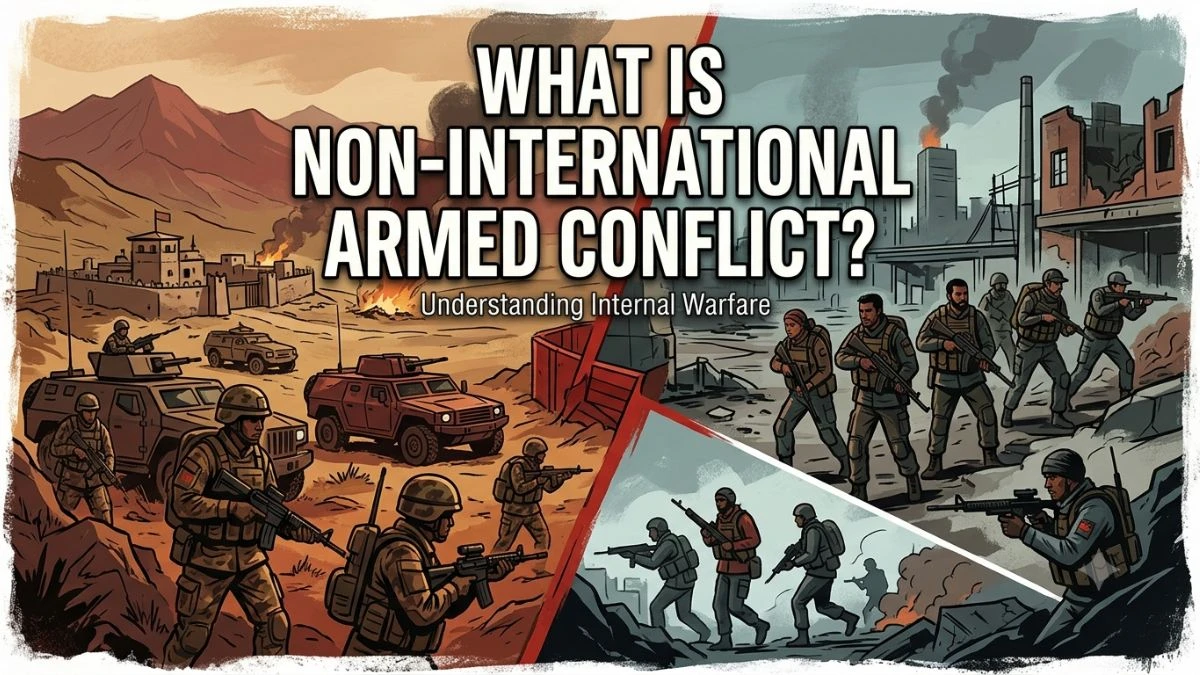
A non-international armed conflict (NIAC) is an armed conflict that takes place within a country between government forces and an organized armed group, or between organized armed groups. Under international humanitarian law, a NIAC exists when the violence reaches a sufficient level of intensity and the armed groups involved have enough organization to conduct sustained military operations.
Unlike an international armed conflict, a NIAC does not require two or more countries to be fighting each other.
What Does Non-International Armed Conflict Mean?
The term non-international armed conflict describes a category of armed conflict recognized by international humanitarian law (IHL).
The word “non-international” does not simply mean that an event happens inside a country’s borders. Internal violence must reach a particular legal threshold before it can be classified as a NIAC.
Two factors are especially important:
- Intensity of the violence – The fighting must be sufficiently serious and prolonged to go beyond riots, isolated attacks, or ordinary criminal violence.
- Organization of the parties – The armed groups must have enough structure and capability to carry out coordinated military operations.
A conflict may therefore occur entirely within one country without automatically becoming a NIAC.
What Are the Requirements for a NIAC?
International humanitarian law generally looks at the circumstances of the violence rather than simply the government’s description of the situation.
1. Sufficient Intensity of Violence
The violence must reach a level that distinguishes an armed conflict from internal disturbances.
Factors that may be considered include:
- How frequently armed clashes occur
- The duration and seriousness of the fighting
- The number and type of weapons used
- The number of people involved
- The number of casualties and displaced persons
- Whether government military forces, rather than only ordinary police, are required to respond
- Whether territory, towns, or strategic locations are being contested
There is no single worldwide numerical test, such as a specific number of casualties, that automatically creates a NIAC.
2. Organization of the Armed Groups
An armed group must possess a sufficient degree of organization for the situation to qualify as a NIAC.
Relevant indicators can include:
- A command structure
- Internal discipline
- The ability to issue and enforce orders
- The ability to recruit and train members
- The ability to plan coordinated attacks
- The ability to obtain and use weapons
- The ability to sustain military operations
- Some capacity to comply with international humanitarian law
A group does not necessarily need to control territory to be considered sufficiently organized.
When Does Internal Violence Become a NIAC?
Not every violent event inside a country qualifies.
For example, an isolated terrorist attack, criminal gang activity, a short-lived riot, or a protest that becomes violent will not normally constitute a NIAC merely because weapons or serious violence are involved.
The key question is whether the overall situation demonstrates both sufficient intensity and sufficient organization.
This distinction is important because international humanitarian law applies differently to armed conflicts than it does to ordinary law-enforcement situations.
NIAC vs. International Armed Conflict
The two categories should not be confused.
| Feature | International Armed Conflict | Non-International Armed Conflict |
|---|---|---|
| Main parties | States | State forces and organized armed groups, or organized armed groups against each other |
| Typical setting | Between countries | Primarily within a country |
| Main treaty rules | Geneva Conventions and other applicable IHL rules | Common Article 3 and, where applicable, Additional Protocol II and other IHL rules |
| Territorial requirement | No specific internal territorial requirement | The conflict generally involves violence within a state |
| Organization requirement for non-state groups | Not applicable in the same way | Important for classification |
| Intensity requirement | The existence of armed force between states is the key issue | Important for distinguishing armed conflict from internal disturbances |
An international armed conflict can also have an internal dimension, and the legal classification of a particular situation can change as circumstances develop. The classification therefore depends on the facts and applicable law rather than simply on political terminology.
What Law Applies to a NIAC?
The principal treaty rule applicable to NIACs is Common Article 3 of the four Geneva Conventions of 1949.
Common Article 3 establishes minimum humanitarian protections for persons who are not, or are no longer, taking an active part in hostilities. It prohibits certain forms of treatment, including:
- Violence to life and person
- Murder
- Mutilation
- Cruel treatment
- Torture
- Taking hostages
- Outrages upon personal dignity
- Passing sentences without a regularly constituted court and essential judicial guarantees
Common Article 3 is sometimes described as a “minimum humanitarian standard” because it provides fundamental protections even in conflicts that do not satisfy the more demanding conditions for application of Additional Protocol II.
What Is Additional Protocol II?
Additional Protocol II of 1977 is a treaty specifically dealing with the protection of victims of certain non-international armed conflicts.
It provides more detailed rules concerning areas such as:
- Protection of civilians
- Treatment of persons whose liberty has been restricted
- Humane treatment
- Protection of children
- Medical care
- Protection of objects necessary for civilian survival
- Restrictions on attacks against civilians and civilian objects
However, Additional Protocol II has a narrower scope than Common Article 3.
It applies only to certain NIACs involving government armed forces and organized armed groups that meet the conditions set out in the Protocol, including the requirement that the armed group exercise territorial control sufficient to carry out sustained and concerted military operations and implement the Protocol.
The United States signed Additional Protocol II but has not ratified it. This is different from Common Article 3, which is part of the Geneva Conventions to which the United States is a party.
Some rules contained in Additional Protocol II may also reflect customary international humanitarian law, but whether a particular rule has customary status must be assessed separately from whether the treaty itself is legally binding on a particular state.
Does a NIAC Have to Stay Inside One Country?
The phrase “non-international” can be misleading.
A NIAC is distinguished from an international armed conflict primarily by the nature of the parties and the legal circumstances of the conflict, not simply by drawing a line on a map.
A NIAC can involve cross-border effects, foreign military involvement, or armed groups operating in more than one country. Those circumstances can make legal classification more complicated.
For example, foreign states may intervene in a conflict involving an armed group. The involvement of another state does not automatically turn the entire situation into a single international armed conflict. Different relationships and confrontations may need to be legally classified separately.
Who Decides Whether a Conflict Is a NIAC?
There is no universal international official who automatically declares that a particular situation is a NIAC.
Legal classification is generally based on the facts on the ground and the applicable rules of international humanitarian law.
Courts, governments, international organizations, military authorities, and other legal bodies may analyze factors such as the intensity of hostilities and the organization of the parties.
The label used by a government or armed group is not necessarily decisive.
Calling an event a “war,” “counterterrorism operation,” “insurgency,” or “internal security operation” does not by itself determine its classification under international humanitarian law.
Why Does NIAC Classification Matter?
Classification is important because it determines which international humanitarian law rules apply to the situation.
A NIAC may affect the legal framework concerning:
- Treatment of captured or detained persons
- Protection of civilians
- Conduct of hostilities
- Treatment of wounded and sick persons
- Humanitarian assistance
- Protection of medical personnel and facilities
- Prosecution of certain serious violations
- Rules governing attacks and precautions
Importantly, classifying a situation as a NIAC does not give armed groups the same legal status as a state.
International humanitarian law regulates the conduct of all parties to the conflict without necessarily recognizing an armed group as a government or granting its members the same status as state armed forces.
NIAC Does Not Mean Every Person Fighting Is a Combatant
Another important distinction concerns the legal status of individuals.
In an international armed conflict, members of the armed forces of a state may have combatant and prisoner-of-war status under applicable rules.
NIACs do not generally provide members of non-state armed groups with the same international-law combatant privilege.
At the same time, persons who are not taking part in hostilities receive protections under applicable humanitarian law.
The exact rules concerning detention, targeting, participation in hostilities, and prosecution can depend on the applicable treaty law, customary international law, domestic law, and the facts of the particular conflict.
Examples of Situations That May Be NIACs
A situation may potentially qualify as a NIAC when:
- Government armed forces engage in prolonged fighting with a sufficiently organized insurgent group.
- Two organized armed groups conduct sustained armed hostilities against each other within a country.
- An armed group has a functioning command structure and conducts repeated military operations against state forces over an extended period.
Whether any particular conflict qualifies requires a factual and legal assessment. The name given to the conflict is not enough.
What Is Not Normally a NIAC?
The following situations do not automatically meet the NIAC threshold:
Ordinary Crime
Violent criminal activity, even when serious, is generally handled through domestic law unless the circumstances also satisfy the requirements for an armed conflict.
Protests and Demonstrations
A protest does not become a NIAC merely because some participants clash with police or commit acts of violence.
Riots and Civil Disturbances
Large-scale riots can cause significant damage and casualties, but they are not automatically armed conflicts under international humanitarian law.
Isolated Terrorist Attacks
A terrorist attack can be extremely serious without creating a NIAC. The broader pattern of violence and organization must be examined.
Short-Term Armed Violence
A brief confrontation does not necessarily meet the required level of intensity. The circumstances and duration of the hostilities matter.
NIAC and Terrorism Are Not the Same Thing
“NIAC” and “terrorism” describe different legal concepts.
A NIAC is a classification under international humanitarian law based principally on the intensity of hostilities and organization of the parties.
Terrorism, by contrast, is addressed through various domestic and international legal frameworks and does not automatically establish that an armed conflict exists.
An organization can therefore be described as terrorist under a particular legal regime without every violent activity involving that organization automatically constituting a NIAC.
The two concepts may overlap in some situations, but they should not be treated as synonyms.
NIAC in the United States
In the United States, NIAC is primarily an international humanitarian law concept rather than the name of a general federal criminal offense.
U.S. authorities may consider the law of armed conflict when U.S. forces participate in or respond to armed conflicts involving non-state armed groups.
U.S. courts and government authorities may also examine international humanitarian law when dealing with issues involving military operations, detention, targeting, and the treatment of individuals.
However, domestic U.S. law continues to play an important role. International humanitarian law does not simply replace federal or state criminal law whenever violence occurs inside the United States.
Common Article 3 vs. Additional Protocol II
These two legal instruments are often confused.
Common Article 3 applies to non-international armed conflicts and establishes fundamental protections for persons affected by the conflict.
Additional Protocol II provides more detailed protections for certain NIACs that meet its specific scope requirements.
Therefore, it is incorrect to assume that every NIAC automatically falls under every provision of Additional Protocol II.
Important Legal Terms to Know
Understanding a few related terms makes NIAC easier to understand:
International humanitarian law (IHL): The body of international rules designed to limit the effects of armed conflict and protect people who are not, or are no longer, participating in hostilities.
Common Article 3: A provision shared by the four Geneva Conventions that establishes fundamental protections in NIACs.
Additional Protocol II: A 1977 treaty that develops rules concerning certain NIACs.
Internal disturbance: Serious domestic unrest that does not reach the legal threshold of an armed conflict.
Organized armed group: A non-state armed group with sufficient structure and capability to conduct sustained military operations.
International armed conflict (IAC): An armed conflict between states to which the relevant international humanitarian law rules apply.
Frequently Asked Questions
Can a civil war be a non-international armed conflict?
Yes. A civil war may qualify as a NIAC when the opposing parties satisfy the relevant legal requirements, particularly the required level of intensity and organization. However, not every event described politically as a civil war necessarily satisfies the legal test.
Can two non-state armed groups have a NIAC?
Yes. A NIAC can involve organized armed groups fighting each other without the government being one of the parties, provided the circumstances meet the applicable threshold for a NIAC.
Does a NIAC give rebels legal recognition as a government?
No. Humanitarian-law classification does not by itself recognize an armed group as a legitimate government or confer sovereign status on it.
Are civilians protected during a NIAC?
Yes. Civilians and other persons who are not taking part, or are no longer taking part, in hostilities receive protections under applicable international humanitarian law. The precise protections depend on the circumstances and applicable rules.
Can a NIAC become an international armed conflict?
The legal classification of conflicts can become more complicated when states become directly involved. Different aspects of a situation may fall under different classifications depending on the parties and nature of the hostilities.
Does international humanitarian law make fighting in a NIAC legal?
No. IHL regulates conduct during armed conflict; it does not generally decide whether a party was legally entitled to start the conflict. Domestic law, international law concerning the use of force, and other applicable legal rules may address separate questions.
Does a NIAC require an armed group to control territory?
Not necessarily. Territorial control is relevant to the scope of Additional Protocol II, but it is not a universal requirement for every NIAC under Common Article 3.
Are NIAC rules relevant to detainees?
Yes. International humanitarian law establishes important protections for people detained or otherwise no longer participating in hostilities. Domestic law and other applicable legal rules may provide additional protections.
What is the main test for identifying a NIAC?
The two central factors are generally the intensity of the armed violence and the organization of the parties. The facts of the particular situation must be examined rather than relying only on political labels.
Key Takeaway
A non-international armed conflict is an armed conflict involving a state and an organized armed group, or organized armed groups fighting each other, where the hostilities reach the required level of intensity. It is governed by international humanitarian law, including Common Article 3 and, when its conditions are met, Additional Protocol II.
The most important point is that not every instance of internal violence is a NIAC. Riots, protests, ordinary criminal activity, and isolated attacks generally do not meet the legal threshold. Classification depends on the actual circumstances, particularly the intensity of the fighting and the organization of the parties.
Explore Question Categories

Founder & Publisher, Law Act
Prabh Kalsi is the founder and publisher of Law Act. He manages the website’s content research, organization, editing, and publishing. Law Act’s legal content is developed using publicly available legislation, government resources, official publications, and other authoritative sources. The website provides general legal information for educational and informational purposes and does not provide personalized legal advice.