

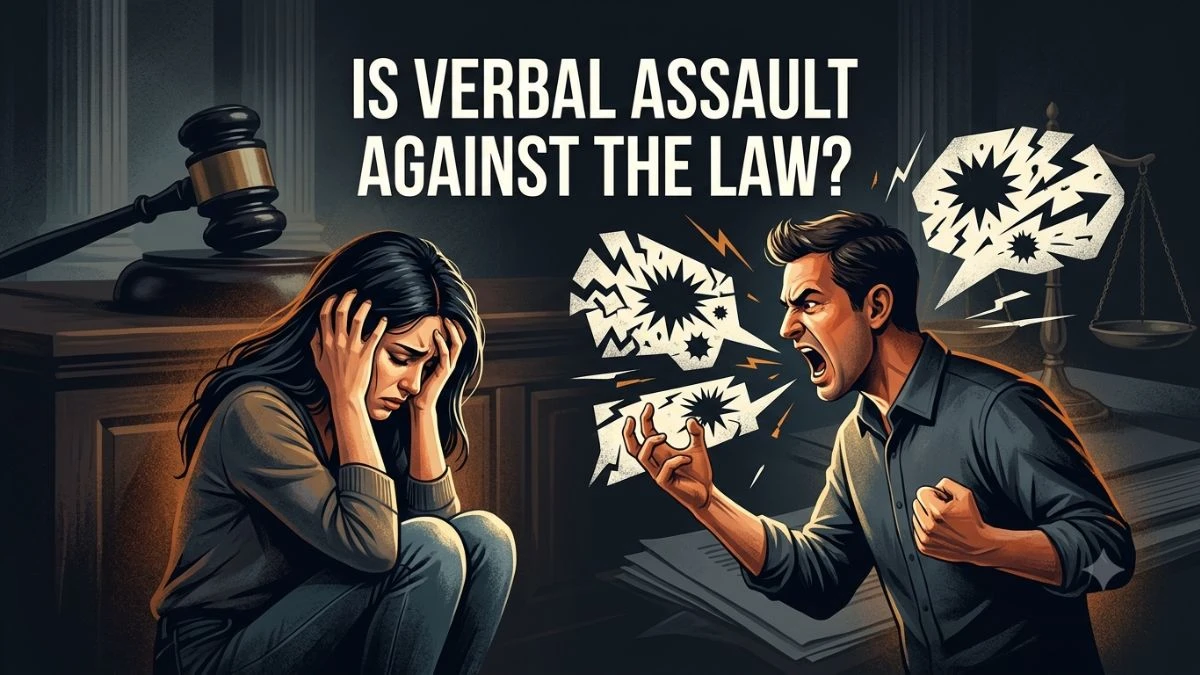
Yes, verbal conduct can be illegal in the United States, but simply yelling at someone, insulting them, swearing, or being rude is generally not a crime by itself. The legal consequences can be different when speech involves a serious threat, stalking, harassment, or other unlawful conduct.
The important point is that “verbal assault” is not a single criminal offense under U.S. law. It is a common phrase people use to describe threatening, abusive, intimidating, or aggressive words.
Whether particular speech is unlawful depends on several factors, including:
- What was actually said
- The circumstances in which it was said
- Whether there was accompanying conduct
- The speaker’s intent or mental state when relevant
- Whether the conduct was repeated
- Whether the communication involved a credible threat
- Where the incident occurred
- The specific state or federal law that applies
This distinction matters because offensive speech and illegal speech are not the same thing.
Is Verbal Assault a Crime in the United States?
There is no general federal crime called “verbal assault” that makes every angry, insulting, or abusive statement illegal.
A person usually does not commit a crime merely by saying something rude such as:
“You’re an idiot.”
Likewise, an argument, profanity, criticism, or an unpleasant comment does not automatically become a criminal offense simply because it hurts someone’s feelings.
The legal analysis changes when the words are part of conduct prohibited by law. Depending on the facts, that could include a criminal threat, stalking, harassment, or conduct that satisfies a state’s definition of assault.
Because criminal laws are largely defined by statutes in individual states, the same words may have different legal consequences depending on where the incident occurred.
When Can Verbal Conduct Become Illegal?
Verbal conduct may have legal consequences when it crosses into another recognized category of unlawful behavior.
1. Serious threats of violence
A statement threatening to kill, seriously injure, or physically attack another person may potentially be criminal.
However, context matters. Not every angry statement containing the word “kill” or “hurt” automatically qualifies as a criminal threat. Courts may examine the language, surrounding circumstances, and the nature of the communication.
The First Amendment also matters in threat cases. The Supreme Court has recognized that true threats can fall outside ordinary First Amendment protection, while also requiring constitutional safeguards before threatening speech can be punished.
2. Repeated harassment
Repeated unwanted communications may become legally significant when they satisfy the requirements of an applicable harassment statute.
Examples can include:
- Repeated threatening phone calls
- Persistent threatening text messages
- Repeated unwanted emails
- Targeted online communications
- Repeated intimidation
- Unwanted contact that continues after someone asks the person to stop
Whether this is criminal harassment depends on the applicable statute and its required elements.
3. Stalking
Verbal communications can also be part of stalking when they are combined with repeated unwanted conduct directed at a particular person.
For example, repeatedly contacting someone, following them, monitoring them, or sending threatening messages may be treated much more seriously than one isolated insult.
4. Workplace harassment
Verbal conduct at work may violate federal employment law when it constitutes unlawful harassment based on a protected characteristic and satisfies the applicable legal standard.
The Equal Employment Opportunity Commission (EEOC) explains that federal employment laws prohibit harassment based on characteristics including race, color, religion, sex, national origin, age, disability, and genetic information.
Are Insults and Name-Calling Illegal?
Usually, no.
A single insult, rude comment, swear word, or act of name-calling generally does not create criminal liability simply because it is offensive.
For example:
“You’re a terrible person.”
or:
“You’re an idiot.”
may be insulting, but those statements alone ordinarily do not constitute a crime.
That does not mean every verbal confrontation is legally harmless. If insulting language is combined with threats, stalking, repeated unwanted contact, or other unlawful conduct, the legal analysis can change.
The key question is not simply “Was the statement offensive?” It is “Did the conduct satisfy the requirements of a particular law?”
Can a Verbal Threat Be a Crime?
Yes, potentially.
A serious threat can result in criminal consequences when it meets the requirements of an applicable law.
For example, a statement threatening to kill or seriously injure a person may be investigated if the circumstances indicate that it was a genuine threat rather than ordinary anger, joking, political hyperbole, or another form of protected expression.
Important factors can include:
- The exact words used
- Who received the statement
- The surrounding circumstances
- Whether the statement was directed at a particular person
- Whether the speaker knew or was reckless regarding its threatening character when required by law
- Whether other conduct accompanied the statement
- The applicable state or federal statute
The Supreme Court’s decision in Counterman v. Colorado is particularly relevant to the constitutional treatment of threatening speech because it addressed the mental-state requirement in true-threat cases.
Because threat laws differ, you should not assume that a particular phrase is automatically a crime—or automatically protected—without considering its context and the applicable law.
Can Words Alone Be Assault?
Sometimes, but this depends heavily on state law and the circumstances.
The word “assault” does not have one identical meaning throughout the United States.
Under the traditional common-law concept, assault generally involves an intentional act that causes another person to reasonably anticipate imminent harmful or offensive physical contact. Criminal statutes, however, can define assault differently.
This is why an angry statement such as:
“I hate you.”
would not ordinarily be enough by itself to establish assault.
A threat accompanied by conduct that makes a person reasonably anticipate immediate physical harm may be treated differently under some laws.
For example, a person who moves aggressively toward someone while making a threat may present a different legal situation from someone who makes the same statement during a distant online argument.
The words, conduct, timing, circumstances, and applicable state statute all matter.
What Is the Difference Between Verbal Assault and Physical Assault?
The phrase “verbal assault” is commonly used in everyday language, while physical assault has a specific legal meaning that varies by jurisdiction.
In ordinary conversation, verbal assault may mean:
- Threatening someone
- Intimidating someone
- Yelling aggressively
- Abusing someone verbally
- Making frightening statements
- Repeatedly using threatening language
But those behaviors do not automatically create a separate criminal offense called “verbal assault.”
Physical assault generally involves conduct involving actual or threatened physical harm, depending on the jurisdiction’s definition.
For example, some states define assault in terms of an unlawful attempt to cause physical injury, while other legal contexts use the concept of causing reasonable apprehension of imminent harmful or offensive contact.
Therefore, it is important to identify the actual offense rather than assuming that every verbal confrontation is legally “assault.”
Can Repeated Verbal Abuse Be Harassment?
Yes, in some circumstances.
Repeated unwanted conduct may qualify as harassment when the applicable law’s requirements are satisfied.
Examples may include:
- Repeated threatening calls
- Continuous unwanted text messages
- Repeated threatening emails
- Targeted online messages
- Persistent intimidation
- Repeated unwanted contact
- Threatening communications combined with other conduct
However, simply annoying another person does not automatically establish criminal harassment.
Some laws require specific elements involving factors such as intent, repetition, threats, fear, or the effect of the conduct on the recipient.
For that reason, a person dealing with repeated verbal abuse should look at the harassment or stalking law that applies in the relevant state.
Is Verbal Abuse at Work Illegal?
It can be, but workplace rudeness is not automatically illegal harassment.
Federal employment laws enforced by the EEOC prohibit workplace harassment based on protected characteristics such as race, color, religion, national origin, sex, disability, age, and genetic information.
Examples of potentially unlawful workplace harassment can include:
- Racial slurs
- Sex-based insults
- Religious intimidation
- Disability-related degrading comments
- Repeated offensive comments about national origin
- Serious sexual comments
- Threatening conduct based on a protected characteristic
The EEOC explains that unlawful harassment generally involves conduct that is sufficiently severe or pervasive to create a hostile, intimidating, or abusive work environment, or conduct connected with an adverse employment action.
This means that an unpleasant boss, an argument with a coworker, or one rude comment does not automatically establish a federal harassment claim.
At the same time, extremely serious conduct may be legally significant even if it occurs only once.
State employment laws can provide additional protections beyond federal law.
Can Verbal Abuse Online Be Illegal?
Yes, depending on what the person is doing and what the applicable law prohibits.
Online communications can be relevant to criminal or civil claims when they involve conduct such as:
- Serious threats
- Stalking
- Criminal harassment
- Repeated targeted intimidation
- Other unlawful conduct
This can occur through:
- Social media
- Text messaging
- Online forums
- Messaging applications
- Comment sections
However, an offensive online comment is not automatically a crime.
A person criticizing you, insulting you, or posting an unpleasant opinion does not necessarily violate criminal law.
The legal question depends on the content, context, repetition, conduct involved, and applicable statute.
Does the First Amendment Protect Verbal Abuse?
The First Amendment protects a broad range of speech, but it does not mean every statement is legally protected from every consequence.
The First Amendment primarily limits government action. It does not operate as a general rule preventing private employers, businesses, or other private parties from enforcing lawful workplace or organizational rules.
Certain categories of speech can also receive different constitutional treatment.
Threats are an important example. The Supreme Court has recognized the category of “true threats,” while emphasizing the constitutional requirements involved when the government seeks to punish threatening speech.
Therefore, the statement “the First Amendment protects all verbal abuse” is too broad.
Likewise, saying that every offensive statement is illegal would also be incorrect.
Can You Sue Someone for Verbal Abuse?
Possibly, but an insult alone usually does not automatically create a lawsuit.
Depending on the facts and state law, different civil claims may become relevant.
Intentional Infliction of Emotional Distress
Extremely serious and intentional conduct may potentially support a claim for intentional infliction of emotional distress in some jurisdictions.
Ordinary arguments, insults, and unpleasant interactions generally do not automatically meet the legal standard.
Defamation
Defamation generally involves an actionable false statement of fact that causes legally recognized harm to reputation.
An insult or obvious opinion is not automatically defamation.
For example, calling someone “stupid” is different from making a provably false factual statement about that person’s conduct.
The exact requirements for defamation—including issues involving public figures, fault, damages, and privileges—vary by jurisdiction.
Employment Claims
Workplace conduct may support an employment-related claim when it violates applicable federal or state discrimination or harassment laws.
The EEOC specifically recognizes workplace harassment as a form of employment discrimination when the statutory requirements are met.
Other State-Law Remedies
Depending on the circumstances, state law may provide additional remedies involving threats, stalking, harassment, protective orders, defamation, or emotional distress.
A lawyer can determine whether the facts support a particular claim.
What Should You Do If Someone Is Threatening You?
If someone is making serious threats, especially threats suggesting immediate physical harm, treat the situation seriously.
Preserve the evidence
Keep:
- Text messages
- Emails
- Voicemails
- Screenshots
- Social media messages
- Letters
- Call records
- Relevant photographs or videos
Do not edit or alter the original evidence.
Record important details
Write down:
- The date and time
- Where the incident occurred
- What was said
- Who was present
- What happened immediately before and afterward
- Any subsequent contact
If possible, record the exact words rather than relying only on a general description.
Avoid escalating the situation
Responding with your own threats can make the situation more complicated.
If communication is necessary, keep it calm and factual.
Report workplace conduct when appropriate
If the problem occurs at work, consider following the employer’s reporting procedure, particularly when the conduct involves discrimination, threats, or repeated harassment.
Contact law enforcement when appropriate
If there is an immediate danger of physical harm, contact emergency services or local law enforcement.
For non-emergency situations, the appropriate reporting process may depend on the jurisdiction.
Get state-specific legal advice
If you are considering criminal charges, a civil lawsuit, a protective order, or another legal remedy, speak with a licensed attorney who can review the specific facts and applicable state law.
What Laws Can Apply to Verbal Threats or Harassment?
There is no single nationwide “verbal assault law” that covers every aggressive statement.
Depending on the circumstances, the relevant legal framework may include:
- State criminal-threat laws
- State assault statutes
- State harassment laws
- State stalking laws
- Cyberstalking or cyber-harassment laws
- Federal criminal laws in limited circumstances
- Federal employment discrimination laws
- State employment laws
- Defamation law
- Intentional infliction of emotional distress
- Protective-order or restraining-order laws
The correct law depends on what happened and where it happened.
A person should therefore avoid relying on a general definition of “verbal assault” when determining whether conduct is illegal.
What Makes a Verbal Threat More Legally Serious?
Several circumstances can make threatening speech more significant.
For example, authorities or courts may consider:
- Whether the threat identified a specific person
- Whether a particular act of violence was threatened
- Whether the communication was repeated
- Whether the speaker had engaged in related conduct
- Whether the recipient was targeted repeatedly
- Whether the circumstances suggested an immediate risk
- Whether the communication occurred as part of stalking
- Whether the applicable statute requires a particular mental state
The surrounding circumstances can be just as important as the words themselves.
A single statement taken out of context may not tell the whole legal story.
Is Yelling at Someone Illegal?
Usually not by itself.
Yelling may be unpleasant or intimidating, but loud speech alone generally does not create criminal liability.
The situation may be different when yelling includes:
- A serious threat
- Repeated harassment
- Stalking
- Physical intimidation
- Conduct prohibited by a specific law
- Workplace harassment that satisfies applicable legal requirements
The fact that someone shouted does not, by itself, determine whether a crime occurred.
Can You Go to Jail for Verbal Threats?
Yes, potentially.
A person can face criminal charges if threatening speech satisfies the requirements of an applicable criminal law.
However, there is no universal rule that every verbal threat results in jail.
Possible consequences depend on:
- The specific offense
- The state or federal law involved
- The severity of the alleged conduct
- The person’s criminal history
- Whether a weapon or physical conduct was involved
- Whether the conduct was repeated
- Other facts surrounding the incident
Some cases may result in investigation or charges, while others may not meet the elements of a criminal offense.
What Is the Difference Between an Insult, Threat, Harassment, and Assault?
These terms should not be treated as interchangeable.
| Conduct | General Meaning | Automatically Illegal? |
|---|---|---|
| Insult | Offensive or disrespectful statement | Usually no |
| Yelling | Speaking loudly or aggressively | Usually no |
| Threat | Statement suggesting intended harm | Potentially |
| Harassment | Repeated or otherwise prohibited unwanted conduct | Potentially |
| Stalking | Repeated targeted conduct that meets statutory requirements | Potentially |
| Assault | Legally defined conduct involving threatened or attempted harm, depending on jurisdiction | Potentially |
The actual legal definition depends on the applicable law.
Frequently Asked Questions About Verbal Assault
Can a person be arrested for yelling threats?
Potentially. If the statements and circumstances satisfy an applicable criminal law, police may investigate or make an arrest. Whether an arrest is lawful depends on the facts and jurisdiction.
Does recording a verbal confrontation help in court?
It can provide evidence of what was said or what happened, but recording laws vary by state. Before secretly recording a private conversation, check the law that applies where the recording is made and used.
Can a text message be considered a threat?
Yes. A threat does not necessarily have to be spoken in person. Text messages, emails, social media messages, and other electronic communications can be relevant when they satisfy the requirements of an applicable law.
Can a threat be illegal if the person says they were joking?
Possibly. Calling something a joke does not automatically determine its legal status. Courts can consider the complete context, including the words used, circumstances, conduct, and applicable legal standard.
Does an angry argument create a criminal record?
Not necessarily. An argument by itself does not automatically create criminal liability or a criminal record. Criminal consequences generally require conduct that satisfies the elements of an applicable offense.
Can a landlord take action over threatening verbal behavior?
Potentially, depending on the lease, the conduct, and applicable landlord-tenant law. Threats or serious disruptive conduct may have consequences even when the conduct does not fit a criminal offense.
Can a school punish a student for threatening speech?
Potentially. Schools can have rules governing student conduct, and threatening behavior may lead to disciplinary action. Constitutional and state-law protections can vary depending on the circumstances and type of school.
Can verbal threats affect a restraining or protective order?
They can be relevant. Whether threatening speech supports a protective order depends on the applicable state law and the evidence presented to the court.
Does the law protect rude political speech?
Political speech generally receives strong First Amendment protection, but that protection does not automatically extend to every statement made in a political context. The legal treatment depends on the nature of the speech and whether it falls within an unprotected category such as a true threat.
Can verbal abuse affect child custody proceedings?
Potentially. Threatening or abusive behavior may become relevant in family-law proceedings when it bears on issues such as safety or the child’s best interests. The rules and standards differ by state.
What evidence is useful in a verbal-threat case?
Useful evidence may include messages, emails, voicemails, screenshots, witness testimony, photographs, videos, call records, and contemporaneous notes describing what happened.
Key Points to Remember
“Verbal assault” is commonly used in everyday language, but it is not one universal criminal offense in the United States.
An insult, swear word, rude comment, or argument is generally not automatically illegal.
A serious threat can potentially lead to criminal consequences when it satisfies the requirements of applicable law.
Words may be relevant to an assault case in some jurisdictions, particularly when the circumstances involve an imminent threat of physical harm, but assault laws differ significantly among states.
Repeated unwanted communications may potentially constitute harassment or stalking when the statutory requirements are met.
Online threats and targeted communications can have legal consequences just like certain offline conduct.
Workplace verbal conduct can violate federal employment law when it constitutes unlawful harassment based on a protected characteristic and meets the applicable legal standard.
The First Amendment protects a broad range of speech but does not provide blanket protection for every form of threatening or unlawful conduct.
A person generally cannot sue simply because someone insulted or offended them.
The exact legal answer depends on the words used, the surrounding circumstances, the conduct involved, and the law of the applicable jurisdiction.
Conclusion
So, is verbal assault against the law?
Not necessarily. In the United States, ordinary insults, profanity, yelling, and rude comments are generally not crimes simply because they are offensive.
The situation can become legally serious when verbal conduct involves a credible threat, stalking, harassment, physical intimidation, unlawful workplace harassment, or another offense recognized by state or federal law.
The term “verbal assault” can therefore be misleading. Instead of asking only whether something was “verbal assault,” it is more useful to determine whether the conduct could constitute a criminal threat, assault, harassment, stalking, workplace harassment, defamation, or another legally recognized violation.
Because these laws vary by state, anyone dealing with serious threats or repeated harassment should preserve evidence and obtain advice from a licensed attorney familiar with the law where the incident occurred.
This article provides general legal information and is not legal advice.
Sources & References
- United States Constitution – First Amendment
- Equal Employment Opportunity Commission (EEOC) – Harassment Laws
- US Department of Justice – Stalking and Harassment Information
- Legal Information Institute – Assault Definition
Explore Question Categories

Founder & Publisher, Law Act
Prabh Kalsi is the founder and publisher of Law Act. He manages the website’s content research, organization, editing, and publishing. Law Act’s legal content is developed using publicly available legislation, government resources, official publications, and other authoritative sources. The website provides general legal information for educational and informational purposes and does not provide personalized legal advice.