

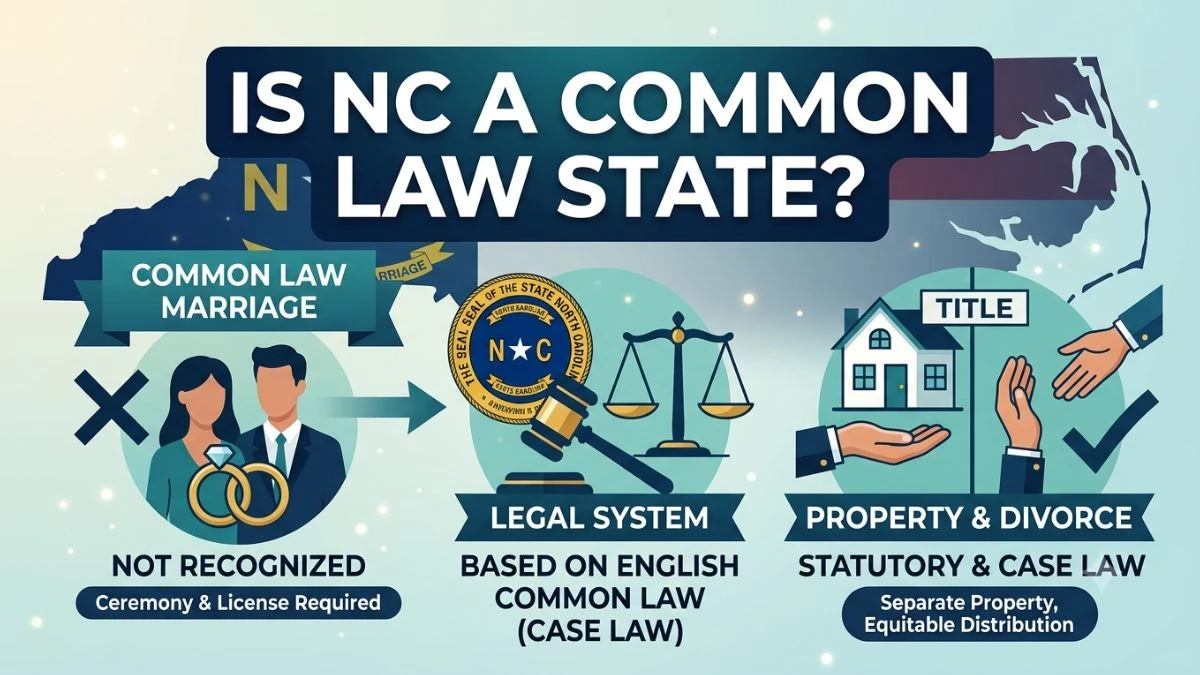
Yes. North Carolina is a common law state. Its legal system follows the common law tradition inherited from English law, while also relying heavily on statutes, constitutional provisions, administrative rules, and judicial decisions.
North Carolina General Statutes § 4-1 provides that portions of the common law that were previously in force in the state remain in effect unless they have been abrogated by statute. In practical terms, North Carolina courts apply both legislation enacted by the General Assembly and legal principles developed through court decisions.
However, being a common law state does not mean that every legal issue is decided by judges or that North Carolina recognizes common-law marriage.
What Does It Mean to Be a Common Law State?
A common law state uses a legal tradition in which court decisions and judicial precedent play an important role in developing and interpreting the law.
The common law tradition originated in England and became part of the American legal system. Over time, individual states developed their own laws while retaining many common-law principles.
In North Carolina, courts may consider earlier decisions when deciding a new case. A court may also interpret statutes and determine how established legal rules apply to circumstances that were not specifically addressed by legislation.
This does not give judges unlimited authority to make laws. Courts must operate within the Constitution, statutes, binding precedent, and other applicable sources of law.
What Does North Carolina General Statutes § 4-1 Say?
North Carolina General Statutes § 4-1 is an important provision concerning the common law.
It states:
“All such parts of the common law as were heretofore in force and use within this State, or so much of the common law as is not abrogated by statute, are in force within this State.”
The important phrase is “not abrogated by statute.”
This means that a common-law rule can continue to apply unless the legislature has changed, replaced, or eliminated that rule through legislation.
Therefore, North Carolina’s legal system is not based solely on judicially developed law. Statutory law can modify or displace an existing common-law principle.
How Does Common Law Work in North Carolina?
When resolving a legal dispute, a North Carolina court generally examines the law that applies to the particular issue.
Depending on the case, this can include:
- The North Carolina Constitution
- The United States Constitution
- North Carolina statutes
- Regulations and administrative rules
- Decisions of North Carolina appellate courts
- Applicable federal law
- Established common-law principles
- Binding judicial precedent
The court then determines how those authorities apply to the facts before it.
For example, if a statute clearly addresses an issue, the court will interpret and apply that statute. If an issue involves an established common-law rule, the court may look to prior decisions and other authoritative sources to determine the applicable legal principle.
What Is Judicial Precedent?
Judicial precedent means that earlier court decisions can influence how similar legal issues are decided later.
Not every court decision has the same authority. Decisions from a higher court can be binding on lower courts in appropriate circumstances, while decisions from other courts may be persuasive rather than controlling.
This system promotes consistency because courts generally do not decide every similar case as though the law were completely new.
North Carolina’s appellate courts therefore play an important role in explaining how statutes and common-law principles should be applied.
Can a North Carolina Statute Change Common Law?
Yes.
One of the most important features of North Carolina’s system is that the General Assembly can change or abolish common-law rules through legislation.
This is why it is not always enough to say that something is permitted or prohibited simply because it was recognized under traditional common law. The current statutory law and later judicial decisions must also be considered.
In a legal dispute, the relevant question is often not simply “What was the common-law rule?” but rather “What is the current law after considering statutes and later court decisions?”
Is North Carolina Based on Common Law or Civil Law?
North Carolina follows the common law legal tradition, rather than the civil-law tradition used in many countries around the world.
The distinction is mainly historical and structural.
Common-law systems place significant importance on judicial decisions and precedent alongside legislation. Civil-law systems generally place greater emphasis on comprehensive written legal codes as the primary source of legal rules.
North Carolina, like other U.S. states within the common-law tradition, uses a combination of written legislation and judicial precedent.
Is Common Law the Same as Common-Law Marriage?
No. These are completely different concepts.
A common law legal system describes the broader method and tradition through which a jurisdiction develops and applies law.
A common-law marriage concerns whether two people can be legally recognized as married without obtaining a formal marriage license and completing the required marriage ceremony or formalities.
Therefore, the fact that North Carolina is a common law state does not mean that North Carolina recognizes common-law marriage.
This distinction is particularly important because the two terms sound similar but refer to different areas of law.
Does North Carolina Recognize Common-Law Marriage?
North Carolina does not generally allow couples to establish a new common-law marriage simply by living together or considering themselves married.
The issue is separate from North Carolina’s status as a common law jurisdiction.
There can also be legal questions involving marriages that were validly established in another jurisdiction, so a specific situation should not be evaluated solely by looking at whether North Carolina permits people to create a new common-law marriage within the state.
Why Is Common Law Important in North Carolina?
Common law remains important because legislation cannot expressly address every possible factual situation.
Court decisions can help:
- Interpret the meaning of statutes
- Apply existing legal rules to new circumstances
- Resolve legal questions not completely addressed by legislation
- Clarify how earlier legal principles should be applied
- Establish precedent for future cases
At the same time, common law operates within a larger legal framework. Constitutional requirements, statutes, regulations, and controlling appellate decisions can affect whether an older common-law rule remains applicable.
Who Makes Law in North Carolina?
Law in North Carolina comes from several sources rather than one single institution.
The North Carolina General Assembly creates statutes. The courts interpret and apply those statutes and decide disputes. The North Carolina Constitution establishes fundamental state legal principles, while the U.S. Constitution and valid federal law can also control matters within federal jurisdiction.
Administrative agencies may issue regulations when authorized by law.
This combination explains why describing North Carolina simply as a “common law state” does not mean that common law is the only source of law.
What Happens When a Statute Conflicts With Common Law?
When the General Assembly has enacted a statute that changes or abolishes an existing common-law rule, the statutory rule generally governs the issue.
This is consistent with N.C. Gen. Stat. § 4-1, which preserves common law only to the extent that it has not been abrogated by statute.
For that reason, anyone researching a North Carolina legal issue should check both the relevant statutes and applicable court decisions rather than relying on a general statement about common law.
North Carolina Common Law: A Simple Example
Imagine that a legal principle developed through earlier court decisions applies to a particular type of dispute.
If the General Assembly later passes a statute specifically addressing that subject and changing the existing rule, the court must consider the new statute.
The old common-law rule does not automatically remain controlling simply because it existed for many years.
This illustrates how common law and statutory law work together in North Carolina.
Is North Carolina a Common Law Jurisdiction?
Yes. North Carolina is properly described as a common law jurisdiction because its legal system developed within the English common-law tradition and continues to recognize common-law principles.
However, that description should be understood in context. Modern North Carolina law consists of statutes, constitutional provisions, regulations, judicial decisions, and other legal authorities in addition to traditional common law.
Frequently Asked Questions
What is the main source of common law in North Carolina?
North Carolina’s common-law tradition comes from the historical English common-law system. N.C. Gen. Stat. § 4-1 provides statutory recognition for portions of that common law that remain in force.
Does common law apply automatically to every legal dispute in North Carolina?
No. Whether a common-law rule applies depends on the particular legal issue and whether the rule has been modified or replaced by a statute, constitutional provision, or controlling legal authority.
Can courts in North Carolina ignore an existing statute and use common law instead?
Generally, no. Courts must apply applicable statutes. Where legislation has changed or abolished a common-law rule, the statutory rule generally controls.
Are all court decisions in North Carolina binding precedent?
No. The legal authority of a judicial decision depends on the court that issued it and the circumstances in which it is being considered. Higher-court decisions can have binding effect on lower courts, while other decisions may be persuasive.
Did North Carolina’s common law come from English law?
Yes. North Carolina’s legal tradition developed from English common law, which became part of the foundation of the American legal system.
Does common law still matter when North Carolina has many statutes?
Yes. Statutes cover a large part of modern law, but common-law principles and judicial decisions continue to play an important role in interpreting and applying the law.
Where can I find North Carolina’s statutes?
North Carolina statutes are maintained in the state’s General Statutes. Chapter 4 includes provisions concerning the common law, including § 4-1.
Conclusion
North Carolina is a common law state. Its legal system follows the common-law tradition while also relying extensively on statutes, constitutional law, regulations, and judicial precedent.
N.C. Gen. Stat. § 4-1 is especially important because it recognizes common-law principles that remain in force unless they have been abrogated by statute.
The key point is that “common law state” refers to North Carolina’s legal tradition, not to common-law marriage. These are separate legal concepts.
Key Takeaway
Is NC a Common Law State? Yes. North Carolina follows the common-law legal tradition, and its statutes expressly recognize common law to the extent it has not been abrogated by legislation.
Sources & References
- U.S. Constitution – Full Faith and Credit Clause
https://constitution.congress.gov/constitution/article-4/
Explore Question Categories

Founder & Publisher, Law Act
Prabh Kalsi is the founder and publisher of Law Act. He manages the website’s content research, organization, editing, and publishing. Law Act’s legal content is developed using publicly available legislation, government resources, official publications, and other authoritative sources. The website provides general legal information for educational and informational purposes and does not provide personalized legal advice.