

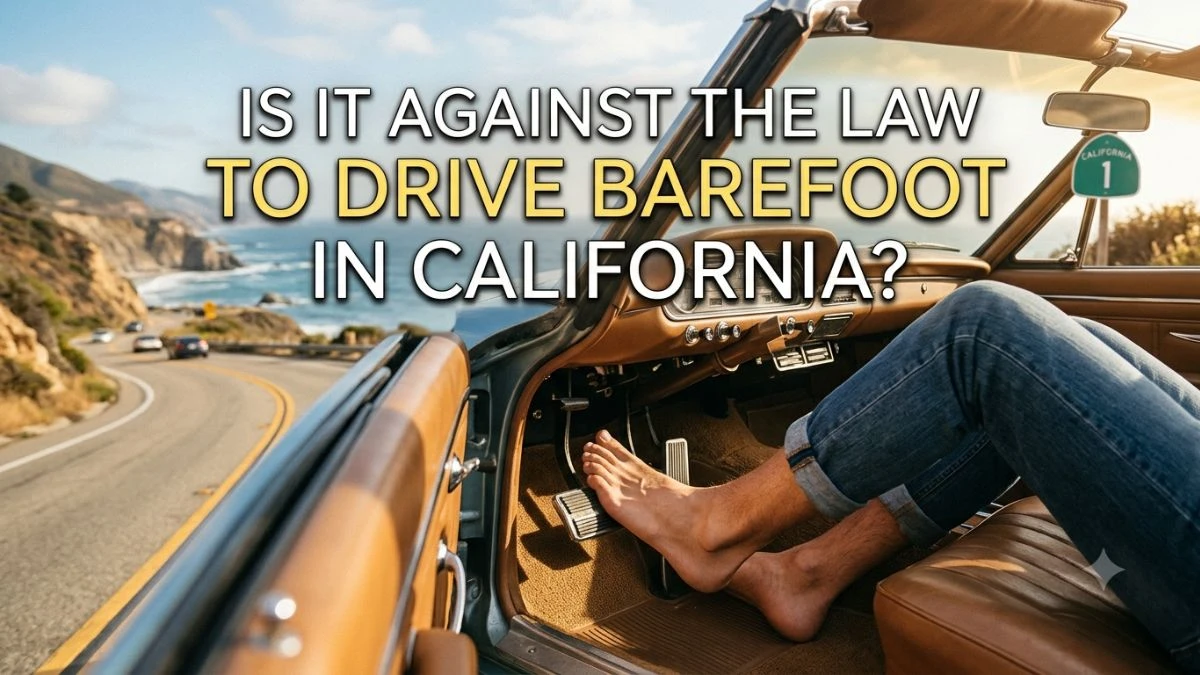
No. Driving barefoot is legal in California. California does not have a state law that requires drivers of ordinary passenger vehicles to wear shoes while driving. Being barefoot, by itself, is not a traffic violation.
The important point is that California law focuses on safe operation and control of the vehicle, rather than whether a driver is wearing shoes. If your choice of footwear—or lack of footwear—contributes to unsafe driving, other traffic laws may become relevant.
Is Driving Barefoot Legal in California?
Yes. You can legally drive a car in California without shoes.
There is no specific California Vehicle Code provision that makes ordinary barefoot driving an offense. California’s traffic rules regulate how vehicles are operated, including requirements involving speed, control, and safe driving, rather than imposing a general shoe requirement.
The California DMV’s Driver Handbook focuses on safe vehicle operation and driver control. It does not establish a general requirement that drivers wear shoes.
So, if you take off your shoes before driving home from the beach, for example, you are not breaking California law merely because your feet are bare.
Can Police Give You a Ticket Just for Driving Barefoot?
Generally, no. Being barefoot is not itself a California traffic offense.
However, this does not mean a driver is exempt from the state’s other traffic laws. If a driver’s conduct creates an independent traffic violation, the officer can enforce the applicable law based on that conduct.
For example, if a driver loses control because a foot slips while operating the pedals, the relevant legal issue would be the unsafe driving or resulting violation—not simply the absence of shoes.
This distinction is important:
Bare feet are not the offense. Unsafe driving can be.
What Does California Law Require From Drivers?
California’s traffic laws contain broader rules governing safe vehicle operation.
One important provision is California Vehicle Code § 22350, commonly known as the Basic Speed Law. It requires drivers to operate at a speed that is reasonable and prudent for the conditions. The California DMV explains that drivers must adjust speed for factors such as traffic, road conditions, weather, visibility, and other hazards.
Another relevant provision is California Vehicle Code § 23103, which addresses reckless driving.
These laws do not prohibit barefoot driving. Instead, they illustrate why the legality of driving barefoot is separate from the driver’s responsibility to operate the vehicle safely.
What If Your Bare Foot Slips Off the Pedal?
This is where the legal situation can change.
Imagine a driver is traveling normally but has wet feet. While attempting to brake, the driver’s foot slips, causing the vehicle to continue moving and collide with another car.
The driver would not automatically receive a ticket simply because they were barefoot. However, investigators could consider whether the driver failed to operate the vehicle safely and whether another traffic violation occurred.
The circumstances matter.
Factors could include:
- Whether the driver maintained control of the vehicle
- Whether the driver was traveling at a safe speed
- Whether the driver reacted appropriately to a hazard
- Whether another traffic law was violated
- Whether the driver’s actions contributed to the collision
The key legal question is therefore not simply “Were you barefoot?” but “Were you operating the vehicle safely?”
Is Driving Barefoot Safe?
Legality and safety are two different questions.
Some drivers prefer being barefoot because they can feel the accelerator and brake pedals more directly. Other drivers may find that bare feet become uncomfortable, especially during a long trip or when the feet are wet.
There is no single footwear choice that is legally required in California.
What matters from a practical safety perspective is whether you can consistently and comfortably:
- Press the brake pedal when necessary
- Control the accelerator smoothly
- Move your foot between pedals without difficulty
- Maintain control during sudden braking
- Respond quickly to changing traffic conditions
If you cannot reliably control the pedals, the footwear—or lack of footwear—you are using is not a good choice for driving.
Is Barefoot Driving Safer Than Flip-Flops?
It depends on the driver and the footwear.
Loose flip-flops, sandals, or other footwear can move around while driving and may make pedal operation less predictable. Bare feet eliminate the possibility of a loose shoe becoming caught or misplaced, but they can introduce their own problems, such as reduced comfort or slipping when the feet are wet.
For that reason, the better question is not whether barefoot driving is automatically safer than driving with shoes.
The better question is:
Which option allows you to maintain the most reliable control of the pedals?
Drivers should also avoid leaving loose footwear in the driver’s footwell, where it could interfere with the pedals.
Can You Drive in Flip-Flops in California?
Yes. California does not have a general law that prohibits driving while wearing flip-flops.
However, legality does not necessarily mean that a particular pair of flip-flops is a good choice for driving.
A loose sandal can move when you press a pedal or when you move your foot between the brake and accelerator. If your footwear interferes with your ability to control the vehicle, it can become a safety concern.
The same principle applies to any type of footwear.
Can You Drive in High Heels?
California does not have a general law making it illegal to drive while wearing high heels.
However, high heels can change the position and movement of the driver’s foot and may make some pedal movements less comfortable or precise.
If a particular pair of shoes makes it difficult for you to operate the pedals properly, changing footwear before driving may be the safer decision.
Can You Drive in Sandals or Boots?
Yes. California does not generally require drivers to use a particular type of shoe.
Sandals, boots, athletic shoes, and other footwear can all be worn while driving as long as the driver remains capable of safely operating the vehicle.
The practical concern is whether the footwear:
- Slips off easily
- Gets caught under or around a pedal
- Has an excessively bulky sole
- Restricts ankle movement
- Makes braking or acceleration difficult
A driver’s ability to control the vehicle is more important than the label attached to the footwear.
What Happens If Barefoot Driving Contributes to an Accident?
A collision does not automatically turn barefoot driving into a separate offense.
However, if the evidence shows that the driver’s conduct contributed to the crash, the circumstances can become relevant to traffic enforcement or a civil claim.
For example, if a driver loses pedal control and causes a collision, investigators may examine the driver’s actions, vehicle condition, road conditions, speed, reaction time, and other circumstances.
In a civil case, questions of fault can also become important. California law generally recognizes comparative responsibility when determining damages in negligence cases. The exact effect depends on the facts of the individual accident.
Therefore, drivers should not assume that something is legally permitted simply because there is no specific law banning it.
Does California DMV Require Drivers to Wear Shoes?
There is no general California DMV requirement that drivers wear shoes when operating an ordinary passenger vehicle.
The California Driver Handbook emphasizes safe driving and maintaining control of the vehicle. Its safety guidance addresses factors such as road conditions, speed, visibility, following distance, and vehicle control.
This is an important distinction:
A safety recommendation is not the same thing as a footwear law.
Drivers remain responsible for making sure they can safely operate their vehicles.
What About Driving Barefoot at Night?
Driving barefoot at night is not separately prohibited simply because it is nighttime.
The same rules apply whether you are driving during the day or after dark. You must be able to control the vehicle safely and follow California traffic laws.
Night driving can introduce additional challenges, including reduced visibility and glare. The California DMV recommends adjusting driving behavior to conditions and maintaining adequate awareness of the road environment.
Therefore, the relevant issue is safe driving—not whether the driver is wearing shoes at a particular time of day.
What If You Are Driving Home From the Beach?
This is one of the most common situations in which the question comes up.
Suppose you remove your wet sandals after visiting a California beach and drive home barefoot.
There is no general California law that makes that act illegal solely because you are not wearing shoes.
However, you should make sure your feet are dry enough to operate the pedals reliably and that your discarded footwear is not left somewhere in the driver’s footwell where it could interfere with pedal operation.
Does Barefoot Driving Affect Insurance?
There is no general rule that says an insurance claim is automatically denied because a driver was barefoot.
Insurance and accident claims depend on the policy, the facts of the collision, applicable law, and the circumstances surrounding the loss.
If barefoot driving is alleged to have contributed to a collision, it could become one fact considered when determining what happened. That is very different from saying that barefoot driving automatically invalidates insurance coverage.
Drivers should therefore avoid assuming that either of these statements is universally true:
“Barefoot driving is illegal.”
or
“Barefoot driving can never matter legally.”
The accurate answer lies between those two extremes.
What Is the Safest Footwear for Driving?
California does not prescribe one type of footwear for ordinary drivers.
From a practical safety perspective, many drivers prefer footwear that:
- Fits securely
- Does not easily slip off
- Allows natural ankle movement
- Provides reasonable pedal feel
- Does not have an excessively thick sole
- Does not interfere with the pedals
Ultimately, the safest choice is the option that allows the individual driver to maintain consistent control of the vehicle.
If you are uncomfortable driving barefoot, wearing secure shoes is a simple alternative.
California Barefoot Driving Law: What You Need to Know
Here is the legal position in simple terms:
| Question | California rule |
|---|---|
| Is driving barefoot illegal? | No |
| Does California require ordinary drivers to wear shoes? | No specific requirement |
| Can you drive in flip-flops? | Yes |
| Can you drive in sandals? | Yes |
| Can you drive in high heels? | Yes |
| Can you drive barefoot at night? | Yes |
| Can unsafe driving still result in enforcement? | Yes |
| Does barefoot driving automatically make you liable after a crash? | No |
| Is safe vehicle control still required? | Yes |
Why Do People Think Barefoot Driving Is Illegal?
The belief that driving without shoes is illegal is a long-standing driving myth.
The concern is understandable because footwear can affect how a person interacts with the pedals. But a safety concern should not be confused with a law.
California does not generally regulate ordinary passenger-vehicle driving by requiring a particular type of footwear.
That is why the correct legal answer is different from the common warning that “you have to wear shoes to drive.”
Frequently Asked Questions
Can I remove my shoes while driving in California?
Yes, there is no general California law that makes driving without shoes illegal. You are still responsible for maintaining safe control of the vehicle.
Can an officer stop me because I am barefoot?
Bare feet alone are not a California traffic violation. A stop or citation would need to be based on an applicable legal reason rather than simply the absence of shoes.
Is it illegal to drive barefoot on a California freeway?
No. California does not impose a general footwear requirement simply because you are driving on a freeway. Normal traffic and safe-driving laws still apply.
Can a barefoot driver be charged with reckless driving?
Barefoot driving itself is not reckless driving. However, if a driver’s conduct independently satisfies the elements of a reckless-driving offense, the applicable law could apply regardless of footwear.
Does California law require closed-toe shoes?
No general California law requires ordinary passenger-vehicle drivers to wear closed-toe shoes.
Is it better to drive barefoot than in loose sandals?
There is no universal answer. The safest option is the one that gives the driver dependable control of the pedals without slipping or interference.
Can barefoot driving be mentioned in an accident investigation?
Yes. If footwear or the absence of footwear is relevant to how a collision occurred, it may be considered as part of the circumstances. That does not mean barefoot driving automatically establishes fault.
Does California have a specific barefoot-driving statute?
No specific California statute generally prohibits an ordinary passenger-vehicle driver from operating a vehicle barefoot.
Sources & References
- California Legislative Information – Vehicle Code
https://leginfo.legislature.ca.gov - California Department of Motor Vehicles (DMV)
https://www.dmv.ca.gov
Explore Question Categories

Founder & Publisher, Law Act
Prabh Kalsi is the founder and publisher of Law Act. He manages the website’s content research, organization, editing, and publishing. Law Act’s legal content is developed using publicly available legislation, government resources, official publications, and other authoritative sources. The website provides general legal information for educational and informational purposes and does not provide personalized legal advice.