


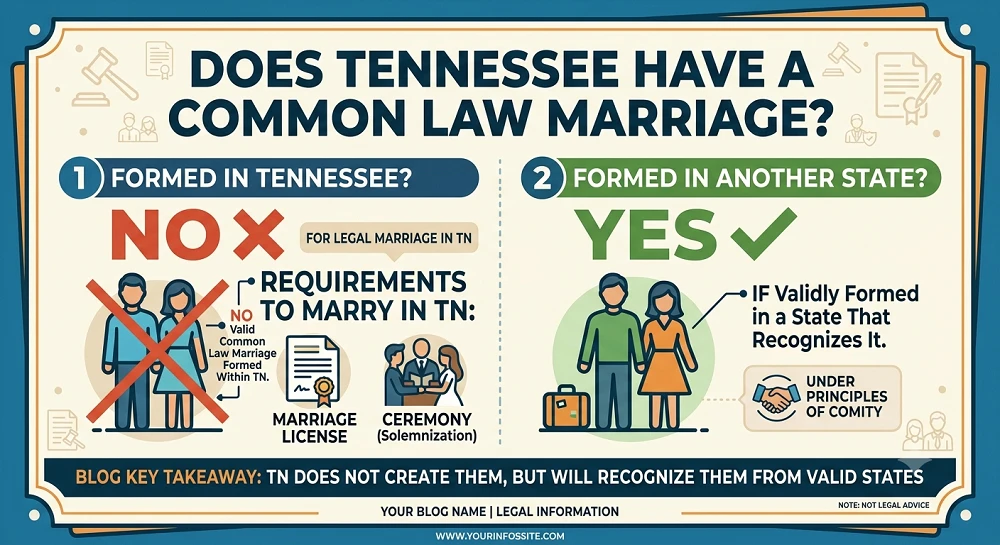
No. Tennessee does not allow couples to create a common law marriage simply by living together in Tennessee. There is no rule that automatically makes two people married after living together for 7 years, 10 years, or any other length of time.
Tennessee generally requires couples to follow the state’s legal marriage process, including obtaining a marriage license and having the marriage properly solemnized.
There is, however, an important exception. Tennessee may recognize a common law marriage that was legally established in another state where common law marriage is permitted.
This distinction is important because a couple cannot create a Tennessee common law marriage through cohabitation, but a marriage that was already legally established elsewhere may be recognized after the couple moves to Tennessee.
Quick Answer
| Question | Answer |
|---|---|
| Does Tennessee have common law marriage? | No, not for marriages created in Tennessee. |
| Does living together make you married? | No. |
| Is there a 7-year marriage rule? | No. |
| Does having children together create marriage? | No. |
| Does sharing a home or bank account create marriage? | No. |
| Can Tennessee recognize an out-of-state common law marriage? | Yes, if it was legally valid where it was created. |
| Is a marriage license required in Tennessee? | Generally, yes. |
| Is a traditional wedding required? | No particular ceremony formula is required by Tennessee law. |
What Is Common Law Marriage?
A common law marriage is a legally recognized marriage that can arise without a traditional wedding ceremony in jurisdictions that permit this type of marriage.
The requirements vary from state to state. In states that recognize common law marriage, couples generally must satisfy specific legal requirements showing that they intended and agreed to be married and met the state’s other requirements.
Tennessee does not provide a process for two unmarried people to establish a common law marriage merely through their conduct while living in Tennessee.
That means a long-term relationship, even one that looks like a marriage in everyday life, does not automatically become a legal marriage under Tennessee law.
Does Living Together Make You Married in Tennessee?
No.
A couple can live together for many years without becoming legally married in Tennessee.
For example, living together, paying household expenses, sharing a residence, or maintaining joint finances does not by itself create a marriage.
The same is true even when the couple has been together for decades.
The important issue is not how long the relationship has lasted. The question is whether the parties have a legally recognized marriage under Tennessee law or another jurisdiction’s law.
Is There a 7-Year Common Law Marriage Rule in Tennessee?
No. Tennessee does not have a seven-year common law marriage rule.
The idea that living together for seven years automatically creates a marriage is a widespread misconception. Tennessee law does not establish a seven-year period after which unmarried partners become spouses.
Living together for:
- 7 years
- 10 years
- 20 years
- or longer
does not, by itself, create a Tennessee marriage.
The length of cohabitation may be relevant to the facts of a legal dispute, but it does not replace the legal requirements for establishing a marriage.
How Do You Legally Get Married in Tennessee?
Tennessee uses a statutory marriage process.
Under Tennessee Code Annotated § 36-3-103, the parties generally must obtain a marriage license before being joined in marriage.
Tennessee law also specifies who may legally solemnize a marriage under § 36-3-301.
The marriage does not have to involve an elaborate ceremony. Tennessee Code Annotated § 36-3-302 provides that no particular formula is required for solemnization, subject to the requirements established by law.
After the marriage is solemnized, the person authorized to perform the marriage has responsibilities concerning the marriage license and its return to the appropriate county clerk.
Therefore, a couple does not need a large wedding reception or traditional ceremony to become legally married. What matters is compliance with Tennessee’s legal requirements.
What Does Not Create a Marriage in Tennessee?
Several things can make a relationship look similar to a marriage without creating a legal marriage.
Standing alone, the following generally do not make unmarried partners spouses:
- Living together
- Sharing a house or apartment
- Being in a relationship for many years
- Having children together
- Sharing a bank account
- Paying bills together
- Buying property together
- Wearing wedding rings
- Using the same last name
- Introducing one another as husband or wife
- Filing paperwork that describes the parties as a couple
- Sharing household expenses
- Having joint insurance or financial arrangements
These circumstances can have legal significance for other reasons, such as determining property ownership, financial responsibilities, parentage, or the parties’ intentions. But they do not independently create a Tennessee marriage.
Does Having Children Together Create a Common Law Marriage?
No.
Having children with another person does not automatically make the parents legally married in Tennessee.
Parents can have legal rights and responsibilities concerning their children even when they are not married. Those issues are separate from whether a marriage exists.
For unmarried parents, matters such as parenting arrangements, child support, custody, and parentage can involve different legal rules from those governing married spouses.
Does Sharing a Last Name Mean You Are Married?
No.
Using the same surname does not automatically establish a legal marriage.
A person may use a partner’s surname socially or for other personal reasons without satisfying Tennessee’s legal requirements for marriage.
Similarly, using different surnames does not mean that a legally married couple is unmarried.
Legal marital status is determined by applicable marriage law, not simply by the names people use.
Does Buying a House Together Make You Married?
No.
Two unmarried people can purchase real estate together.
Joint ownership of a home does not automatically turn the owners into spouses. Property rights generally depend on the deed, ownership structure, agreements, financial contributions, and applicable property law.
This distinction can become particularly important if an unmarried couple separates or one partner dies.
Ownership of property and marital status are separate legal questions.
Does Tennessee Recognize Common Law Marriage From Another State?
Potentially, yes.
This is one of the most important exceptions to understand.
Although Tennessee does not allow a couple to create a common law marriage in Tennessee simply through cohabitation, Tennessee courts may recognize a marriage that was validly created under the law of another state that permits common law marriage.
For example, imagine that two people establish a legally valid common law marriage while living in a state that recognizes common law marriage. They later move to Tennessee.
The move to Tennessee does not necessarily invalidate the marriage.
The key question is whether the parties actually established a valid marriage under the law of the jurisdiction where the alleged marriage arose.
Can You Become Common Law Married by Going to Another State?
Simply traveling to another state does not automatically create a common law marriage.
The couple must satisfy the legal requirements of the state in which they claim the marriage was established.
This distinction matters because common law marriage is not recognized in every state, and the requirements differ among jurisdictions.
If a couple claims that a common law marriage was created outside Tennessee, the applicable state’s law and the facts surrounding the relationship may need to be examined.
What Happens When a Common Law Married Couple Moves to Tennessee?
Moving to Tennessee does not automatically end a marriage that was legally established in another jurisdiction.
If the couple was legally married under the law applicable where the marriage was created, Tennessee may recognize that marital status.
This creates two very different situations:
Couple A: Two unmarried people live together in Tennessee for 15 years. They do not become married merely because they lived together for that period.
Couple B: Two people establish a legally valid common law marriage in a state that recognizes common law marriage and later move to Tennessee. Tennessee may recognize their existing marriage.
The location and legal validity of the alleged marriage therefore matter.
How Can an Out-of-State Common Law Marriage Be Established?
If marital status becomes disputed, the parties may need to show that the claimed marriage actually satisfied the requirements of the state where it was allegedly created.
The relevant evidence can depend on the law of that jurisdiction and the circumstances of the relationship.
Potentially relevant evidence may include:
- Where the couple lived
- When the relationship allegedly became a marriage
- Whether both people intended to be married
- How the parties represented their marital status
- Financial and property records
- Statements made by the parties
- Documents identifying marital status
- Other evidence required under the law of the state involved
However, evidence that a couple behaved like spouses does not necessarily prove a common law marriage. The legal requirements of the relevant jurisdiction must still be satisfied.
What Rights Do Unmarried Couples Have in Tennessee?
Unmarried couples can live together and share property and finances, but they generally do not automatically receive every legal right associated with marriage.
For example, marital status can affect areas such as:
- Inheritance
- Property division
- Spousal support
- Medical decision-making
- Financial authority
- Estate administration
- Certain tax and benefit matters
The precise legal consequences depend on the circumstances.
Unmarried partners may therefore want to consider appropriate legal planning rather than assuming that a long-term relationship provides the same protections as marriage.
Depending on their situation, documents may include:
- Wills
- Powers of attorney
- Advance directives
- Beneficiary designations
- Property agreements
- Cohabitation agreements
- Other estate-planning documents
A qualified Tennessee attorney can help determine which documents are appropriate for a particular situation.
Common Law Marriage vs. Legal Marriage in Tennessee
| Issue | Legally Married Couple | Unmarried Couple |
| Legal marital status | Married under applicable law | Not married merely because they live together |
| Ending the relationship | Divorce may be required | No divorce simply to end cohabitation |
| Property | Marital-property rules may apply | Ownership generally depends on title and other legal principles |
| Inheritance | Spousal rights may apply | Rights may depend on estate planning and applicable law |
| Spousal support | May be available in a divorce | Generally not available simply because of cohabitation |
| Medical decisions | Some rights may arise from marriage | Additional legal planning may be important |
| Estate planning | Spousal status can affect estate rights | Wills and beneficiary designations may be especially important |
The outcome in an individual case depends on the applicable law and facts.
What Tennessee Courts Say About Common Law Marriage
Tennessee courts have distinguished between creating a common law marriage in Tennessee and recognizing a marriage that was legally created somewhere else.
In Martin v. Coleman, the Tennessee Supreme Court addressed Tennessee’s statutory approach to marriage and explained the importance of Tennessee’s marriage statutes.
Tennessee appellate decisions have also addressed the recognition of marriages originating in jurisdictions where common law marriage is permitted.
For example, Bowser v. Bowser discusses the distinction between a common law marriage allegedly created through conduct in Tennessee and a marriage that was validly contracted under the law of another state.
This distinction is important when a dispute involves a couple who lived in more than one state.
Tennessee Marriage Laws You Should Know
Several provisions in Title 36, Chapter 3 of the Tennessee Code are particularly relevant to marriage licensing and solemnization.
Tennessee Code Annotated § 36-3-103 — Marriage License
This provision addresses the requirement for obtaining a marriage license before the parties are joined in marriage.
Tennessee Code Annotated § 36-3-301 — Who May Solemnize a Marriage
This section identifies persons authorized under Tennessee law to solemnize marriages.
Tennessee Code Annotated § 36-3-302 — No Particular Ceremony Formula
Tennessee law does not require one specific wording or formula for a marriage ceremony, subject to the statutory requirements.
Tennessee Code Annotated § 36-3-303 — Return of Marriage License
This provision addresses the return of the marriage license to the county clerk following solemnization.
Tennessee Code Annotated § 36-3-304 — Marriage Certificate
This provision addresses the form and issuance of the marriage certificate.
Because statutes and court decisions can change, anyone dealing with an actual dispute should verify the current law and obtain advice based on the specific facts.
Frequently Asked Questions About Tennessee Common Law Marriage
Can an unmarried partner inherit from me automatically in Tennessee?
Not necessarily. Marriage can affect inheritance rights, while an unmarried partner may need estate-planning documents such as a will or beneficiary designation to receive particular assets.
Can an unmarried partner make medical decisions for me?
Do not assume that living together gives your partner the same authority as a spouse. Medical decision-making can involve separate legal rules and planning documents.
Can an unmarried couple file taxes as married in Tennessee?
Tennessee does not have a state individual income tax on wages, but federal tax filing status is governed by federal law. A couple should not assume that living together makes them eligible to file a federal return as married.
Can unmarried partners own a bank account together?
Yes. Two people can generally have joint financial accounts without being married. Joint ownership of an account does not itself establish a marriage.
Can an unmarried couple adopt a child together?
Adoption rules depend on the type of adoption and the applicable Tennessee law. Relationship status can affect the legal process, so prospective parents should obtain current legal guidance for their circumstances.
Can an unmarried partner claim part of my property after we separate?
Not automatically. Property disputes between unmarried partners can depend on ownership documents, agreements, contributions, and other applicable legal principles.
Does Tennessee recognize domestic partnerships as marriages?
A domestic partnership and a legal marriage are not automatically the same legal status. The rights available to unmarried partners depend on the specific law, agreements, and circumstances involved.
What should I do if my partner says we are legally married?
If marital status is disputed, gather documents showing where and when the relationship allegedly became a marriage and obtain advice from a Tennessee family-law attorney. If the claimed marriage originated in another state, that state’s marriage law may be especially important.
Key Takeaways
- Tennessee does not allow a couple to create a common law marriage simply by living together in Tennessee.
- There is no seven-year common law marriage rule in Tennessee.
- Living together for any particular number of years does not automatically create a marriage.
- Having children together does not create a marriage.
- Sharing property, finances, a home, or a last name does not independently establish marriage.
- Tennessee generally requires a marriage license and lawful solemnization for a marriage established under Tennessee law.
- Tennessee does not require one particular traditional wedding ceremony formula.
- Tennessee may recognize a common law marriage that was legally established in another state where common law marriage is permitted.
- Whether an out-of-state common law marriage is valid depends on the law and facts applicable where the alleged marriage was created.
- Unmarried couples should not assume that cohabitation gives them the same legal rights as spouses.
Conclusion
Does Tennessee have common law marriage? No—not for a marriage created through living together in Tennessee.
A couple does not become legally married simply because they have shared a home for many years, combined finances, purchased property, raised children, used the same surname, or presented themselves socially as a married couple.
Tennessee follows a statutory marriage system that includes requirements concerning a marriage license and lawful solemnization.
The important exception is an out-of-state common law marriage. If a couple legally established a common law marriage in a jurisdiction that recognizes this type of marriage, Tennessee may recognize that marriage after the couple moves to Tennessee.
If your situation involves an alleged out-of-state common law marriage, inheritance, property ownership, divorce, or another dispute over marital status, the exact facts can make a significant difference. Consider speaking with a Tennessee family-law attorney who can evaluate the applicable law.
Sources & References
Explore Question Categories

Founder & Publisher, Law Act
Prabh Kalsi is the founder and publisher of Law Act. He manages the website’s content research, organization, editing, and publishing. Law Act’s legal content is developed using publicly available legislation, government resources, official publications, and other authoritative sources. The website provides general legal information for educational and informational purposes and does not provide personalized legal advice.