

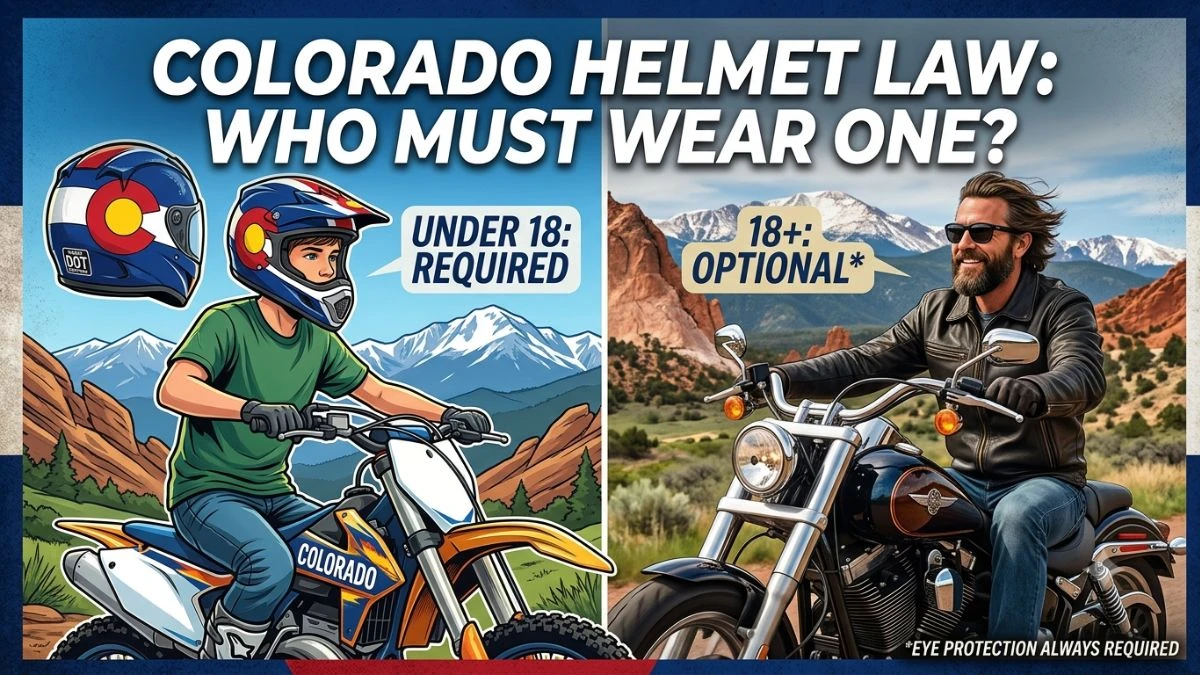
Yes. Colorado has a motorcycle helmet law, but it does not require all motorcycle riders to wear a helmet. Under Colorado law, anyone under 18 who operates or rides as a passenger on a motorcycle, autocycle, or low-power scooter generally must wear a protective helmet that meets federal safety standards. Riders and passengers 18 or older are generally not required to wear a helmet under Colorado’s helmet law.
Colorado also has a separate eye-protection requirement for people riding motorcycles and certain other covered vehicles on public highways.
Colorado Motorcycle Helmet Law at a Glance
| Question | Colorado law |
|---|---|
| Must riders under 18 wear a helmet? | Yes |
| Must riders 18 or older wear a helmet? | Generally, no |
| Must adult riders use eye protection? | Generally, yes |
| Must a required helmet meet federal standards? | Yes |
| Must a required helmet have a chin strap? | Yes |
| Main helmet statute | C.R.S. § 42-4-1502 |
| Eye-protection statute | C.R.S. § 42-4-232 |
What Is the Motorcycle Helmet Law in Colorado?
Colorado does not have a universal motorcycle helmet requirement for adults. Instead, its helmet law focuses primarily on people under 18 years of age.
A person under 18 who drives or rides as a passenger on a motorcycle, autocycle, or low-power scooter on a roadway must generally wear a protective helmet that satisfies the requirements established by Colorado law.
The relevant provision is Colorado Revised Statutes § 42-4-1502, which addresses protective helmets for motorcycles and autocycles.
The helmet must be properly secured to the person’s head while the vehicle is moving.
Do Adults Have to Wear Motorcycle Helmets in Colorado?
Generally, no.
Colorado law does not require a motorcycle operator or passenger who is 18 or older to wear a helmet solely because of their age.
This is an important distinction between Colorado and states that have universal motorcycle helmet laws. In a universal-helmet state, adult riders generally must wear helmets as well. Colorado instead allows adults to ride without a helmet under its state helmet requirement.
However, choosing not to wear a helmet does not mean that every other motorcycle safety rule can be ignored. Colorado has separate requirements concerning eye protection, equipment, and the operation of motorcycles on public highways.
What Helmet Must a Rider Under 18 Wear?
When Colorado law requires a person under 18 to wear a motorcycle helmet, the helmet must satisfy specific safety requirements.
The law requires a protective helmet that:
- Is designed for motorcycle use.
- Is intended to reduce injuries caused by impacts to the head.
- Contains appropriate protective lining or padding.
- Has a chin strap.
- Meets or exceeds the applicable federal motorcycle helmet safety standard.
- Is properly secured to the rider’s head with the chin strap while the vehicle is moving.
The federal standard referenced by Colorado is Federal Motor Vehicle Safety Standard No. 218, commonly associated with motorcycle helmets and found in 49 CFR § 571.218.
This means a decorative or novelty helmet that does not satisfy the required safety standard may not meet the legal requirement for a rider under 18.
Does Colorado Require a DOT-Compliant Helmet?
For a person who is legally required to wear a helmet under Colorado’s under-18 rule, the helmet must meet or exceed the applicable federal motorcycle helmet safety standard.
Federal Motor Vehicle Safety Standard No. 218 establishes requirements for motorcycle helmets.
For practical purposes, riders should look for a properly certified motorcycle helmet rather than relying solely on a helmet’s appearance or marketing description.
Adult riders may not be legally required to wear a helmet, but using a properly fitted helmet that complies with applicable safety standards is still an important safety measure.
Is Eye Protection Required on a Motorcycle in Colorado?
Yes. Colorado has a separate rule requiring eye protection for people operating or riding certain covered vehicles on public highways.
Under C.R.S. § 42-4-232, motorcycle operators and riders generally must use:
- Goggles; or
- Eyeglasses with lenses made from safety glass or plastic.
The statute also provides an exception when the person is wearing a helmet that includes qualifying eye protection.
This is separate from the helmet requirement in C.R.S. § 42-4-1502.
In other words, an adult rider may generally have the legal option not to wear a motorcycle helmet, but that does not automatically eliminate the state’s eye-protection requirement.
Does a Motorcycle Windshield Count as Eye Protection?
You should not automatically assume that a motorcycle windshield satisfies Colorado’s eye-protection requirement.
The eye-protection statute contains specific rules and exceptions, and a windshield is not necessarily equivalent to wearing qualifying goggles or eyeglasses.
If you are riding on a Colorado public highway, it is safer to make sure you are complying with the specific eye-protection requirements rather than relying on a windshield alone.
Do Motorcycle Passengers Have to Wear Helmets in Colorado?
It depends on the passenger’s age.
A passenger under 18 who is covered by Colorado’s motorcycle helmet law generally must wear a qualifying protective helmet.
An adult passenger who is 18 or older is generally not required to wear a helmet under Colorado’s state helmet requirement.
Passengers should also consider the state’s separate eye-protection requirements when traveling on public highways.
Does Colorado Have a Universal Motorcycle Helmet Law?
No. Colorado does not have a universal motorcycle helmet law for adults.
The state’s helmet requirement generally applies to people under 18 who operate or ride as passengers on covered motorcycles, autocycles, and low-power scooters.
This means an adult who is 18 or older can generally legally operate or ride a motorcycle without a helmet under Colorado state law.
That legal permission should not be confused with a recommendation that riding without a helmet is safe. A helmet can provide substantial protection in the event of a crash, which is why motorcycle safety authorities encourage riders to wear appropriate protective equipment.
What Happens If You Violate Colorado’s Helmet Law?
A violation of C.R.S. § 42-4-1502 is classified under Colorado law as a class A traffic infraction.
The particular circumstances of a case can matter, including the person’s age, the type of vehicle involved, and whether an exception under the statute applies.
If you receive a citation and are unsure how the law applies to your circumstances, consider reviewing the current statute or obtaining advice from a qualified Colorado attorney.
Can You Ride a Motorcycle Without a Helmet in Colorado?
For an adult, generally yes.
If you are 18 or older, Colorado’s motorcycle helmet law generally does not require you to wear a helmet.
If you are under 18, Colorado generally requires a qualifying protective helmet when you operate or ride as a passenger on a covered motorcycle, autocycle, or low-power scooter.
There is an important additional point: Colorado’s eye-protection requirement applies separately. Therefore, riding without a helmet does not necessarily mean that you can ride without goggles or qualifying eyeglasses.
What Age Can You Ride a Motorcycle Without a Helmet in Colorado?
The key age under Colorado’s helmet law is 18.
People under 18 are generally required to wear a qualifying helmet when covered by C.R.S. § 42-4-1502.
Once a rider or passenger is 18 or older, the state’s helmet requirement generally no longer applies to that person.
Other motorcycle laws and safety requirements can still apply regardless of age.
Colorado Helmet Law and Motorcycle Insurance
Whether a rider is legally required to wear a helmet and whether wearing one can affect an insurance claim are two different questions.
Colorado’s helmet law establishes when a helmet is legally required. An insurance dispute after a motorcycle crash can involve additional issues, such as the circumstances of the accident, the applicable insurance policy, injuries, and allegations concerning the rider’s conduct.
Therefore, you should not assume that because an adult was legally permitted to ride without a helmet, every insurance or personal-injury issue will automatically be decided in that rider’s favor.
Insurance and injury claims are highly fact-specific.
Is Riding Without a Helmet Legal but Still Risky?
Yes.
Colorado’s law allows most adults to ride without a motorcycle helmet, but legal permission does not mean that riding without protective equipment carries no risk.
A motorcycle helmet is designed to help protect the head during a crash. Other protective equipment, such as gloves, riding jackets, pants, and appropriate footwear, can also reduce the risk of certain injuries.
For this reason, adult riders may choose to wear a properly fitted helmet even though Colorado law generally does not require one for people 18 and older.
Colorado Motorcycle Helmet Law Compared With Eye Protection
These two requirements should be treated separately.
Helmet requirement: C.R.S. § 42-4-1502 generally requires people under 18 who operate or ride as passengers on covered motorcycles, autocycles, and low-power scooters to wear a qualifying protective helmet.
Eye-protection requirement: C.R.S. § 42-4-232 separately establishes eye-protection requirements for people operating or riding covered vehicles on public highways.
The distinction matters because an adult rider may generally choose not to wear a helmet while still being required to comply with Colorado’s eye-protection rules.
What Does Colorado Recommend for Motorcycle Safety?
Although adult riders are generally not required by state law to wear a motorcycle helmet, wearing one is a sensible safety precaution.
A rider should consider using a properly fitted motorcycle helmet that complies with the applicable federal safety standard. Eye protection, protective clothing, gloves, and appropriate riding footwear can also provide additional protection.
Colorado’s legal minimum and recommended safety practices are not necessarily the same thing. A law may permit a particular behavior while safety experts still recommend taking additional precautions.
Frequently Asked Questions
Can a 17-year-old ride a motorcycle without a helmet in Colorado?
Generally, no. A person under 18 who is covered by Colorado’s motorcycle helmet statute must wear a qualifying protective helmet while operating or riding as a passenger on a covered vehicle.
Does Colorado require helmets on three-wheel motorcycles?
The answer can depend on how the vehicle is legally classified. Colorado’s helmet statute specifically addresses motorcycles, autocycles, and low-power scooters, so the vehicle’s classification should be considered rather than assuming that every three-wheeled vehicle is treated identically.
Does Colorado’s helmet law apply on public highways?
The helmet statute applies to covered motorcycle, autocycle, and low-power scooter operation or riding on a roadway, subject to the terms and exceptions contained in the law.
Can a passenger choose not to wear a helmet if the passenger is 18?
Generally, yes. An adult passenger is generally outside Colorado’s under-18 helmet requirement. However, other applicable requirements, including eye-protection rules, should still be considered.
Are motorcycle helmets required at all times in Colorado?
Not for every rider. Colorado’s state helmet requirement generally applies to covered riders and passengers under 18. Adults 18 and older are generally not required to wear a helmet under the state’s helmet law.
What is C.R.S. § 42-4-1502?
C.R.S. § 42-4-1502 is the Colorado statute governing protective helmets for motorcycles and autocycles. It establishes the state’s helmet requirement, including the rule applicable to people under 18.
What is C.R.S. § 42-4-232?
C.R.S. § 42-4-232 establishes minimum safety standards involving motorcycles, autocycles, and low-power scooters, including Colorado’s eye-protection requirements.
Is a motorcycle helmet required for an adult learner?
Colorado’s helmet requirement is based primarily on age rather than simply whether someone is a learner. An adult who is 18 or older is generally not subject to the state’s under-18 helmet requirement, although other licensing and motorcycle-operation laws may apply.
Does Colorado law require a chin strap on a motorcycle helmet?
Yes, when the helmet is required under Colorado’s under-18 helmet provision, it must be properly secured with a chin strap while the covered vehicle is moving.
Can a novelty motorcycle helmet satisfy Colorado’s law?
Not necessarily. A helmet required under Colorado law must meet or exceed the applicable federal motorcycle helmet safety standard. A novelty helmet that does not satisfy that standard may not fulfill the legal requirement.
Does Colorado require eye protection if I wear a half helmet?
A half helmet does not automatically eliminate the eye-protection requirement. The relevant question is whether the helmet provides the type of qualifying eye protection recognized by Colorado law. Otherwise, the rider may need goggles or qualifying eyeglasses.
Sources & References
- Colorado State Patrol – Motorcycle Laws
- Colorado Revised Statutes § 42-4-1502
- Colorado Department of Transportation – Motorcycle Safety
Explore Question Categories

Founder & Publisher, Law Act
Prabh Kalsi is the founder and publisher of Law Act. He manages the website’s content research, organization, editing, and publishing. Law Act’s legal content is developed using publicly available legislation, government resources, official publications, and other authoritative sources. The website provides general legal information for educational and informational purposes and does not provide personalized legal advice.