

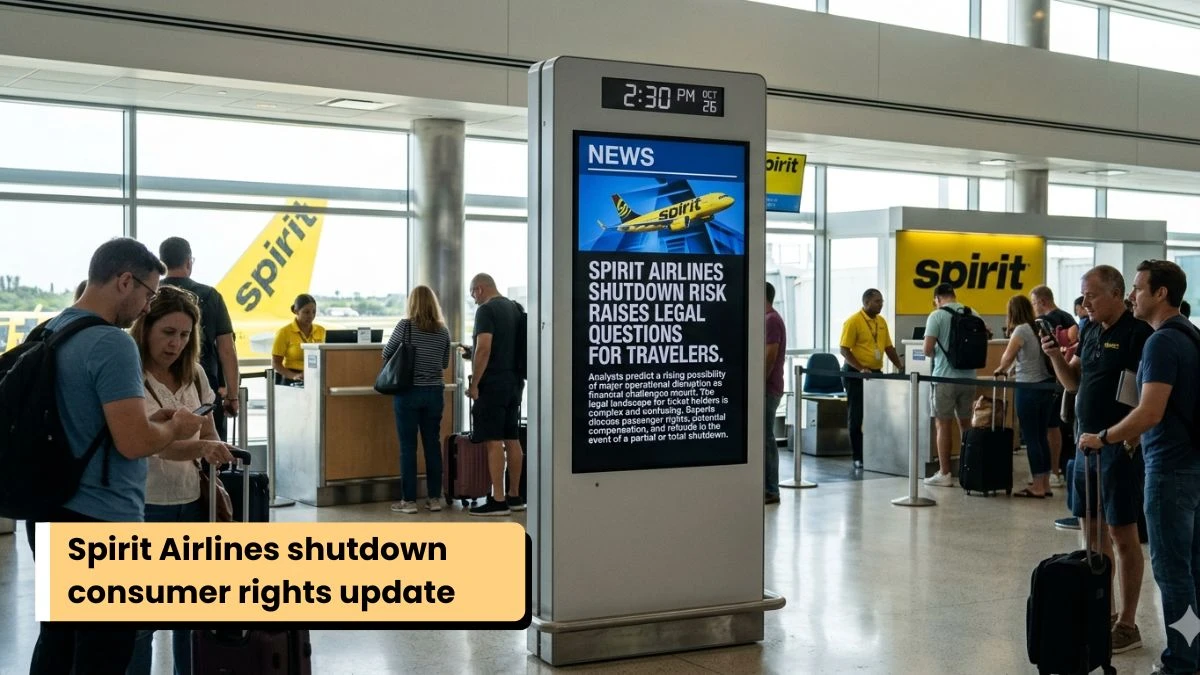
Spirit Airlines is reportedly preparing for a possible shutdown after rescue financing stalled. The situation raises significant legal issues involving bankruptcy, passenger refunds, employee protections, market competition, and federal oversight of the U.S. airline industry.
Spirit Airlines Faces New Crisis as Rescue Talks Stall
Spirit Airlines is once again at the center of a major financial and legal crisis. The ultra-low-cost carrier is reportedly preparing contingency plans for a potential operational shutdown after negotiations over a proposed $500 million federal rescue package failed to produce a final agreement.
The latest developments emerged on May 1, 2026, as reports indicated that Spirit had been unable to secure sufficient support from key bondholders and government officials for a last-minute financing arrangement. If the airline ceases operations, it would mark one of the most significant airline collapses in the United States since the 2008 financial crisis.
For consumers, investors, employees, and regulators, the stakes are substantial. A shutdown would trigger a complex web of legal rights, bankruptcy procedures, refund obligations, and potential regulatory intervention.
Latest Developments in the Spirit Airlines Crisis
Spirit has been operating under Chapter 11 bankruptcy protection while attempting to restructure its business, reduce debt, and emerge as a smaller, more financially stable airline. In March, the company announced a restructuring support agreement designed to cut its debt and lease obligations dramatically—from approximately $7.4 billion to roughly $2 billion.
That restructuring plan had been expected to position Spirit for emergence from bankruptcy by early summer 2026. However, rising fuel costs, ongoing liquidity pressure, and weakening investor confidence appear to have undermined those efforts.
A proposed federal rescue package reportedly would have provided up to $500 million in financing in exchange for warrants that could have given the U.S. government a substantial equity stake—potentially as much as 90% of the reorganized company. That deal now appears unlikely to move forward in its original form.
What This Means Under U.S. Bankruptcy Law
Spirit’s current restructuring is governed by Chapter 11 of the U.S. Bankruptcy Code, which allows companies to continue operating while reorganizing their debts. Chapter 11 is designed to preserve business value, protect jobs, and maximize recoveries for creditors.
If Spirit cannot secure adequate financing, it could be forced to convert its case to Chapter 7 liquidation. That would mean the airline would cease operations, liquidate assets, and distribute proceeds to creditors according to statutory priority rules.
In such a scenario, secured lenders would generally be paid first, followed by administrative expenses, employee wage claims (subject to statutory caps), certain tax obligations, and then unsecured creditors. Shareholders typically recover little or nothing in airline liquidations.
For ticket holders, claims for unused flights would likely become unsecured claims unless alternative arrangements are made. That is rarely an ideal position to be in—unsecured creditors are often last in line and first in disappointment.
Consumer Rights: What Happens to Tickets, Credits, and Loyalty Points?
If Spirit suspends operations, travelers could face immediate disruption. The legal protections available depend largely on how the shutdown unfolds.
Passengers who purchased tickets with a credit card may be able to seek chargebacks under the federal Fair Credit Billing Act if flights are canceled and refunds are not promptly issued.
Travelers who booked through online travel agencies may have additional contractual protections. Those who purchased travel insurance should review policy terms carefully, especially coverage for supplier default or airline insolvency.
Frequent flyer points and travel credits are generally treated as contractual obligations. In bankruptcy, their value can be modified, suspended, or extinguished, depending on court-approved restructuring terms.
Spirit has previously stated that tickets, credits, and loyalty points would remain valid during its Chapter 11 proceedings. That assurance, however, applies only while operations continue.
Competition and Antitrust Implications
Spirit’s potential exit would have major implications for competition in the U.S. airline market.
As one of the nation’s largest ultra-low-cost carriers, Spirit has played a critical role in price discipline, particularly on leisure routes. Its disappearance could reduce fare competition, especially in markets where legacy carriers already dominate.
This development also revives debate over the federal government’s 2024 successful challenge to the proposed JetBlue Airways acquisition of Spirit. That merger was blocked on antitrust grounds, with regulators arguing that eliminating Spirit would harm price-sensitive consumers.
Ironically, a Spirit liquidation could produce similar competitive consequences—only without the regulatory safeguards or continuity benefits that a merger might have offered.
Employment and Labor Law Consequences
A Spirit shutdown could jeopardize nearly 20,000 jobs, including pilots, flight attendants, mechanics, and corporate staff.
Employees would have important rights under federal labor and bankruptcy law. The Worker Adjustment and Retraining Notification (WARN) Act may require advance notice of mass layoffs, though exceptions can apply in bankruptcy or unforeseeable business circumstances.
Workers may also have priority claims for unpaid wages, salaries, commissions, and certain benefits. However, these claims are subject to statutory limits under the Bankruptcy Code.
Union contracts, pension obligations, and healthcare benefits could also become subject to renegotiation or termination through bankruptcy court proceedings.
Investor Risks and Securities Law Issues
Spirit’s financial distress also presents significant risks for shareholders and bondholders.
Equity holders in bankrupt companies often face severe dilution or total loss, especially where rescue financing includes substantial warrant or equity conversion rights.
Bondholders, meanwhile, may be forced to negotiate debt-for-equity exchanges, revised repayment terms, or reduced recoveries.
Any federal financing arrangement involving an ownership stake would likely raise additional questions concerning corporate governance, fiduciary duties, and disclosure obligations under U.S. securities laws.
Market volatility surrounding Spirit underscores the importance of understanding bankruptcy priority rules before investing in distressed companies.
Broader Regulatory and Policy Implications
Spirit’s situation highlights broader challenges facing the U.S. airline industry, including fuel price volatility, intense competition, and the fragile economics of ultra-low-cost carriers.
It may also prompt renewed scrutiny from the U.S. Department of Transportation, the Federal Aviation Administration, and antitrust authorities.
Regulators will likely focus on:
- Consumer refund enforcement
- Protection of stranded passengers
- Market concentration risks
- Labor and pension impacts
- Future airline restructuring policy
The case could also influence how policymakers approach financial assistance for strategically important but privately owned transportation companies.
What Travelers Should Do Now
Passengers with upcoming Spirit bookings should closely monitor official airline communications.
Practical steps include:
- Save copies of all itineraries and receipts
- Pay for future travel using a credit card
- Review travel insurance coverage
- Consider backup travel arrangements
- Monitor refund and cancellation policies
Travelers with imminent flights may want to assess alternative carriers, particularly if their travel plans are time-sensitive.
What Happens Next for Spirit Airlines?
Spirit’s immediate future will likely depend on whether it can secure emergency financing, finalize a revised restructuring plan, or negotiate a last-minute agreement with creditors and government stakeholders.
Possible outcomes include:
- Successful completion of its Chapter 11 restructuring
- Additional debtor-in-possession financing
- Asset sales or strategic partnerships
- Conversion to Chapter 7 liquidation
- Government-backed restructuring support
For now, Spirit remains operational, but the window for a sustainable recovery appears to be narrowing rapidly.
Conclusion: Spirit Airlines Crisis Carries Major Legal and Consumer Implications
The Spirit Airlines crisis is more than a business story. It is a significant legal, regulatory, and consumer protection event with implications across bankruptcy law, antitrust policy, labor rights, and airline regulation.
For passengers, the key issue is protecting refunds and travel plans. For employees, it is preserving wages and benefits. For investors, it is understanding the realities of distressed-company restructurings. And for regulators, it is balancing market competition with consumer protection.
As the Spirit Airlines situation unfolds, it will likely become one of the most closely watched airline restructurings in recent U.S. history.

Founder & Publisher, Law Act
Prabh Kalsi is the founder and publisher of Law Act. He manages the website’s content research, organization, editing, and publishing. Law Act’s legal content is developed using publicly available legislation, government resources, official publications, and other authoritative sources. The website provides general legal information for educational and informational purposes and does not provide personalized legal advice.