

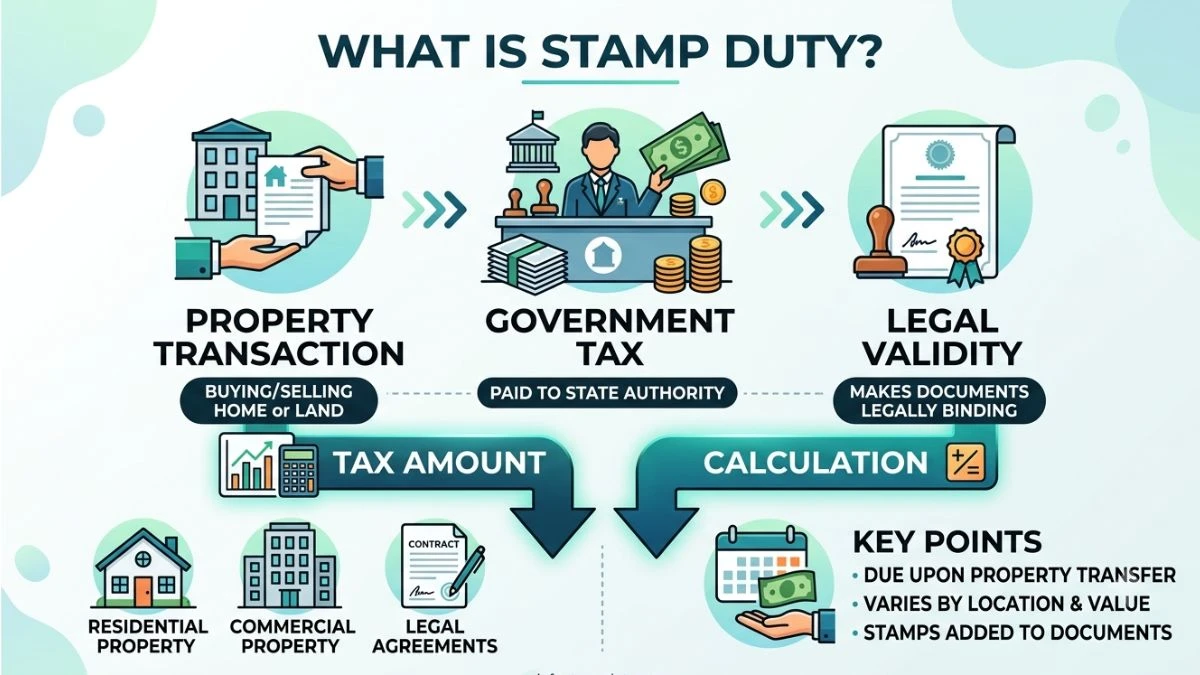
Stamp duty is a government tax charged on certain legal documents and instruments, such as property sale deeds, gift deeds, lease agreements and other transactions. In India, stamp duty rates and rules vary from state to state.
For example, when you buy a house or land, the sale deed may be subject to stamp duty. The amount payable depends on factors such as the type of document, transaction value, property value, location and the stamp duty law applicable in that state.
What Does Stamp Duty Mean?
Stamp duty is a tax imposed on specified instruments, meaning documents that create, transfer, limit, extend or record certain rights or obligations.
The Indian Stamp Act, 1899 contains provisions dealing with instruments chargeable with stamp duty. Section 3 is the main charging provision under the central Act, while state amendments and state stamp laws can affect the rules and rates applicable in a particular state.
Stamp duty is commonly associated with property transactions, but it can also apply to other documents depending on the applicable law.
Stamp Duty in Example
Suppose you purchase a property and execute a sale deed.
The government may require you to pay a particular amount of stamp duty on that document. The amount is not necessarily the same in every state.
Therefore:
Stamp duty = Government tax payable on certain chargeable legal instruments.
Why Is Stamp Duty Charged?
Stamp duty is primarily a form of government revenue imposed on instruments covered by the applicable stamp law.
It also provides a legal and administrative framework for documenting transactions.
For property transactions, properly stamping the relevant document is particularly important because an insufficiently stamped document can create legal and procedural problems.
Is Stamp Duty the Same Across India?
No. Stamp duty is not the same in every state.
This is one of the most important things to understand about stamp duty in India.
Although the Indian Stamp Act, 1899 is a central law, stamp duty has an important state-law component. States may have their own stamp laws, amendments, schedules, rates, exemptions and procedures.
Therefore, the stamp duty payable on the same type of transaction can differ depending on the state.
For example, the stamp duty payable on a property transaction in Delhi may be different from the amount payable for a similar transaction in Maharashtra, Uttar Pradesh or Karnataka.
Always check the applicable state law and current government rate before calculating stamp duty.
On Which Documents Is Stamp Duty Paid?
Stamp duty may apply to different types of instruments depending on the applicable law.
Common examples include:
| Document | Common Purpose |
|---|---|
| Sale Deed | Transfer of property ownership |
| Gift Deed | Transfer of property as a gift |
| Lease Agreement | Creating a lease or tenancy |
| Mortgage Deed | Creating a mortgage or security interest |
| Agreement to Sell | Agreement for a future sale |
| Partnership Deed | Recording the terms of a partnership |
| Power of Attorney | Authorising another person to act on behalf of the principal |
| Certain Financial or Commercial Instruments | Recording transactions covered by stamp laws |
The exact stamp duty depends on the document and the law applicable to it.
How Is Stamp Duty Calculated?
There is no single stamp duty calculation formula that applies to every document or every state in India.
Depending on the transaction, the calculation may consider:
- Type of document
- Transaction value
- Property value
- Market value or government-assessed value
- Location of the property
- Nature of the transaction
- Applicable state stamp duty rate
- Applicable exemptions or concessions
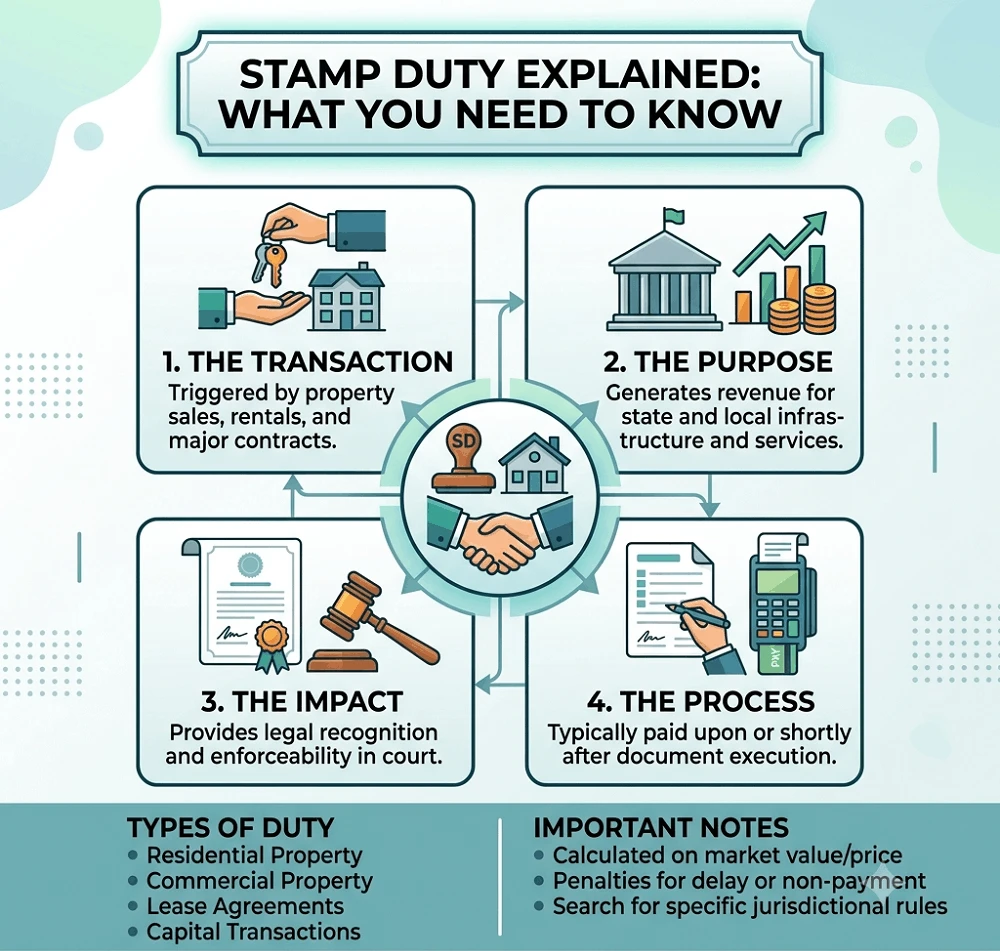
Stamp Duty on Property
For property transactions, the applicable duty may be linked to the property’s transaction value or the value determined under the relevant state rules.
In many jurisdictions, authorities use a government-determined value such as a circle rate, guidance value, ready reckoner value or similar benchmark.
Therefore, you should not assume that stamp duty is always calculated simply by multiplying the purchase price by a fixed percentage.
The applicable state rules should be checked before calculating the amount.
Who Pays Stamp Duty?
The person responsible for paying stamp duty depends on the type of instrument and the applicable law.
In a typical property purchase, the buyer commonly bears the stamp duty, but the legal responsibility can vary depending on the document, transaction and applicable provisions.
The parties should therefore check the relevant stamp law instead of relying only on a general rule.
When Should Stamp Duty Be Paid?
The time for stamping a document depends on the applicable stamp law and the type of instrument.
Some instruments must be stamped before or at the time of execution, while specific rules can apply to other documents.
For property transactions, stamp duty is commonly dealt with as part of the process of executing and registering the relevant document.
Because the timing requirements can vary, it is important to follow the applicable state procedure.
What Happens If Stamp Duty Is Not Paid?
If a document that is chargeable with stamp duty is not properly stamped, it can have legal consequences.
Under Section 33 of the Indian Stamp Act, certain authorities have powers relating to the examination and impounding of instruments that appear not to be duly stamped.
Section 35 provides restrictions on admitting an instrument chargeable with duty in evidence when it is not duly stamped, subject to the provisions of the Act, including the procedure for payment of the required duty and penalty where applicable.
Does an Unstamped Document Become Completely Invalid?
Not necessarily.
This is an important distinction.
An unstamped or insufficiently stamped document can face restrictions on its use in evidence or other legal consequences, but it is too broad to say that every unstamped document is automatically “invalid.”
The exact consequence depends on the document, the applicable stamp law and the circumstances of the case.
For this reason, legal content should avoid using “invalid” as a blanket description of every unstamped document.
Stamp Duty vs Registration Charges
Stamp duty and registration charges are not the same thing.
| Stamp Duty | Registration Charges |
| A tax imposed on certain instruments | A fee associated with registration of documents |
| Governed by applicable stamp laws | Governed primarily by registration laws and applicable rules |
| May apply to property transactions and other instruments | Commonly arises when a document is registered |
| Amount varies according to applicable law | Amount varies according to applicable rules |
| Paid to the government | Paid to the government |
For many property transactions, both stamp duty and registration charges may be payable.
Stamp Duty vs Property Registration: What Is the Difference?
A simple way to understand the difference is:
Stamp duty is a tax on a chargeable instrument, while registration is the process of officially registering a document with the appropriate authority.
For example, during a property transaction, a buyer may have to pay stamp duty on the sale deed and also pay registration charges when the document is registered.
The two charges should therefore not be treated as interchangeable.
What Are the Important Sections of the Indian Stamp Act?
Several provisions of the Indian Stamp Act, 1899 are particularly relevant when discussing stamp duty.
Section 3 – Instruments Chargeable With Duty
Section 3 is the main charging provision. It identifies instruments that are chargeable with stamp duty under the Act, subject to its provisions and exemptions.
Section 29 – Duties by Whom Payable
Section 29 deals with who is responsible for paying the duty in specified cases. The actual responsibility depends on the type of instrument and the applicable provision.
Section 31 – Adjudication as to Proper Stamp
Section 31 provides for adjudication regarding the proper stamp in circumstances covered by the provision.
Section 33 – Examination and Impounding of Instruments
Section 33 deals with the examination and impounding of instruments that are not duly stamped.
Section 35 – Instruments Not Duly Stamped
Section 35 contains important restrictions concerning the admission in evidence of instruments that are chargeable with duty but are not duly stamped, subject to the provisions of the Act.
Important Supreme Court Decisions on Stamp Duty
Indian courts have considered several important questions involving unstamped and insufficiently stamped documents.
Avinash Kumar Chauhan v. Vijay Krishna Mishra
In Avinash Kumar Chauhan v. Vijay Krishna Mishra, (2009) 2 SCC 532, the Supreme Court considered the consequences of an insufficiently stamped document and the restrictions under the Stamp Act.
SMS Tea Estates Pvt. Ltd. v. Chandmari Tea Co. Pvt. Ltd.
In SMS Tea Estates Pvt. Ltd. v. Chandmari Tea Co. Pvt. Ltd., (2011) 14 SCC 66, the Supreme Court considered issues involving an arbitration agreement contained in an insufficiently stamped document.
N.N. Global Mercantile Pvt. Ltd. v. Indo Unique Flame Ltd.
The Supreme Court’s Constitution Bench decision in N.N. Global Mercantile Pvt. Ltd. v. Indo Unique Flame Ltd. examined the relationship between stamp duty requirements and arbitration agreements contained in unstamped or insufficiently stamped instruments.
Because the law concerning unstamped arbitration agreements has developed through multiple decisions, the current legal position should be checked against the latest judgment and applicable statutory provisions before relying on an older summary.
How Can Stamp Duty Be Paid?
The method of paying stamp duty depends on the state and the type of document.
Depending on the applicable system, stamp duty may be paid through methods such as:
- E-stamping
- Online payment
- Stamp paper
- Franking
- Other government-approved methods
Not every method is available for every document or in every state.
The safest approach is to use the official portal or procedure prescribed by the relevant state government.
Is Stamp Duty Refundable?
A stamp duty refund may be available in certain circumstances, but there is no universal refund rule for every transaction.
Refund eligibility, deadlines, deductions and procedures depend on the applicable law and the circumstances of the transaction.
If a transaction is cancelled or a stamped document is not used, the relevant state rules should be checked before assuming that the entire stamp duty can be refunded.
Frequently Asked Questions
What is stamp duty in simple words?
Stamp duty is a government tax charged on certain legal documents and transactions. It is commonly associated with property documents such as sale deeds, gift deeds and lease agreements.
Is stamp duty a tax?
Yes. Stamp duty is a form of tax imposed on instruments covered by the applicable stamp law.
Is stamp duty mandatory in India?
Stamp duty is mandatory for instruments that are chargeable with duty under the applicable law, subject to exemptions and other legal provisions.
Who pays stamp duty when buying a property?
In many property transactions, the buyer pays the stamp duty. However, responsibility can depend on the type of document and the applicable law.
How is stamp duty calculated on property?
The calculation depends on the applicable state law and may consider the transaction value, government-assessed property value and other prescribed factors.
Is stamp duty the same in all Indian states?
No. Stamp duty rates, exemptions, procedures and concessions can vary between states.
What is the difference between stamp duty and registration charges?
Stamp duty is a tax on applicable instruments, whereas registration charges are fees associated with registering a document with the government.
Can stamp duty be paid online?
Yes, in many states. Several state governments provide online or electronic methods for paying stamp duty, but the available method depends on the state and document.
What happens if a document is not properly stamped?
An insufficiently stamped document may face legal restrictions, including restrictions on its admission in evidence under applicable provisions. Additional duty and penalty may also become payable in circumstances provided by law.
Does an unstamped document have no legal value?
Not necessarily. The legal consequences depend on the document, the applicable stamp law and the circumstances. It is therefore better to say that an insufficiently stamped document may face restrictions rather than saying that every such document is automatically invalid.
Is stamp duty required for a rent or lease agreement?
It can be. Whether stamp duty applies, and how much is payable, depends on the type and duration of the lease and the applicable state stamp law.
Key Points to Remember
- Stamp duty is a government tax on specified instruments.
- The Indian Stamp Act, 1899 contains important central provisions relating to stamp duty.
- Stamp duty rules and rates can vary between Indian states.
- Property transactions commonly involve stamp duty.
- Stamp duty and registration charges are different.
- The person responsible for paying stamp duty depends on the applicable law and type of instrument.
- An insufficiently stamped document can face restrictions under the Stamp Act.
- Section 3 is an important charging provision.
- Section 33 deals with examination and impounding of instruments.
- Section 35 deals with restrictions concerning instruments that are not duly stamped.
- Online and electronic payment methods are available in many states.
- Always check the current state-specific rules before calculating or paying stamp duty.
Conclusion
Stamp duty is a government tax charged on certain legal documents and transactions in India. It is especially important in property transactions, where documents such as sale deeds, gift deeds and lease agreements may be subject to stamp duty.
The amount payable is not the same throughout India. It depends on the applicable state law, type of document, transaction value, property value and other prescribed factors.
If you are buying property or executing an important legal document, check the current rules of the concerned state before paying stamp duty. For complex or high-value transactions, professional legal advice can help avoid costly mistakes.
Sources & References
- Indian Stamp Act, 1899 – India Code: https://www.indiacode.nic.in/
- Constitution of India – Legislative Department, Government of India: https://legislative.gov.in/constitution-of-india/
Explore Question Categories

Founder & Publisher, Law Act
Prabh Kalsi is the founder and publisher of Law Act. He manages the website’s content research, organization, editing, and publishing. Law Act’s legal content is developed using publicly available legislation, government resources, official publications, and other authoritative sources. The website provides general legal information for educational and informational purposes and does not provide personalized legal advice.