


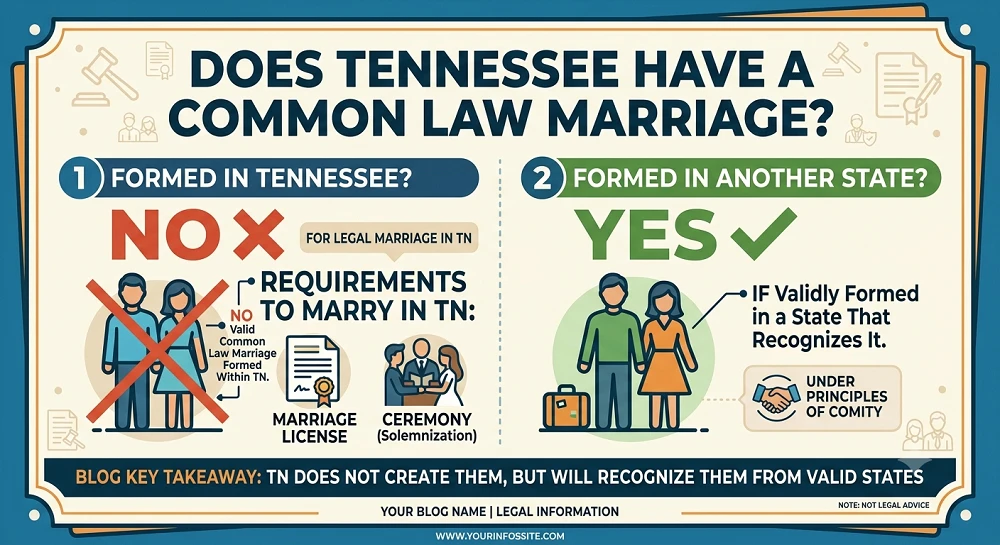
No. Tennessee does not recognize common law marriages created in Tennessee. Simply living together for many years, sharing a home or finances, using the same last name, or having children together does not automatically make a couple legally married under Tennessee law.
Tennessee treats marriage as a matter governed by state law. Tennessee Code Annotated § 36-3-103 requires the parties to obtain a marriage license before being joined in marriage, and Tennessee law provides for the solemnization of the marriage by an authorized person.
However, there is an important exception: Tennessee courts may recognize a common law marriage that was legally established in another state where common law marriage is permitted.
Does Tennessee Recognize Common Law Marriage?
No. A couple cannot create a common law marriage simply by living together in Tennessee.
Tennessee courts have explained that marriage in Tennessee is statutory and that a common law marriage cannot be created in Tennessee merely through the parties’ conduct. In Martin v. Coleman, the Tennessee Supreme Court stated that marriage in Tennessee is subject to statutory control. Tennessee appellate courts have continued to apply this rule.
Therefore, there is no specific number of years that a couple can live together in Tennessee and automatically become married.
Is There a 7-Year Common Law Marriage Rule in Tennessee?
No. Tennessee does not have a seven-year common law marriage rule.
Living together for 7 years, 10 years, or even longer does not by itself create a legal marriage in Tennessee.
This is one of the most common misconceptions about common law marriage. The length of a relationship does not substitute for the legal requirements for marriage.
What Makes a Marriage Valid in Tennessee?
Tennessee marriage law generally requires the parties to follow the state’s legal marriage process.
Under Tennessee Code Annotated § 36-3-103, the parties must obtain a marriage license before being joined in marriage.
Tennessee law also identifies persons who may legally solemnize a marriage under § 36-3-301.
The marriage ceremony does not have to follow one specific formula. Tennessee Code Annotated § 36-3-302 provides that no particular formula is required for solemnization, although the parties must make the required declaration before the authorized minister or officer.
The person who solemnizes the marriage is also required to endorse and return the marriage license to the county clerk within the time required by law.
What Does Not Create a Common Law Marriage in Tennessee?
The following circumstances, by themselves, do not create a common law marriage in Tennessee:
- Living together for several years
- Sharing a home
- Sharing a bank account
- Having joint bills
- Having children together
- Introducing each other as husband and wife
- Using the same last name
- Wearing wedding rings
- Buying property together
- Filing certain documents as a couple
- Having a long-term relationship
These circumstances may be evidence of a relationship, but they do not independently create a Tennessee common law marriage.
Does Tennessee Recognize a Common Law Marriage From Another State?
Yes, potentially.
This is an important exception to Tennessee’s general rule.
Tennessee courts have recognized that although a common law marriage cannot be created in Tennessee, Tennessee may recognize a marriage that was validly established under the law of another state where common law marriage is permitted.
For example, suppose a couple legally establishes a common law marriage in a state that recognizes this type of marriage. The couple later moves to Tennessee.
Tennessee courts may recognize the marriage if it was actually valid under the law of the state where it was created.
However, simply traveling to another state or claiming to be married does not automatically establish a common law marriage. The couple must satisfy the legal requirements of the state where the alleged common law marriage was formed.
What Happens If a Couple Moves to Tennessee?
Moving to Tennessee does not automatically destroy a valid marriage that was legally created somewhere else.
For common law marriages, the important question may be whether the couple actually established a valid marriage under the law of the state where the marriage arose.
Tennessee appellate decisions have specifically addressed this issue and have recognized the distinction between:
- Creating a common law marriage in Tennessee; and
- Recognizing a common law marriage that was validly created in another jurisdiction.
Tennessee does not permit the first, but its courts may recognize the second.
Can an Unmarried Couple Get Married Without a Traditional Wedding?
A large formal wedding is not necessarily required.
The important point is that the parties must comply with Tennessee’s legal requirements for marriage, including the marriage-license and solemnization requirements. Tennessee law does not require a particular ceremony formula.
Therefore, not having a large wedding is different from having a common law marriage.
A couple can have a simple legal marriage without having a traditional wedding celebration.
What Rights Do Unmarried Couples Have in Tennessee?
Unmarried partners generally do not automatically receive all of the legal rights and protections that Tennessee law provides to spouses.
For example, issues involving property, inheritance, medical decisions, and financial matters can become more complicated when two people live together without being legally married.
Depending on their circumstances, unmarried couples may consider documents such as:
- A will
- Power of attorney
- Advance medical directives
- Beneficiary designations
- Property ownership agreements
- Cohabitation agreements
The appropriate documents depend on the couple’s individual circumstances.
Common Law Marriage vs. Legal Marriage in Tennessee
| Issue | Legally Married Couple | Unmarried Couple |
|---|---|---|
| Marriage status | Legally married | Not automatically married |
| Divorce | Divorce proceedings are available | No divorce is required merely to end cohabitation |
| Inheritance | Spousal rights may apply | Rights may depend on a will, beneficiary designation, or other law |
| Property | Marital-property rules may apply | Ownership generally depends on title and other legal principles |
| Spousal support | May be available in a divorce | Generally not available simply because the couple lived together |
| Medical and financial planning | Some rights may arise from marital status | Additional legal documents may be important |
The specific legal consequences depend on the facts of each case.
What Tennessee Law Says About Marriage Licenses
Tennessee Code Annotated § 36-3-103 provides that, before the parties are joined in marriage, they must present a marriage license issued by a Tennessee county clerk to the minister or officer authorized to solemnize the marriage.
Tennessee’s marriage statutes are contained primarily in Title 36, Chapter 3 of the Tennessee Code, which covers marriage licensing and ceremonies.
What Tennessee Courts Say About Common Law Marriage
Tennessee appellate courts have repeatedly distinguished between common law marriages created in Tennessee and valid common law marriages created elsewhere.
In Bowser v. Bowser, the Tennessee Court of Appeals explained that common law marriages based on conduct in Tennessee are not recognized, while Tennessee courts may recognize a valid common law marriage entered into under the law of another state where such marriages are permitted.
The Tennessee Court of Appeals has similarly stated that common law marriage cannot be entered into in Tennessee but that a marriage validly contracted in a state recognizing common law marriage may be recognized in Tennessee.
Frequently Asked Questions
Does living together for 7 years make you married in Tennessee?
No. Tennessee does not have a seven-year rule that automatically creates a common law marriage.
How many years do you have to live together to be common law married in Tennessee?
There is no number of years. Tennessee does not allow a couple to create a common law marriage merely by living together in Tennessee.
Can you be common law married in Tennessee?
You cannot create a common law marriage in Tennessee simply through cohabitation or conduct. However, Tennessee may recognize a common law marriage that was legally created in another state that permits common law marriage.
Does Tennessee recognize common law marriage from another state?
Yes, potentially. Tennessee courts may recognize a common law marriage that was validly established under the law of another state where common law marriage is legally permitted.
Does having children together create a common law marriage in Tennessee?
No. Having children together does not, by itself, create a common law marriage in Tennessee.
Does sharing a last name make you married in Tennessee?
No. Using the same last name does not by itself create a legal marriage.
Does buying a house together make you married?
No. Joint ownership of real estate does not automatically create a marriage.
Can an unmarried couple live together legally in Tennessee?
Yes. Living together does not by itself create a legal marriage.
Do you need a wedding ceremony to get married in Tennessee?
Tennessee law requires legal solemnization of the marriage, but it does not require one particular ceremony format. Tennessee Code Annotated § 36-3-302 states that no specific formula is required, subject to the statutory requirements.
Key Takeaways
- Tennessee does not recognize common law marriages created within Tennessee.
- Living together does not automatically make a couple married.
- There is no seven-year common law marriage rule in Tennessee.
- A marriage license is part of Tennessee’s statutory marriage process.
- Tennessee law provides for marriage solemnization by authorized persons.
- Tennessee may recognize a valid common law marriage created in another state where common law marriage is permitted.
- The validity of an out-of-state common law marriage depends on the law and facts applicable where the alleged marriage was created.
- Unmarried couples may need separate estate, property, financial, and medical-planning documents.
Relevant Tennessee Law
The primary Tennessee statutes relevant to this issue include:
- Tennessee Code Annotated § 36-3-103 — License required
- Tennessee Code Annotated § 36-3-301 — Persons who may solemnize marriages
- Tennessee Code Annotated § 36-3-302 — Formula not required
- Tennessee Code Annotated § 36-3-303 — Return of license to clerk
- Tennessee Code Annotated § 36-3-304 — Form of certificate
These provisions are part of Title 36, Chapter 3 of the Tennessee Code.
Conclusion
Tennessee does not recognize a common law marriage created in Tennessee. A couple does not become legally married simply because they live together for a certain number of years or share finances, property, or a family.
Tennessee’s marriage laws require the parties to follow the state’s statutory marriage process, including obtaining a marriage license and having the marriage solemnized as required by law.
However, Tennessee courts may recognize a common law marriage that was validly created in another state that permits common law marriage.
If you believe you may have a common law marriage from another state, the specific facts and the law of that state can be important. For a legal dispute involving property, inheritance, divorce, or marital status, consider consulting a Tennessee family-law attorney.
Sources & References
Explore Question Categories

Prabh Kalsi provides global legal information and educational content to help readers understand legal concepts, rights, and processes across different countries. With experience in researching legal topics and simplifying complex legal information, he creates easy-to-understand content based on publicly available and trusted sources. This content is intended for informational purposes only.