

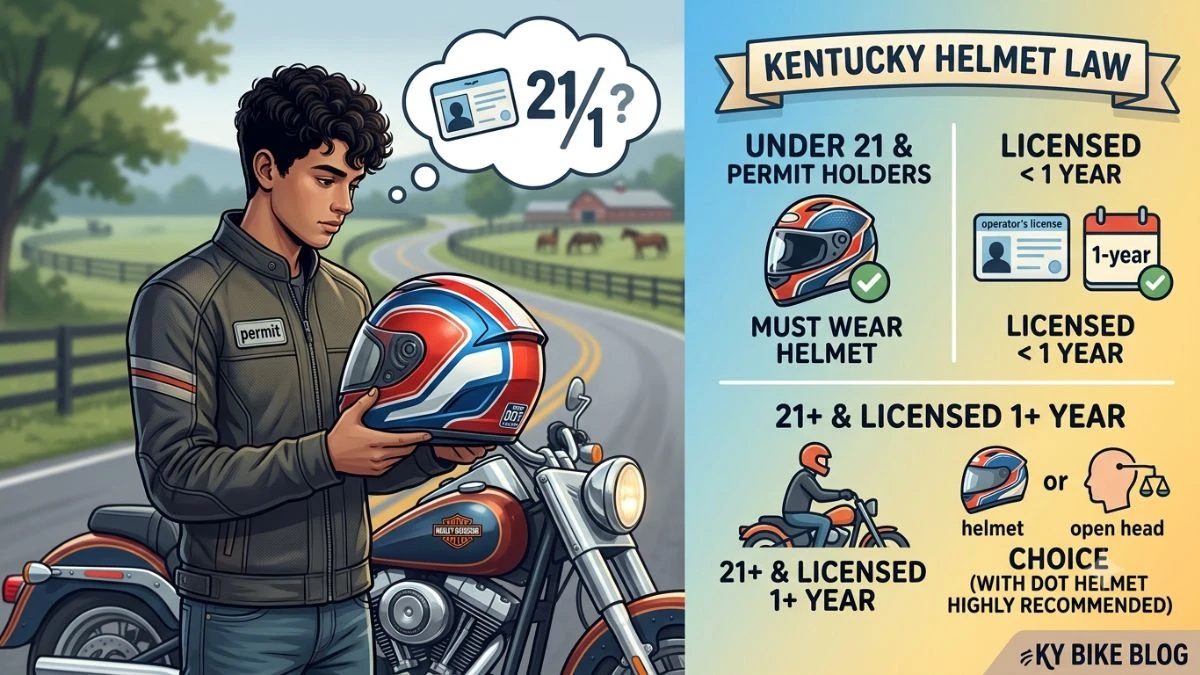
Yes. Kentucky has a motorcycle helmet law, but it is not a universal helmet law. Kentucky requires certain motorcycle riders and passengers to wear protective headgear, while some experienced adult riders may legally operate a motorcycle without a helmet.
Under Kentucky Revised Statutes (KRS) § 189.285, motorcycle helmet requirements depend mainly on the person’s age and licensing status. The law also requires motorcycle operators to use approved eye protection while operating on a highway.
Who Must Wear a Motorcycle Helmet in Kentucky?
Kentucky law requires protective headgear when a motorcycle is being operated on a public highway for the following people:
| Rider or passenger | Helmet required? |
|---|---|
| Motorcycle rider under 21 | Yes |
| Motorcycle passenger under 21 | Yes |
| Person under 21 riding in a sidecar | Yes |
| Motorcycle instruction-permit holder operating a motorcycle | Yes |
| Motorcycle operator licensed for less than 1 year | Yes |
| Adult operator who has held a motorcycle license for at least 1 year | Generally no |
These requirements come directly from KRS § 189.285(3). The statute specifically covers people under 21 who operate or ride as passengers, motorcycle instruction-permit holders, and operators who have held a valid motorcycle operator’s license for less than one year.
Can You Ride a Motorcycle Without a Helmet in Kentucky?
Yes, in certain circumstances.
Kentucky does not require every motorcycle rider to wear a helmet. An operator who is not within one of the categories listed in KRS § 189.285(3) may generally ride without protective headgear.
For example, an adult rider who is at least 21 and has held a valid motorcycle operator’s license for at least one year generally does not have a statutory helmet requirement under KRS § 189.285.
However, age by itself is not the only factor. A person who is 21 or older may still have to wear a helmet if another statutory requirement applies, such as operating a motorcycle with an instruction permit or having held the required motorcycle license for less than one year.
Is Kentucky a Universal Motorcycle Helmet Law State?
No. Kentucky is not a universal motorcycle helmet-law state.
A universal helmet law would generally require motorcycle operators and passengers to wear helmets regardless of age or licensing history. Kentucky instead uses a limited requirement that applies to specific categories of riders and passengers.
The three main circumstances are:
- The person is under 21.
- The person is operating with a motorcycle instruction permit.
- The person has held a valid motorcycle operator’s license for less than one year.
The exact language of the statute should be used when determining whether a particular rider is legally required to wear protective headgear.
What Does KRS § 189.285 Say About Motorcycle Helmets?
KRS § 189.285 is the primary Kentucky statute governing motorcycle operation, headgear, and related safety requirements.
Subsection (3) requires protective headgear for:
- A person under 21 who operates a motorcycle or rides as a passenger on a motorcycle or in a sidecar;
- A person with a motorcycle instruction permit who is operating a motorcycle; and
- A person who has held a valid motorcycle operator’s license, or a combination motor vehicle-motorcycle operator’s license, for less than one year and is operating a motorcycle.
The same statute also addresses licensing, eye protection, motorcycle seating, footrests, mirrors, and other operating requirements.
Does a Motorcycle Passenger Have to Wear a Helmet in Kentucky?
It depends on the passenger’s age.
A passenger under 21 must wear protective headgear while riding on a motorcycle or in a sidecar attachment on a public highway.
The statute specifically includes passengers in its under-21 requirement. It does not impose the same helmet requirement on every adult motorcycle passenger.
This means an adult passenger is treated differently from a passenger under 21 under Kentucky’s helmet statute.
What If the Rider Has a Motorcycle Instruction Permit?
A person operating a motorcycle with a motorcycle instruction permit must wear protective headgear.
Kentucky also places a separate restriction on instruction-permit operators: a person authorized to drive a motorcycle under an instruction permit is not authorized to carry passengers.
Therefore, a permit holder should not assume that the rules applicable to an experienced licensed rider also apply to the permit holder.
How Long Must You Have a Motorcycle License to Ride Without a Helmet?
For an operator who is otherwise subject to the licensing-based helmet requirement, Kentucky law specifies a one-year period.
KRS § 189.285 requires protective headgear for a motorcycle operator who has held a valid motorcycle operator’s license, or a combination motor vehicle-motorcycle operator’s license, for less than one year.
Once the operator has held the qualifying license for at least one year, that particular statutory helmet requirement no longer applies, assuming no other provision requires the rider to wear protective headgear.
What Kind of Motorcycle Helmet Is Legal in Kentucky?
When Kentucky law requires a rider to wear protective headgear, the helmet must satisfy the standards established by the Kentucky Transportation Cabinet.
Under 601 KAR 14:010, required protective headgear must:
- Meet the requirements of 49 CFR 571.218; and
- Have a permanent and legible DOT label meeting the requirements specified by the regulation.
The regulation specifies where the DOT marking must appear and how it must be displayed.
Therefore, when a helmet is legally required, using compliant protective headgear is important rather than relying on a helmet simply because it looks like a motorcycle helmet.
Does Kentucky Require Motorcycle Eye Protection?
Yes. Eye protection is a separate requirement from the helmet rule.
KRS § 189.285(1)(b) states that a person may not operate a motorcycle on a highway unless the person uses an approved eye-protective device while the motorcycle is in motion.
Kentucky’s administrative regulation, 601 KAR 14:010, establishes standards for these eye-protective devices. The regulation requires the device to meet the Vehicle Equipment Safety Commission’s requirements and to carry the specified marking, such as “VESC-8” or “V-8” where space is limited.
This requirement is important because being legally permitted to ride without a helmet does not mean a motorcycle operator is free from Kentucky’s eye-protection requirement.
What Other Motorcycle Equipment Does Kentucky Require?
Kentucky’s motorcycle rules cover more than protective headgear.
Under KRS § 189.285, a motorcycle operator must:
- Possess a valid motorcycle operator’s license when operating on a highway;
- Use an approved eye-protective device while the motorcycle is moving;
- Operate a motorcycle equipped with the required rear-view mirror;
- Use a permanently attached seat designed for the operator or passenger; and
- Use a permanently attached footrest designed for the person riding the motorcycle.
These requirements operate separately from the question of whether the rider must wear a helmet.
Are Motor Scooters Covered by Kentucky’s Helmet Rules?
Kentucky’s law also specifically addresses motor scooters.
Under KRS § 189.2851, a motor scooter operated on a highway is treated as a motorcycle for certain legal and equipment purposes, and the operator is subject to the protective headgear requirements of KRS § 189.285.
Therefore, someone operating a qualifying motor scooter should not assume that the state’s motorcycle helmet requirements do not apply simply because the vehicle is called a scooter.
What Happens If You Ride Without a Required Helmet?
If Kentucky law requires a person to wear protective headgear and the person operates or rides without the required helmet, the conduct may violate KRS § 189.285.
The legal consequences of a particular violation can depend on the circumstances. Issues can become more complicated when a motorcycle crash, injury, insurance claim, or personal-injury lawsuit is involved.
Helmet use may become one of several facts considered in a legal dispute. Anyone involved in a serious motorcycle accident should consider obtaining advice from a Kentucky attorney about the specific circumstances rather than relying solely on a general online article.
Did Kentucky Previously Have a Universal Motorcycle Helmet Requirement?
Kentucky’s motorcycle helmet rules have changed over time.
The current statute does not impose a universal helmet requirement on every motorcycle operator and passenger. Instead, KRS § 189.285 identifies specific categories of people who must wear protective headgear.
Because older articles and websites may describe Kentucky’s previous motorcycle helmet requirements, readers should check the current version of the Kentucky Revised Statutes when researching the law.
Is It Safer to Wear a Helmet Even When Kentucky Law Does Not Require One?
Yes.
The fact that Kentucky law permits some experienced adult riders to operate without a helmet does not mean riding without one is risk-free.
A motorcycle helmet can provide protection against serious head injuries in a crash. Therefore, there is an important distinction between what Kentucky law permits and what may provide greater personal protection.
For riders who are not legally required to wear a helmet, choosing to wear appropriate protective headgear remains a safety decision.
Frequently Asked Questions
Can a 20-year-old motorcycle rider ride without a helmet in Kentucky?
No. A person under 21 who operates a motorcycle on a public highway is within the category required to wear protective headgear under KRS § 189.285(3)(a).
Does a 21-year-old automatically have the same helmet rules as an older rider?
Not necessarily. Turning 21 changes the age-based requirement, but licensing status can still matter. For example, an operator with a motorcycle instruction permit or an operator who has held the required motorcycle license for less than one year may still be required to wear protective headgear.
Can a motorcycle permit holder carry a passenger in Kentucky?
No. KRS § 189.285(4) states that a person operating a motorcycle under an instruction permit is not authorized to carry passengers.
Does Kentucky require a rear-view mirror on a motorcycle?
Yes. KRS § 189.285(1)(c) requires a motorcycle operated on a highway to be equipped with a rear-view mirror as required by KRS § 189.130.
Does Kentucky’s helmet rule apply to motor scooters?
Yes. KRS § 189.2851 specifically makes a motor scooter operator subject to the protective headgear requirements of KRS § 189.285.
What DOT standard applies to a helmet required under Kentucky law?
Kentucky’s 601 KAR 14:010 requires protective headgear to meet 49 CFR 571.218 and to have the specified permanent DOT labeling.
Does Kentucky require eye protection if a rider is already wearing a helmet?
Yes. The eye-protection requirement is separate. A motorcycle operator must use an approved eye-protective device while operating a motorcycle on a highway.
Where can I check the official Kentucky motorcycle helmet law?
The primary statute is KRS § 189.285, while the standards for protective headgear and eye-protective devices are contained in 601 KAR 14:010. The Kentucky Legislature’s official website provides the current statutory and administrative-regulation text.
Sources & References
Explore Question Categories

Founder & Publisher, Law Act
Prabh Kalsi is the founder and publisher of Law Act. He manages the website’s content research, organization, editing, and publishing. Law Act’s legal content is developed using publicly available legislation, government resources, official publications, and other authoritative sources. The website provides general legal information for educational and informational purposes and does not provide personalized legal advice.