

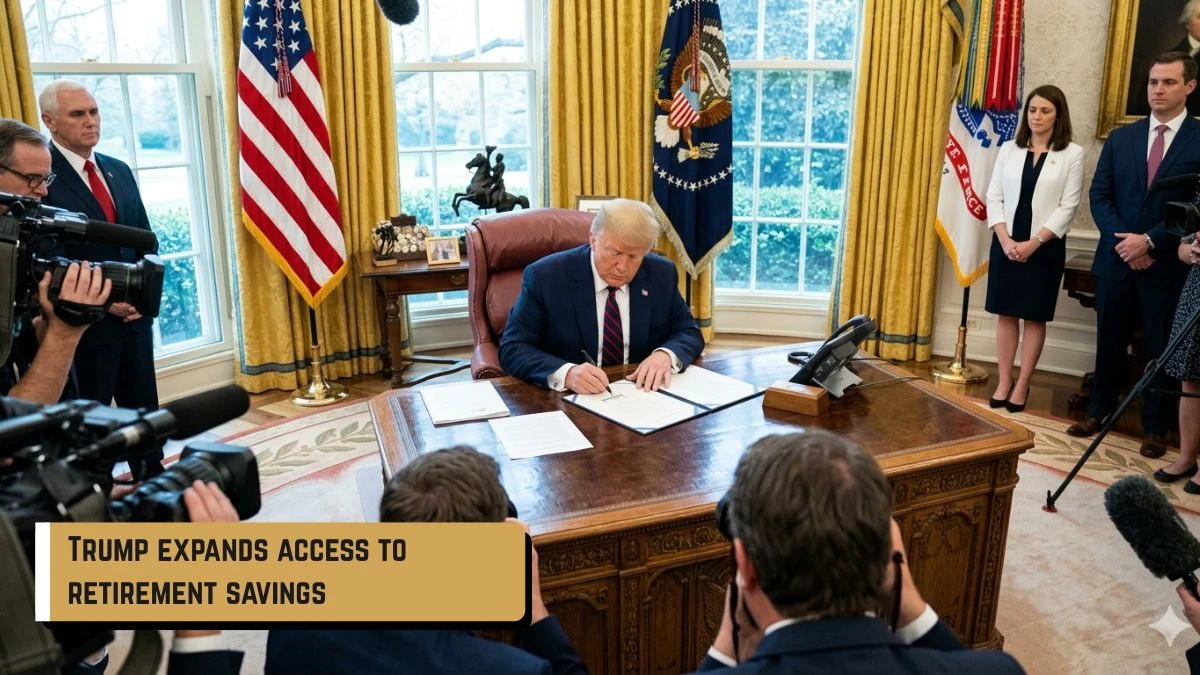
President Trump has signed an executive order creating TrumpIRA.gov, a new federal platform designed to help millions of Americans without employer-sponsored retirement plans access low-cost IRAs. The initiative builds on Secure 2.0’s Saver’s Match and could significantly expand retirement savings opportunities for uncovered workers.
President Donald Trump has signed an executive order aimed at expanding retirement savings access for millions of Americans who currently lack employer-sponsored retirement plans. The order, signed April 30, 2026, directs the U.S. Treasury Department to establish TrumpIRA.gov, a new federal platform intended to connect workers with low-cost private-sector retirement accounts.
The move addresses one of the most persistent gaps in the U.S. retirement system: access. Tens of millions of workers—particularly part-time employees, independent contractors, gig workers, and small-business employees—do not have access to a workplace 401(k) or similar retirement plan. For these workers, saving for retirement has often been more difficult, more expensive, and less automatic.
What Trump’s Executive Order Does
The executive order instructs the Treasury Department to launch TrumpIRA.gov by January 1, 2027. The website will function as a centralized marketplace where eligible workers can compare and enroll in private individual retirement accounts (IRAs) offered by vetted financial institutions.
These accounts are expected to feature:
- Low fees
- Transparent investment options
- Portability across jobs
- Simplified enrollment
- Eligibility for federal matching contributions
The platform is designed to resemble the streamlined investment options available through the federal government’s Federal Retirement Thrift Investment Board and the Thrift Savings Plan.
Why This Matters
Retirement access remains a major policy issue in the United States. According to recent estimates, roughly 41 million Americans between ages 18 and 65 do not have access to an employer-sponsored retirement plan. Other estimates place the broader retirement coverage gap at more than 50 million workers.
Workers most affected include:
- Employees of small businesses
- Part-time workers
- Independent contractors
- Self-employed individuals
- Gig economy workers
Without workplace access, many workers fail to save at all, even when they are eligible to open an IRA independently. Behavioral economics research consistently shows that convenience, automatic enrollment, and matching contributions significantly increase participation.
How the Saver’s Match Fits In
A key feature of the initiative is its integration with the federal Saver’s Match program, created under the bipartisan Secure 2.0 Act of 2022. Beginning in 2027, eligible low- and moderate-income workers who contribute to qualifying retirement accounts can receive a federal matching contribution.
For qualifying individuals:
- The federal government may match up to 50% of contributions
- Maximum annual federal match: $1,000 per person
- Married couples may qualify for up to $2,000
Eligibility generally phases out for individuals earning above approximately $35,500 and couples earning above approximately $71,000, though exact thresholds will be adjusted for inflation and IRS guidance.
Importantly, the executive order does not create the Saver’s Match. That benefit was enacted by Congress through Secure 2.0 and signed into law in 2022. Instead, the order is designed to make it easier for eligible workers to access and use it.
Legal and Regulatory Significance
From a legal and regulatory standpoint, the executive order relies on existing Treasury authority rather than creating a new retirement program through statute. That distinction matters.
Because the order uses executive authority, it can streamline access and administration, but it cannot alter core tax rules, expand statutory eligibility, or appropriate new federal funds without congressional approval.
Key legal implications include:
- Treasury must establish standards for IRA providers listed on the platform.
- The Internal Revenue Service will likely issue guidance on Saver’s Match administration.
- Regulatory oversight will focus on disclosure, fees, fiduciary standards, and consumer protections.
- Congress would be required to expand the match beyond current statutory income limits.
This means TrumpIRA.gov is primarily an administrative and marketplace innovation, not a replacement for legislative retirement reform.
Consumer Impact: What Workers Need to Know
For consumers, the executive order could make retirement savings substantially more accessible—especially for those who have historically been excluded from workplace plans.
Workers who may benefit most include:
- Freelancers and independent contractors
- Small-business employees
- Part-time workers
- Self-employed professionals
- Workers changing jobs frequently
However, consumers should understand that opening an account through TrumpIRA.gov will not be mandatory. Traditional IRAs offered by firms such as Fidelity Investments, The Vanguard Group, and Charles Schwab Corporation will remain available outside the federal portal.
The primary advantage of the new platform will be easier comparison shopping, simplified enrollment, and streamlined access to the Saver’s Match.
Business and Financial Industry Implications
For financial institutions, TrumpIRA.gov could open access to millions of previously underserved savers. Asset managers, brokerages, and retirement-plan providers may compete to have their products featured on the federal marketplace.
For employers—especially small businesses—the program may reduce pressure to sponsor formal retirement plans while still giving workers access to tax-advantaged savings options.
That said, employer-sponsored plans such as 401(k)s generally remain more effective due to:
- Automatic payroll deductions
- Employer matching contributions
- Higher participation rates
- Larger contribution limits
As a result, TrumpIRA.gov is likely to complement, not replace, workplace retirement plans.
Potential Legal and Policy Challenges
Although the executive order has drawn bipartisan interest, it may also raise several legal and policy questions:
- Whether the branding of a federal platform as “TrumpIRA.gov” could face political or ethical scrutiny
- How Treasury will ensure impartial selection of participating financial institutions
- Whether consumers may mistakenly believe the accounts are government-backed investments
- Whether sufficient safeguards will exist against misleading marketing or excessive fees
Consumer-protection disclosures and clear regulatory standards will be essential to avoid confusion and maintain public trust.
What Happens Next
The Treasury Department must now develop the platform, establish provider standards, and coordinate implementation with the IRS.
Key milestones to watch include:
- Treasury rulemaking and provider eligibility criteria
- IRS guidance on Saver’s Match procedures
- Public launch of TrumpIRA.gov by January 1, 2027
- Potential congressional efforts to expand eligibility or funding
The administration has also signaled interest in asking Congress to broaden the Saver’s Match to middle-income workers who currently do not qualify.
Conclusion
Trump’s executive order expanding workers’ access to retirement plans represents a significant administrative effort to close America’s retirement savings gap. By creating TrumpIRA.gov, the administration aims to connect millions of uncovered workers with low-cost retirement accounts and simplify access to valuable federal matching contributions.
While the executive order does not create new statutory retirement benefits, it could substantially improve participation among workers who have long lacked access to employer-sponsored plans. For consumers, employers, and financial institutions alike, the initiative marks an important development in the evolving landscape of U.S. retirement policy.
Sources and References
- The White House – Promoting Retirement-Savings Access for American Workers by Establishing TrumpIRA.gov
https://www.whitehouse.gov/presidential-actions/2026/04/promoting-retirement-savings-access-for-american-workers-by-establishing-trumpira-gov/

Founder & Publisher, Law Act
Prabh Kalsi is the founder and publisher of Law Act. He manages the website’s content research, organization, editing, and publishing. Law Act’s legal content is developed using publicly available legislation, government resources, official publications, and other authoritative sources. The website provides general legal information for educational and informational purposes and does not provide personalized legal advice.