

IPC Section 99 dealt with the limits of the right of private defence under the Indian Penal Code, 1860. It explained when a person could not claim private defence and also made clear that the force used in defence could not exceed what was necessary for that purpose.
The Indian Penal Code, 1860 has been replaced by the Bharatiya Nyaya Sanhita, 2023 (BNS). From 1 July 2024, the corresponding provision is Section 37 of the Bharatiya Nyaya Sanhita, titled “Acts against which there is no right of private defence.”
What did IPC Section 99 provide?
IPC Section 99 restricted the right of private defence in three main situations:
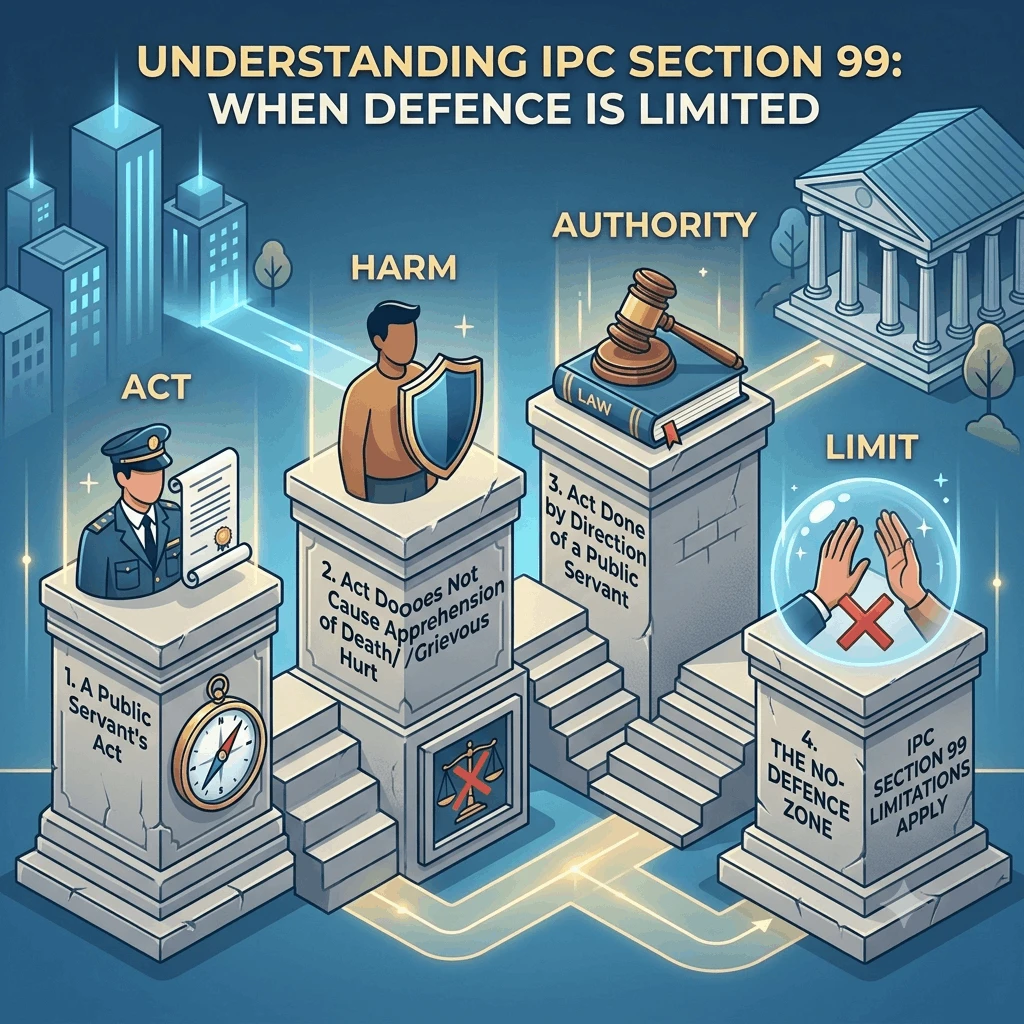
- When the relevant act was done by a public servant acting in good faith under colour of office and did not reasonably create an apprehension of death or grievous hurt.
- When such an act was done by a person acting under the direction of a public servant in similar circumstances.
- When there was sufficient time to seek protection from public authorities.
The section also provided that private defence could not be used to cause more harm than was necessary for defence.
Under the current law, these principles are contained in BNS Section 37.
Detailed Explanation
IPC Section 99 meant that the right to protect yourself or your property had legal limits.
A person could not use private defence as an excuse to cause unnecessary harm, take revenge, or resist an official act when the statutory conditions for the restriction were satisfied.
For example, if a public servant was performing an official act in good faith and the act did not reasonably create a fear of death or grievous hurt, the person generally could not claim private defence merely because they disagreed with the action.
The same principle applied where someone was acting under the direction of such a public servant.
The law also considered whether the person had enough time to seek assistance from the police or another public authority instead of using force.
Most importantly, even where private defence was available, the person could not inflict more harm than was necessary for the purpose of defence.
What Is the Current Law Corresponding to IPC Section 99?
The current provision is Section 37 of the Bharatiya Nyaya Sanhita, 2023.
| Earlier Law | Current Law |
|---|---|
| Indian Penal Code, 1860 | Bharatiya Nyaya Sanhita, 2023 |
| IPC Section 99 | BNS Section 37 |
| Acts against which there is no right of private defence | Acts against which there is no right of private defence |
| Repealed for new offences from 1 July 2024 | In force from 1 July 2024 |
The Ministry of Home Affairs notified 1 July 2024 as the date on which the BNS provisions, subject to the specified exception concerning Section 106(2), came into force.
BNS Section 37 is the corresponding provision to IPC Section 99. Government training material also maps BNS Section 37 → IPC Section 99.
What Are the Main Restrictions Under Section 37 BNS?
1. Acts by public servants acting in good faith
The right of private defence is restricted against an act done or attempted by a public servant acting in good faith under colour of office when the act does not reasonably cause an apprehension of death or grievous hurt.
The wording is important. The provision does not create an unrestricted protection for every action by a public servant. It specifically refers to the circumstances described in the section, including the requirement concerning apprehension of death or grievous hurt.
2. Acts done under the direction of a public servant
The restriction also applies to an act done or attempted under the direction of a public servant acting in good faith under colour of office, subject to the same statutory condition.
Therefore, the provision covers not only the public servant personally performing an act but also certain acts carried out under the public servant’s direction.
3. When there is time to approach public authorities
Private defence is also restricted where there is time to have recourse to the protection of public authorities.
This reflects an important distinction between an immediate threat and a situation where a person has a reasonable opportunity to obtain official assistance.
The provision therefore does not treat private defence as a substitute for approaching the police or other competent authorities whenever there is sufficient time to do so.
4. Force must not exceed what is necessary
Section 37(2) BNS states that the right of private defence does not extend to inflicting more harm than is necessary for the purpose of defence.
This means that the existence of a genuine threat does not automatically justify unlimited force.
The circumstances of the incident matter when determining whether the force used remained within the legal right of private defence.
When Does IPC Section 99 Apply?
Historically, IPC Section 99 became relevant when a person attempted to rely on the right of private defence.
The provision had to be considered along with the other provisions governing private defence, rather than being read in isolation.
For example, IPC Sections 96 and 97 recognised the right of private defence, while Section 99 placed restrictions on that right. Under the BNS, the corresponding framework begins with Sections 34 and 35, followed by Sections 36 and 37.
This is important because Section 99 was not itself a separate offence carrying a punishment. It defined limitations on an existing legal defence.
Example of Private Defence Against an Official Act
Suppose a public servant is carrying out an official function in good faith. If the act does not reasonably create an apprehension of death or grievous hurt, the person affected cannot ordinarily rely on private defence simply because they object to the official action.
However, the statutory explanation also matters.
A person is not deprived of the right of private defence against an act of a public servant unless they know or have reason to believe that the person is a public servant.
A similar rule applies to acts performed under the direction of a public servant. The person’s knowledge or reason to believe that the individual is acting under that authority is relevant under the statutory explanation.
Can Private Defence Be Used When Police Are Present?
The answer depends on the circumstances.
The rule does not mean that a person loses every possibility of private defence merely because a police officer or another public servant is involved.
The relevant question under Section 37 is whether the statutory conditions are satisfied, including whether the act reasonably creates an apprehension of death or grievous hurt and whether there was time to seek protection from public authorities.
The law therefore requires the circumstances of the particular incident to be examined rather than applying a blanket rule.
Is Private Defence the Same as Revenge?
No.
Private defence is intended to protect a person or property from a legally relevant threat. It is not a general right to punish someone after the danger has passed.
This distinction is especially important because the law limits the amount of harm that may be inflicted in exercising private defence.
If a person uses force for retaliation rather than defence, the facts may fall outside the protection of the private-defence provisions.
Does Section 99 IPC Prescribe Any Punishment?
No. IPC Section 99 did not prescribe a separate punishment.
The provision established restrictions on the right of private defence. It was part of the law governing when a person could rely on private defence as a legal justification.
Similarly, BNS Section 37 is not a standalone offence creating a punishment. It sets out circumstances in which the right of private defence is unavailable or limited.
Whether criminal liability arises in a particular case depends on the actual conduct and the other applicable provisions of criminal law.
IPC Section 99 and BNS Section 37 Comparison
| Feature | IPC Section 99 | BNS Section 37 |
|---|---|---|
| Law | Indian Penal Code, 1860 | Bharatiya Nyaya Sanhita, 2023 |
| Status | Repealed as the operative criminal code | Current provision |
| Subject | Limits on private defence | Limits on private defence |
| Public servant | Restriction subject to statutory conditions | Same core restriction |
| Direction of public servant | Covered | Covered |
| Time to approach authorities | Relevant limitation | Expressly covered |
| Excessive harm | Not protected | More harm than necessary is not permitted |
| Separate punishment | No | No standalone punishment |
The BNS reorganised the provision into numbered sub-sections and clauses, while retaining the core restrictions found in IPC Section 99.
Relation Between BNS Sections 35, 36, 37 and 38
Understanding the surrounding provisions makes Section 37 easier to understand.
- BNS Section 35: Right of private defence of the body and property.
- BNS Section 36: Right of private defence against acts of a person with the relevant incapacity or misconception covered by the section.
- BNS Section 37: Acts against which there is no right of private defence.
- BNS Section 38: Circumstances in which private defence of the body may extend to causing death.
These provisions should be read together because Section 37 contains restrictions on the broader right recognised by the preceding provisions.
Why Is IPC Section 99 Still Important?
Although IPC Section 99 is no longer the current provision for offences committed under the new criminal law framework, people continue to search for it because it was an important provision concerning private defence.
It also remains useful when reading older judgments, legal textbooks, case discussions and documents referring to the IPC.
For current legal research, however, readers should check the applicable provisions of the Bharatiya Nyaya Sanhita, 2023, particularly Section 37 for this subject.
The Ministry of Home Affairs lists the BNS among India’s new criminal laws, and the Central Government brought its provisions into force from 1 July 2024, subject to the stated exception.
Key Takeaways
- IPC Section 99 dealt with restrictions on the right of private defence.
- The corresponding current provision is Section 37 of the Bharatiya Nyaya Sanhita, 2023.
- BNS Section 37 has been in force from 1 July 2024.
- Private defence is restricted in specified situations involving public servants acting in good faith under colour of office.
- The provision also covers certain acts performed under the direction of a public servant.
- The right is restricted where there is time to seek protection from public authorities.
- Private defence does not permit a person to inflict more harm than necessary for the purpose of defence.
- Knowledge or reason to believe that a person is a public servant or is acting under such direction can be relevant under the explanations.
- IPC Section 99 itself did not create a separate offence or prescribe a punishment.
- For current law, BNS Section 37 should be consulted instead of relying only on the old IPC provision.
Frequently Asked Questions
What is IPC Section 99 in simple words?
IPC Section 99 placed limits on the right of private defence. It restricted the defence in specified situations involving public servants, their directions and cases where there was time to seek help from public authorities. It also stated that a person could not cause more harm than was necessary for defence.
Which BNS section replaced IPC Section 99?
BNS Section 37 corresponds to IPC Section 99. It deals with “Acts against which there is no right of private defence” and is part of the provisions governing private defence under the Bharatiya Nyaya Sanhita, 2023.
What does “colour of office” mean in Section 37?
“Colour of office” refers to an act performed by a public servant in their official capacity or under apparent official authority. Section 37 specifically considers acts by public servants acting in good faith under colour of office, subject to the conditions stated in the provision.
Does BNS Section 37 apply to property disputes?
Section 37 concerns the limitations on the general right of private defence. The broader right to defend property is addressed in the surrounding provisions of the BNS, including Section 35, while Sections 41 to 43 deal with circumstances concerning private defence of property.
Can a person use unlimited force in self-defence?
No. BNS Section 37(2) expressly provides that the right of private defence does not extend to inflicting more harm than is necessary for the purpose of defence. The circumstances of the particular incident determine how this limitation applies.
When did IPC get replaced by BNS?
The Bharatiya Nyaya Sanhita, 2023 came into force on 1 July 2024, replacing the IPC framework for the offences covered by the new law, subject to the statutory provisions governing commencement. The Central Government notified the commencement date in February 2024.
Conclusion
IPC Section 99 was an important limitation on the right of private defence under the Indian Penal Code. It prevented the defence from being treated as an unlimited power to use force and set out specific restrictions involving public servants, official directions, access to public authorities and unnecessary harm.
The current law should be understood through Section 37 of the Bharatiya Nyaya Sanhita, 2023, which covers the corresponding subject and has been in force since 1 July 2024.
For anyone studying an older IPC case, IPC Section 99 remains relevant to understanding the law applicable at that time. For present-day legal research, the applicable BNS provisions should be checked carefully because the date and circumstances of an incident can affect which legal framework applies.
Sources & References
- India Code – Bharatiya Nyaya Sanhita, 2023: https://www.indiacode.nic.in/
- Legislative Department, Ministry of Law and Justice: https://legislative.gov.in/
Explore Question Categories

Founder & Publisher, Law Act
Prabh Kalsi is the founder and publisher of Law Act. He manages the website’s content research, organization, editing, and publishing. Law Act’s legal content is developed using publicly available legislation, government resources, official publications, and other authoritative sources. The website provides general legal information for educational and informational purposes and does not provide personalized legal advice.