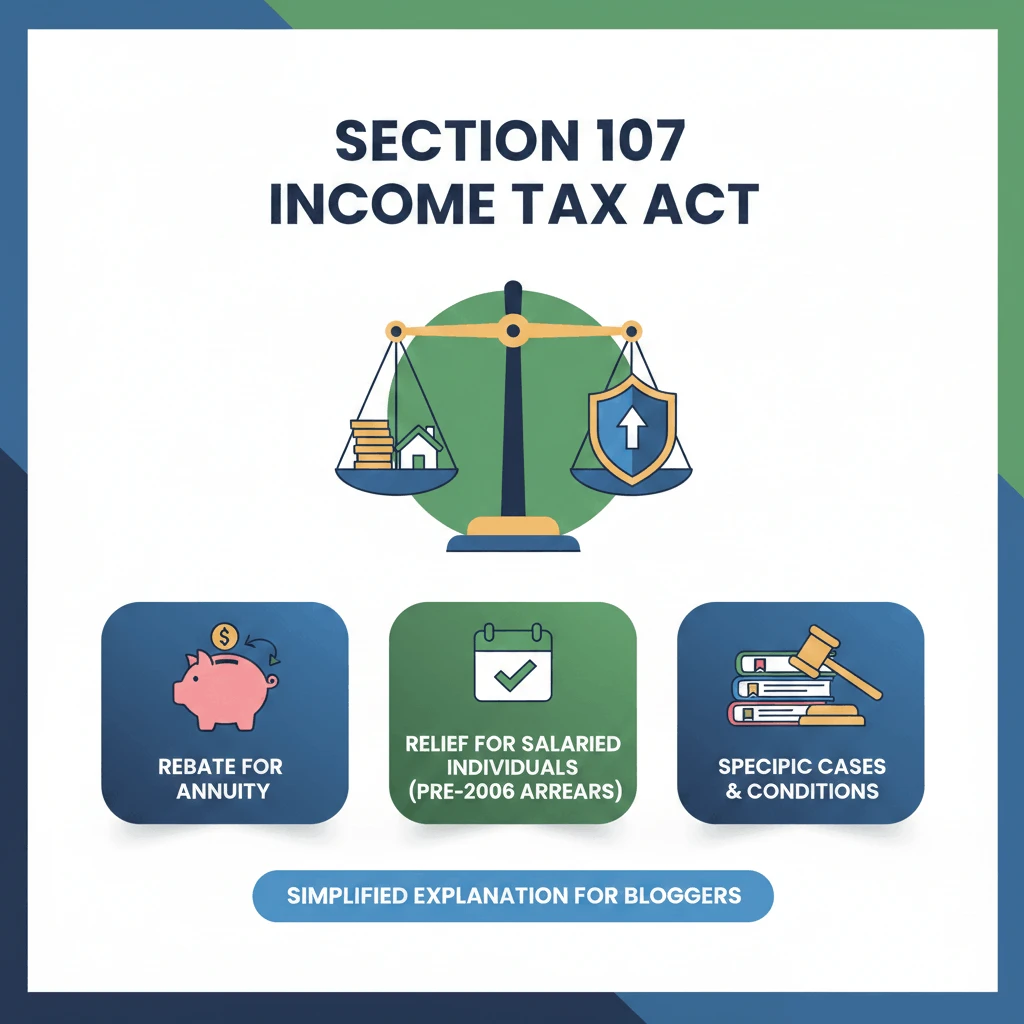
Section 107 of the Income Tax Act is a lesser-known but important provision that deals with income arising from assets transferred under revocable arrangements. Many taxpayers focus only on salary, business income, capital gains, and deductions, but sections like 107 help the tax department determine who is actually responsible for paying tax when assets are transferred with certain conditions.
This section becomes relevant when a person transfers an asset to someone else but still keeps the power to take it back or control its use. In such cases, the income generated from that asset may still be taxed in the hands of the original owner instead of the transferee. This rule prevents misuse of asset transfers for tax saving purposes.
Understanding Section 107 of Income Tax Act is useful for taxpayers, consultants, and business owners who deal with trusts, asset transfers, and structured financial arrangements.
What is Section 107 of Income Tax Act?
Section 107 of Income Tax Act explains how income is treated when it arises from a revocable transfer of assets. A revocable transfer means the original owner has the right to cancel the transfer or regain control over the asset in the future.
Under this section, if a person transfers an asset but keeps the power to reverse the transfer, then the income from that asset will still be taxed in the hands of the transferor (original owner), not the person who received it.
This rule exists to stop people from transferring assets temporarily to family members or related entities just to reduce their tax liability.
The law looks at the real control and power, not just the paperwork of transfer.
Meaning of Revocable Transfer Under Section 107 of Income Tax Act
To understand Section 107 of Income Tax Act properly, it is important to know what a revocable transfer is.
A transfer is considered revocable when:
- The transfer can be cancelled by the original owner
- The asset can come back to the original owner
- The original owner keeps control over income or asset use
- There is a clause allowing reassumption of power directly or indirectly
Even if the transfer looks complete on paper, it may still be treated as revocable if control is not fully given up.
The tax department checks the conditions attached to the transfer agreement before deciding taxability.
Why Section 107 of Income Tax Act is Important
Section 107 of Income Tax Act is important because it prevents tax avoidance through artificial transfers.
Without this provision, a high-income person could transfer assets to someone in a lower tax bracket, show the income in their name, and reduce total tax liability. This would create unfair tax advantages.
This section ensures:
- Income is taxed where control actually exists
- Artificial transfers do not reduce tax unfairly
- Ownership substance is considered over form
- Temporary transfers are not misused
It supports fair taxation and protects government revenue.
Key Features of Section 107 of Income Tax Act
Here are the major points that define the working of Section 107:
| Feature | Explanation |
|---|---|
| Type of transfer | Applies to revocable transfers |
| Asset coverage | Any income-generating asset |
| Control factor | Transferor keeps power or control |
| Tax treatment | Income taxed to original owner |
| Purpose | Prevent tax avoidance |
| Agreement review | Terms and conditions are examined |
These features show that the section focuses on control and reversibility rather than just transfer documents.
How Income is Taxed Under Section 107 of Income Tax Act
When Section 107 of Income Tax Act applies, the income from the transferred asset is included in the total income of the original owner.
This means:
- Rental income from transferred property is taxed to transferor
- Interest from transferred investments is taxed to transferor
- Business income from transferred asset is taxed to transferor
Even if another person receives the income in their bank account, tax liability may still remain with the original owner if the transfer is revocable.
The assessing officer checks the transfer terms before deciding.
Examples to Understand Section 107 of Income Tax Act
Examples help make the concept clearer.
Suppose a person transfers a property to a relative but includes a clause that allows taking it back anytime. The relative receives rental income from the property.
Under Section 107 of Income Tax Act, this rental income can still be taxed in the hands of the original owner because the transfer is revocable.
Another example is when investments are transferred to a trust, but the creator of the trust keeps authority to change terms or reclaim assets. The income from such investments may still be taxed to the creator.
These cases show that real control matters more than names on paper.
Difference Between Revocable and Irrevocable Transfer
Understanding the difference between revocable and irrevocable transfer is necessary to apply Section 107 correctly.
| Basis | Revocable Transfer | Irrevocable Transfer |
|---|---|---|
| Cancellation | Can be cancelled | Cannot be cancelled |
| Control | Control retained | Control fully given |
| Asset return | Possible | Not possible |
| Tax effect | Income taxed to transferor | Income taxed to transferee |
| Section 107 impact | Applies | Does not apply |
Only revocable transfers fall under Section 107 of Income Tax Act.
Situations Where Section 107 of Income Tax Act May Apply
This section may apply in several practical situations.
It can apply in:
- Conditional property transfers
- Trusts with reversal powers
- Investment transfers with control clauses
- Agreements with reassumption rights
- Asset transfers among related parties with hidden conditions
Tax officers carefully examine documentation and side agreements to detect revocable elements.
Even indirect powers can trigger this section.
Documents Checked Under Section 107 of Income Tax Act
To apply Section 107, tax authorities review several documents.
They may check:
- Transfer deed
- Trust deed
- Agreement clauses
- Side letters
- Control rights
- Power of revocation terms
- Reassignment conditions
If any clause shows that the original owner can take back control or asset benefits, the transfer may be treated as revocable.
Full disclosure and proper drafting are very important.
Compliance and Precautions for Taxpayers
Taxpayers should be careful while transferring assets to avoid unintended tax consequences under Section 107 of Income Tax Act.
Important precautions include:
- Draft transfer agreements clearly
- Avoid hidden reversal clauses
- Do not retain control if claiming full transfer
- Ensure legal ownership truly changes
- Take professional advice before structuring transfers
- Maintain proper documentation
If a transfer is meant to be permanent, it should not include any revocation rights.
Good documentation reduces disputes and tax notices.
Section 107 of Income Tax Act and Anti-Avoidance Principles
Section 107 supports the broader anti-avoidance principles of tax law. The idea is that tax should be based on real ownership and benefit, not artificial arrangements.
Tax law often looks beyond form to substance. If someone appears to transfer an asset but still enjoys its benefits and controls it, the tax responsibility remains with that person.
This approach ensures fairness in taxation and discourages misuse of legal structures.
Conclusion
Section 107 of Income Tax Act deals with income from assets transferred under revocable arrangements. If a person transfers an asset but keeps the power to cancel the transfer or control the asset, then the income from that asset is still taxed in their hands.
The section focuses on real control rather than just legal transfer papers. It prevents tax avoidance through temporary or conditional asset transfers. It is especially relevant in cases involving trusts, conditional property transfers, and structured agreements.
Taxpayers planning asset transfers should carefully review agreement terms and ensure transfers are genuine if they want income to be taxed in the hands of the new owner. Proper legal drafting and tax advice play a major role in correct compliance.
Also Read:
- Section 106 of Income Tax Act
- Section 105 of Income Tax Act
- Section 104 of Income Tax Act
- Section 103: Income Tax Act
- Section 102 of the Income Tax Act
Frequently Asked Questions
What is Section 107 of Income Tax Act?
Section 107 explains tax rules for income from assets given under a revocable transfer. If the owner can take the asset back, the income is still taxed in the original owner’s name.
What is a revocable transfer in tax law?
A revocable transfer is when the asset transfer can be cancelled later. If the giver keeps control or reversal rights, the transfer is treated as revocable for tax purposes.
Who pays tax under Section 107 rules?
Tax is paid by the original owner of the asset if the transfer is revocable. Even if someone else receives the income, tax liability may still stay with the transferor.
Does Section 107 apply to property transfers?
Yes, it can apply if property is transferred with a clause to take it back. Rental or other income may still be taxed to the original owner.
How to avoid issues under Section 107?
Make sure the asset transfer is permanent and without reversal rights. Use clear legal documents and avoid keeping control if you want income taxed to the new owner.

Founder & Publisher, Law Act
Prabh Kalsi is the founder and publisher of Law Act. He manages the website’s content research, organization, editing, and publishing. Law Act’s legal content is developed using publicly available legislation, government resources, official publications, and other authoritative sources. The website provides general legal information for educational and informational purposes and does not provide personalized legal advice.