Section 104 of the Income Tax Act is an important provision that deals with undistributed income of certain companies and the tax implications related to it. Many business owners and taxpayers are not fully aware of this section because it mainly applies to specific company situations rather than individual taxpayers. However, understanding it is useful if you run or manage a closely held company.
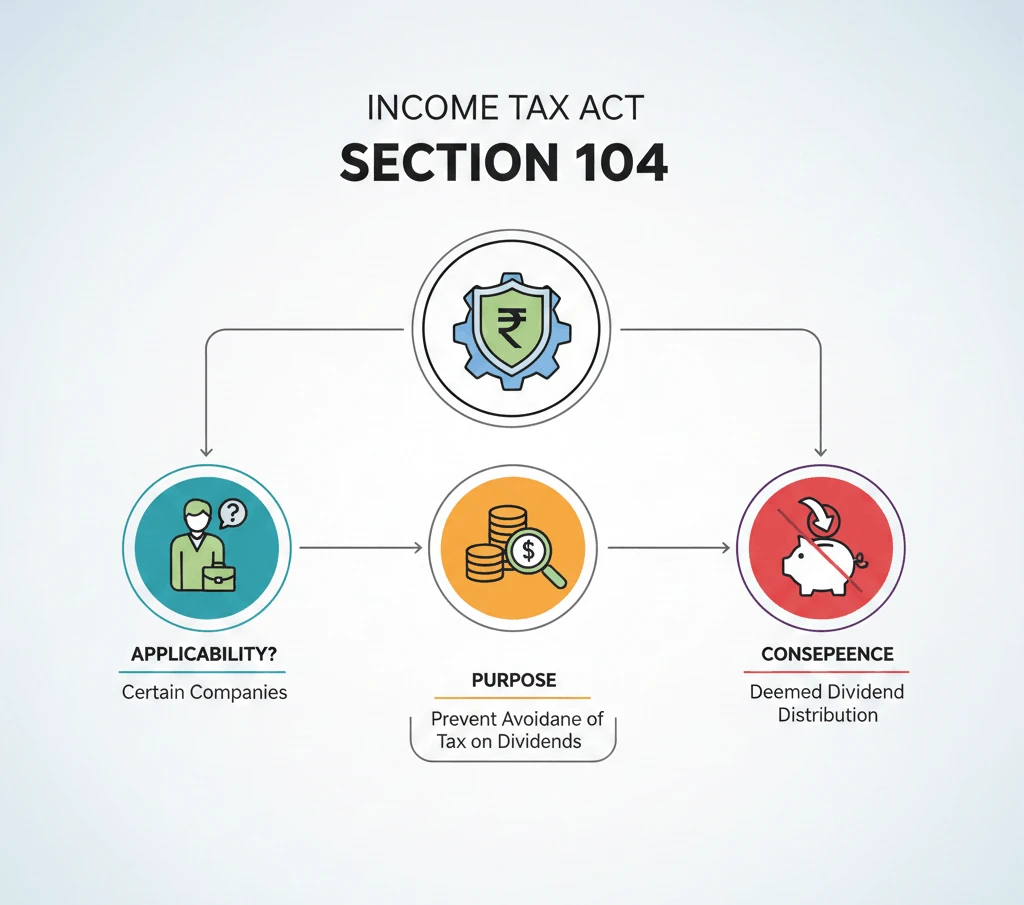
The idea behind this section is to prevent companies from avoiding dividend distribution just to help shareholders avoid higher personal tax on dividend income. If a company keeps accumulating profits without valid business reasons and does not distribute dividends, the tax authority may step in.
This section mainly targets closely held companies where a small group of shareholders control decisions.
Why Section 104 Was Introduced
The government introduced Section 104 to stop tax avoidance through profit hoarding.
Earlier, some companies used to retain profits instead of distributing dividends. This helped shareholders delay or reduce their personal tax burden. By keeping money inside the company, they could avoid higher dividend taxation.
To control this practice, Section 104 gave power to the tax officer to:
- Review company profits
- Check dividend distribution
- Decide if profits are being unfairly retained
- Impose additional tax if needed
So the main purpose of Section 104 is to ensure fair tax collection and discourage unnecessary profit retention.
When Does Section 104 Apply
Section 104 applies when certain conditions are met. It is not automatically applied to every company. The tax officer examines facts before using this section.
It may apply when:
- A company earns profits in a financial year
- The company does not distribute enough dividends
- Profit retention is considered unreasonable
- There is no strong business justification for keeping profits
- The company is closely held or controlled by few persons
If these conditions are satisfied, the Assessing Officer may decide that the company should have distributed more profits as dividends.
Meaning of Closely Held Company Under This Context
A closely held company is generally a company where:
- Shares are not widely available to the public
- Control is in the hands of a small group
- Shareholders are related or connected
- Decision making is centralized
Such companies have more flexibility in deciding dividend distribution. Because of this flexibility, profit hoarding risk is higher. That is why Section 104 focuses more on such companies.
What is Undistributed Income
Undistributed income means profits earned by the company that are not paid out as dividends to shareholders.
After earning profit, a company has two main options:
- Distribute profits as dividends
- Retain profits for business use
Retaining profits is not wrong. In fact, many companies reinvest profits for growth. But if profits are retained without genuine business need, then Section 104 may come into action.
How Tax Officer Evaluates the Situation
The Assessing Officer does not apply Section 104 blindly. A detailed evaluation is done.
The officer checks:
- Total profits of the company
- Amount of dividend distributed
- Business needs and expansion plans
- Financial obligations
- Reserve requirements
- Past dividend history
- Industry conditions
If the officer believes that the company could have reasonably distributed more dividend, then additional tax may be imposed on undistributed profits.
Reasonable Cause for Not Distributing Dividend
Not distributing dividend is acceptable if there are valid reasons. Section 104 does not punish genuine business decisions.
Some acceptable reasons include:
- Business expansion plans
- New project investments
- Loan repayments
- Working capital needs
- Financial uncertainty
- Industry downturn
- Future capital expenditure
If the company can prove that profit retention was necessary for business growth or stability, Section 104 may not be applied.
Additional Tax Under Section 104
If the tax officer decides that dividend distribution was unreasonably low, then the company may have to pay additional tax on undistributed income.
This additional tax is separate from normal corporate tax.
It acts like a penalty tax for not distributing profits fairly. The rate and calculation depend on the rules applicable during the relevant assessment year.
The goal is not punishment but to remove the tax benefit of profit hoarding.
Simple Example to Understand Section 104
Let us understand with a simple example.
Suppose a private company earns a profit of Rs. 1 crore in a year.
After reviewing financials, it is clear that:
- Business has stable cash flow
- No major expansion planned
- No heavy debts
- Enough reserves already exist
But the company distributes only Rs. 2 lakh as dividend and keeps the rest without valid reason.
In such a case, the Assessing Officer may say that dividend distribution is too low. Section 104 may be applied and additional tax may be charged on remaining undistributed profit.
Key Factors Considered by Tax Authority
The tax authority considers several practical factors before invoking Section 104.
Here is a helpful summary table:
| Factor | What Officer Checks |
|---|---|
| Profit Level | How much net profit is earned |
| Dividend Paid | Percentage of profit distributed |
| Business Needs | Whether funds are needed for operations |
| Expansion Plans | Future investment requirements |
| Financial Health | Cash flow and reserves |
| Industry Risk | Market uncertainty |
| Past Pattern | Previous dividend history |
This shows that the decision is not random. It is based on financial and business reality.
Companies Not Targeted by Section 104
Section 104 is generally not meant for:
- Widely held public companies
- Companies regularly distributing dividends
- Companies with genuine reinvestment needs
- Companies under financial stress
- Startups reinvesting profits
Such companies usually have valid business reasons for profit retention.
Relationship With Dividend Distribution Rules
Section 104 is closely connected with dividend policy.
Companies must balance:
- Shareholder expectations
- Business growth needs
- Tax implications
- Reserve requirements
A well-planned dividend policy helps avoid tax disputes and ensures compliance.
Companies should document reasons if dividends are kept low. Proper documentation helps defend decisions during tax assessment.
Importance for Company Directors and Owners
Company directors and promoters should understand Section 104 clearly because dividend decisions are often taken at board level.
They should:
- Record reasons for profit retention
- Maintain board meeting minutes
- Prepare financial justification
- Plan dividend policy
- Consult tax professionals
Proper planning helps avoid additional tax burden.
Compliance and Best Practices
To stay safe regarding Section 104, companies should follow good practices.
Best practices include:
- Maintain transparent accounts
- Document business plans
- Justify retained earnings
- Distribute reasonable dividends when possible
- Keep written financial projections
- Take professional tax advice
These steps reduce risk of disputes with tax authorities.
Practical Impact Today
In modern tax structure, dividend taxation rules have evolved, and several anti-avoidance measures already exist. Because of that, Section 104 is not commonly invoked in routine cases today.
However, it still remains an important legal provision and may apply in special situations where profit hoarding appears intentional.
That is why knowledge of this section remains useful for private company owners and tax planners.
Conclusion
Section 104 of the Income Tax Act is about tax on unreasonable retention of company profits. It allows the tax department to charge additional tax if a company does not distribute enough dividends without valid business reason.
It mainly applies to closely held companies where profit distribution decisions are controlled by a few people. The goal is to prevent tax avoidance through dividend suppression.
If profit retention is justified by business needs, then there is no problem. But if profits are held back only to reduce shareholder tax, the law may step in.
Also Read:
- Section 102 of the Income Tax Act
- Section 101 of the Income Tax Act
- Section 100 of the Income Tax Act
- Section 10 of the Income Tax Act
- Section 1 of the Income Tax Act
Frequently Asked Questions
What is Section 104 of Income Tax Act?
Section 104 of the Income Tax Act allows the tax department to charge extra tax on certain companies if they do not distribute enough profit as dividends. It mainly targets closely held companies that keep profits without valid business reasons.
When does Section 104 apply to a company?
Section 104 applies when a company earns good profit but distributes very low or no dividend without proper justification. If profit is kept only to reduce shareholder tax and not for business needs, the tax officer may apply this section.
Does Section 104 apply to all companies?
No, Section 104 does not apply to all companies. It mainly applies to closely held companies controlled by a small group of shareholders. Public companies and businesses with genuine reinvestment or expansion needs are generally not targeted under this rule.
What is undistributed income under Section 104?
Undistributed income means company profit that is not paid to shareholders as dividends. If a company keeps most of its profit and cannot show valid business reasons like expansion, reserves, or debt repayment, it may be questioned under Section 104.
Can a company keep profits without dividend?
Yes, a company can keep profits without paying dividends if there are genuine business reasons. For example, expansion plans, new projects, loan repayment, or working capital needs are valid reasons. Proper records and financial proof help avoid tax issues.

Founder & Publisher, Law Act
Prabh Kalsi is the founder and publisher of Law Act. He manages the website’s content research, organization, editing, and publishing. Law Act’s legal content is developed using publicly available legislation, government resources, official publications, and other authoritative sources. The website provides general legal information for educational and informational purposes and does not provide personalized legal advice.